divendres, 27 de març del 2015

Egypt sent warships to Yemen's Gulf of Aden: Official*


Two gunboats and two destroyers have crossed the Suez Canal en route to the Red Sea to help secure the Gulf of Aden and the Bab al-Mandeb Strait

Egypt has sent four naval vessels to Yemen's strategic Bab al-Mandab Strait amid a Saudi-led offensive against Yemen's Shiite Houthi group, an Egyptian official said Thursday.

"Two gunboats and two destroyers have crossed the Suez Canal en route to the Red Sea to help secure the Gulf of Aden and the Bab al-Mandeb Strait," a source from Egypt's Suez Canal Authority told The Anadolu Agency.

Earlier Thursday, the Egyptian government announced its "political and military" support for airstrikes launched by Saudi Arabia and several Arab countries – including most of the Gulf States – on Houthi positions in Yemen.

Several Arab states, all of them allies of Washington, have joined the Saudi-led military offensive, which kicked off with a string of overnight airstrikes against Houthi positions and assets in Yemen, including some in capital Sanaa.

Predominantly-Sunni Saudi Arabia said the strikes were in response to calls by Gulf-backed Yemeni President Abd Rabbuh Mansour Hadi for military intervention in Yemen to "save the people from the Houthi militias."

Fractious Yemen has descended into violence since last September, when the Houthis overran capital Sanaa, from which they have sought to extend their influence to other parts of the country.

Some Gulf countries suspect that the Houthi insurgency is supported by Shiite Iran.

* Notícia publicada per Anadolu Agency. De moment és de les poques informacions que tenim sobre els moviments navals egipcis. Malgrat que Egipte no disposi de destructors, creiem que el terme es pot haver emprat per algun problema d'interpretació entre les classificacions de naus locals i internacionals.


dijous, 26 de març del 2015

Acords del Consell d'Administració del Port de Barcelona del mes de març*

Atorgada la concessió de la nova terminal del grup ICL al Port de Barcelona amb una inversió de 69 MEUR (entre pública i privada)

El Consell d’Administració del Port de Barcelona celebrat avui ha acordat atorgar a l’empresa Tráfico de Mercancías, S.A. (TRAMER) una concessió administrativa al moll Álvarez de la Campa per a la construcció i explotació d’una terminal privada de sals sòdiques i potàssiques procedents de les mines de Súria i Sallent/Balsareny.

TRAMER, la filial portuària del grup ICL, havia sol·licitat la construcció d’unes noves instal·lacions per tal de poder concentrar tot el seu tràfic marítim en el Port de Barcelona i fer front als augments de càrrega previstos per als propers anys. En aquest sentit, donat que la terminal i espais dedicats actualment a aquesta activitat al moll Contradic Nord no estan dimensionades per donar servei a l’evolució d’aquest tràfic al Port, ni als volums que preveu la companyia a mig termini, era necessari buscar una nova ubicació. Amb la nova concessió, TRAMER podrà acollir l’increment de més del 70% del tràfic de tones i més del doble d’escales que suposa unificar el seu tràfic a Barcelona, a més de poder gestionar un volum de tones superior a l’actual.

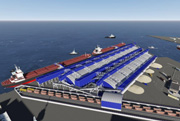
La nova terminal de càrrega al moll Álvarez de la Campa tindrà capacitat per a 4 milions de tones de producte, ocuparà una superfície de 7 hectàrees i disposarà de 14 metres de calat, que permetran la càrrega de vaixells de fins a 60.000 tones. El projecte inclou la construcció d’un edifici d’oficines, 2 magatzems i una terminal ferroviària interior, amb 4 vies en ample mètric i UIC, que permetrà posicionar 2 trens simultàniament. El pressupost d’inversió del projecte bàsic és d’aproximadament 57 milions d’euros més IVA, i s’engloba dins del desenvolupament del Pla Phoenix del grup ICL a Catalunya.

El Port de Barcelona invertirà 12 MEUR en obres complementàries

A més d’aquesta inversió del grup ICL en la nova terminal, el Port de Barcelona invertirà 12 milions d’euros aproximadament en la reforma dels espais que acolliran la infraestructura, especialment en el reforçament del moll i l’ampliació del calat; l’ampliació de la infraestructura ferroviària en ample mètric i internacional fins a la futura terminal; i la remodelació i urbanització de la xarxa viària que donarà accessibilitat a la instal·lació. Aquestes actuacions permetran a TRAMER disposar de 600 metres de línia d’atracada al Port de Barcelona.

D’altra banda, la nova concessió a TRAMER, per un període de 35 anys prorrogables, afecta la zona d’aparcament de vehicles de de la concessió veïna, de la qual són titulars les empreses Remolcadors de Barcelona, S.A. i SAR Remolcadors, S.L. El Consell ha aprovat també, doncs, modificar la superfície corresponent a aquesta concessió i realitzar les obres necessàries per a restituir l’aparcament que li correspon i construir un vial d’accés a les noves instal·lacions de TRAMER.

A més, el Consell ha valorat molt positivament que, com a conseqüència del trasllat d’ubicació d’aquesta empresa, el parament nord del moll Contradic queda alliberat per a altres usos. Donat el creixement del tràfic RO-PAX (mercaderia rodada i passatgers) al Port i que els espais alliberats són contigus als que ja estan destinats a aquesta activitat (molls de Barcelona, Sant Bertran, Ponent i Costa), es considera adequat dedicar en un futur aquest moll a aquest tipus de tràfic.

* Notícia publicada al web del Port de Barcelona. Unes dades interessants, no només en elles mateixes, sinó per les notícies alarmistes sobre possibles desinversions a Catalunya.


dimecres, 25 de març del 2015

Japan’s Biggest Warship Since World War II Enters Service*

(Bloomberg) -- Japan’s armed forces took control of their biggest warship since World War II, underscoring Prime Minister Shinzo Abe’s drive to strengthen the nation’s military.

The Izumo, a 19,500-ton helicopter carrier, will improve the Self-Defense Forces’ capacity to deal with submarines, Defense Minister Gen Nakatani told reporters after inspecting the ship at the Japan Marine United Corp. shipyard in the port city of Yokohama, near Tokyo. The 248-meter (814-foot) vessel can carry 470 personnel and as many as nine helicopters.

Since taking office in 2012, Abe has reversed a decade-long decline in defense spending, lifted a ban on arms exports and reinterpreted the pacifist constitution to allow Japan to defend other countries. The defense push is adding to tensions with China over a territorial dispute that threatens the trade relationship between Asia’s two largest economies.

“As well as having the capacity to search for submarines itself, it will be able to deal with submarines over a larger area as it’s equipped with a lot of helicopters,” Nakatani said, adding that he wasn’t referring to any specific country.

In May 2013, Japan said it detected submarines navigating under water close to territorial waters near Okinawa and Kagoshima prefectures. The government is seeking to toughen the measures Japan can legally take under its pacifist constitution in the event of a “gray zone” situation that doesn’t amount to an armed attack on the nation.

A second ship of the same size and specifications is set to be introduced in early 2018.

The vessels are also capable of carrying Bell Boeing V-22 Osprey tiltrotor aircraft. Ospreys can take off and land like a helicopter and fly long distances like a fixed-wing plane, giving the ships some of the capabilities of a small aircraft carrier.

Nakatani stressed the Izumo’s capacity to help out in disaster relief and peace-keeping operations.

“China has aircraft carriers,” Nakatani said. “The Izumo isn’t designed to carry fixed-wing aircraft,” he said, adding that Japan wasn’t thinking of operating it like an aircraft carrier.
* Notícia publicada a Bloomberg. Ja havíem fet esment de l'Izumo anteriorment i, si bé els comentaris sobre les seves capacitats ASW són certes, també ho és que no només serveixen per això. Són un portaavions VTOL en potència o, com ja apunta l'article, una plataforma per assalts verticals.


dissabte, 24 de gener del 2015

The US Navy’s New Surface Warfare Strategy: ‘Distributed Lethality’*

By Franz-Stefan Gady
January 16, 2015

The United States Navy plans to re-organize and re-equip its surface fleet by grouping ships into small surface action groups and increasing the number of anti-ship weapons on more platforms. The U.S. Navy calls this tactical shift “distributed lethality.”

Breaking Defense quotes, Rear Admiral Peter Fanta and his rough summary of the concept of “distributed lethality”: “If it floats, it fights, that’s ‘distributed lethality’ (…) Make every cruiser, destroyer, amphib, LCS, a thorn in somebody else’s side.” Fanta, the director for Surface Warfare on the Navy staff, spoke at the annual Surface Navy Association National Symposium, which took place in Arlington, Virginia this week.

Vice Admiral Thomas Rowden, commander of Naval Surface Forces, further elaborated on the tactical shift at the symposium, as military.com reports: “We’re going to up-gun as many existing platforms as we can to achieve more total lethality.” Speakers at the symposium noted that the Navy will overhaul ships in service with low-cost weapon and sensor upgrades including Aegis destroyers, cruisers, supply ships, and littoral combat ships. However, more details on the specifics of this reshuffle will only emerge when the president’s 2016 budget request comes out next month.

In 2014, the U.S. Navy had to endure politically motivated budget cuts and a hiring freeze delaying retrofits and maintenance of Navy vessels. This trend will likely continue in 2015. “Budget is coming down,” Fanta emphasized. This should be placed in perspective: In 2014, the U.S. Navy deployed tonnage equal to that of the sixteen next-largest navies combined.

The tactical “distributed lethality” shift is largely due to the increasing anti-access/area denial capabilities of the armed forces of China and Iran but also Russia. In an article in Proceedings Magazine, published by the U.S. Naval Institute, Vice Admiral Rowden, Rear Admiral Fanta, and Rear Admiral Peter Gumataotao, outlined the reasons behind the re-organization of the surface fleet by arguing that, “the shift to the offensive responds to the development of increasingly capable A2/AD weapons and sensors designed specifically to deny U.S. naval forces the freedom of maneuver necessary to project power.(…) Adversaries who counter this advantage diminish the deterrent value of forward-deployed forces and negatively impact the assurances we provide to friends and allies. A shift to the offensive is necessary to ‘spread the playing field,’ providing a more complex targeting problem while creating more favorable conditions to project power where required.”

As of now, the U.S. Navy still lacks an adequate long-range, anti-surface weapon to implement a re-organization of the surface fleet based on the “distributed lethality” idea. One possible future acquisition could be the Norwegian Kongsberg Naval Strike Missile, yet no decisions on the procurement of new weapon systems has been made as of now. The authors of the Proceeding Magazine article also outline additional requirements for their vision, such as improved intelligence/surveillance/reconnaissance and data relay, low-cost medium range strike weapons, and new railguns.

This new tactical reorganization is a clear indication that the days when the U.S. Navy’s surface fleet just served as air defense elements for carrier strike groups, floating bastions for ballistic missile defense, and strike platforms for land attacks are over. It remains to be seen how the Chinese and Russian navies will respond to the shift.

* Article publicat a The Diplomat. Recomanem la lectura d'aquest article, i dels seus enllaços, doncs la US Navy fa temps que necessita redistrubuïr la seva potència de foc. Per descomptat, cal alliberar destructors i creurers de les tasques de "pantalla" als CSG, però es l'exessiva concentració de la potència de foc en un determinat tipus de naus, genera vulnerabilitats.