dilluns, 10 d’agost del 2015
China Unveiled its First VLFS Project Similar to the US Military Mobile Offshore Base Concept*
dimarts, 14 d’abril del 2015
The Rapid Expansion of China’s Navy in Five Charts*
dimecres, 25 de març del 2015
Japan’s Biggest Warship Since World War II Enters Service*
dissabte, 24 de gener del 2015
The US Navy’s New Surface Warfare Strategy: ‘Distributed Lethality’*
January 16, 2015
dimarts, 23 de desembre del 2014
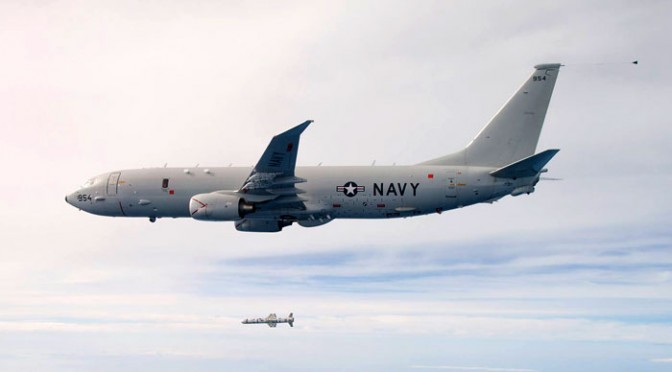
SEIZING THE ASUW INITIATIVE WITH LAND BASED PATROL AIRCRAFT*
dijous, 11 de desembre del 2014
PLA's new Type 1130 CIWS can intercept Mach 4 missiles*
Russian media has reported that China's latest indigenous Type 1130 close-in weapon system can fire 10,000 rounds per minute and destroy 90% of hypersonic missiles traveling at a speed four times the speed of sound, reports our Chinese-language sister paper Want Daily.
The system, which is the third-generation of the close-in weapon system developed by China, was recently spotted being installed on a PLA Type 054A frigate.
Compared to its seven-barreled Type 730 predecessor, the Type 1130's Gatling-type gun has the same 30 mm caliber but the number of barrels increased to 11. While the Type 730 has only one magazine which contains 250 rounds, the latest gun carries two magazines each containing 640 rounds. The design allows the gun to fire over 10,000 rounds per minute and raise its hit rate against missiles traveling at Mach 4 to 90%, according to the Russian media outlet cited.
Though the mammoth rotary cannon has been placed on a Type 054A frigate that only has around a 4,000-ton displacement, the Russian media claimed the system should be deployed on ships with a displacement over 12,000 tons due to its size and weight as well as the amount of electricity it consumes.
The system has been installed on both sides of China's first aircraft carrier, the Liaoning. The Russian media predicted that the system will be deployed on the country's latest guided missile destroyer, the Type 055, in the future.
The Type 1103 will not completely replace the Type 730. Destroyers such as the Types 052, 052B, 052C, 052D and 051C will continue using the latter.
divendres, 5 de desembre del 2014
Coast Guard Admiral: LCS ‘an Incredible Ship’ for Drug Interdiction*
dimarts, 14 d’octubre del 2014
PLA looks to add more Type 052D destroyers
dissabte, 11 d’octubre del 2014
Australia receives first Canberra-class LHD
The Australian government has accepted the first of its two Canberra-class landing helicopter docks (LHDs) from BAE Systems, the vessel's prime contractor said in a statement on 8 October.
The ship will remain at BAE Systems' Williamstown shipyard in Melbourne before its commissioning at Sydney later in 2014, the statement added. It is due for delivery to the Royal Australian Navy (RAN) on 28 November.
Canberra , which is based on Navantia's Juan Carlos I aircraft carrier design, completed its final contractor sea trials in late August.
Work is progressing on second ship Adelaide , which arrived in Australia for outfitting in Bé bé ja tu after being transported from Navantia's Ferrol yard in Spain. Adelaide is scheduled to begin sea trials in the second quarter of 2015, with delivery expected in 2016.
Meanwhile, Australia has begun the process of exercising an option on two more Boeing C-17A Globemaster III strategic airlifters in addition to the six operated by 36 Squadron out of RAAF Base Amberley in Queensland.
Defence Minister David Johnston said in a statement that, if exercised, the two extra Globemasters would "significantly enhance the Royal Australian Air Force's [RAAF's] capacity for operational tasks, disaster relief, and humanitarian assistance in our region and around the world".
"The ability to rapidly react and move large elements of Australia's support systems over long distances during these times has highlighted the need for us to have a good sized fleet," he added.
Australia initially purchased four C-17s under Project AIR 8000 Phase 3 using the US Foreign Military Sales (FMS) programme, with the first aircraft delivered in December 2006. The last of the six in service was delivered to the RAAF in 2012.
* Notícia publicada per Jane's Information Group. Austràlia continua ampliant la seva capacitat de projecció de força, consolidant-se com a element estabilitzador al Pacífic i l'Índic
dissabte, 20 de setembre del 2014
U.S. Submarines: Run Silent, Run Deep... On Diesel Engines?*
"Underway on nuclear power", radioed the skipper of USS Nautilus in 1955, after taking history's first nuclear-powered attack submarine to sea for the first time. Nautilus's maiden cruise left an indelible imprint on the navy. Her success, cheered on by the likes of Admiral Hyman Rickover, the godfather of naval nuclear propulsion, helped encode the supremacy of atomic power in the submarine force's cultural DNA.
Things were never the same after that. America built its last diesel-electric sub, once the state of the art, not long after Nautilus took to the sea. Not since 1990 has the U.S. Navy operated conventionally powered boats. It's been longer than that since they were frontline fighting ships. For a quarter-century, then, it's been all nukes, all the time. No U.S. shipbuilder even constructs diesel boats nowadays.
That was then. Now may be the time to break up the nuclear monopoly. To wit, imagine permanently forward-deploying a squadron of diesel attack boats, or SSKs, to likely hotspots. Such a force would expand America's silent service, reversing the ongoing slide in numbers of hulls. It would do so at reasonable cost in this age of budgetary stress. A standing East Asia squadron would be close to the action. Likely based in Japan and Guam, it would amplify the U.S.-Japanese fleet's prowess vis-á-vis China's navy and merchant marine. It would empower Washington and Tokyo to deny China access to offshore waters without committing the whole fleet of U.S. nuclear-powered boats to the endeavor. And in the process it would open up new vistas for building and reinforcing alliances.
Greater numbers, middling cost, a heavier punch in battle. That's a major contribution from such humble craft. U.S. submariners' diesel-propelled past could be, and should be, part of their future.
There's nothing new or especially radical about conventional U.S. subs' prowling the Western Pacific deep. They did so to devastating effect during World War II. For instance, the Philippine Islands was home to the largest concentration of U.S. submarines in the Pacific on the eve of hostilities. U.S. commanders squandered a golden opportunity to run wild against transports carrying Japanese troops to invade the Philippines. But their missed opportunity doesn't detract from subs' potential to confound opponents amid Asia's intricate nautical terrain. It's an exception that proves the rule.
And indeed, American submarines vindicated their potential in ensuing years. U.S. Pacific Fleet boats were among the first vessels to return to Asia following the Japanese raid on Pearl Harbor. Ordered to sea while the battle line was still ablaze at Ford Island, they helped dismember an island empire. Empires like Japan's depend on ships to ferry all manner of warmaking materiel—raw materials, foodstuffs, finished goods—hither and yon. Take away seaborne movement and you cut the lineaments binding the imperial enterprise together.
The submarine campaign grew more and more effective as the U.S. offensives undulated across the Central and South Pacific. U.S. Navy, Marine and Army amphibious forces wrested outer islands from Japan, letting the navy position, maintenance and logistics outposts closer to the foe. Submarine tenders—floating repair and supply depots for all intents and purposes—staged support operations westward of Hawaii. As the transpacific campaigns progressed, boats wasted less time transiting to and from assigned hunting grounds. They spent more time strewing the seafloor with enemy merchantmen and men-of-war.
Forward bases, then, offset the tyranny of distance—allowing the submarine force to mount a stifling presence in Asian waters. Wartime prime minister General Hideki Tōjō catalogued submarine warfare among three critical determinants of Japan's defeat—high praise from someone in a position to know.
And afterward? Ravaged by undersea combat during World War II, Japan built an impressive submarine force of its own to help prosecute the Cold War. Japan Maritime Self-Defense Force (JMSDF) diesel boats turned geography to advantage, lurking in and around the straits that pierce Asia's offshore island chains. Crews monitored and encumbered east-west movement between the China seas and the Western Pacific. Soviet skippers often balked at attempting the passage. The JMSDF, in short, forged itself into a lethal weapon for a cold war beneath the waves.
*Article complet fent click aquí. Tot i que el debat de recuperar els submarins dièsel/elèctrics no és nou, el professor James R. Holmes, torna a abordar el tema. Aquest tema, que ha estat gairebé tabú per l'obsessió quasi religiosa per la "all nuclear fleet", es suma a una altra " heretgia" com és l'aquisició d'un tipus de submarí dissenyat a l'estranger: AL JAPÓ! Esperem que facin cas a aquestes tesis, doncs l'equilibri de forces al Pacífic en depèn directament.
diumenge, 31 d’agost del 2014
The Military Implications of Scottish and Catalonian Secession*
Scotland will free-ride in the Atlantic without sustained investment, but Catalonian maritime specialization would be welcome in the Mediterranean.
On 18 September, Scotland votes on the question of independence from the United Kingdom, and the polling strongly suggests a vote of no. On 9 November, Catalonia could be voting on the same issue vis-à-vis Spain, but the polling slightly suggests a yes—if the Spanish Constitutional Court allows the vote to take place. NATO members should treat neither case lightly, but the independence of Catalonia would pose fewer military problems for the alliance than that of Scotland.
The secessionist movements in both countries have endorsed joining both the EU and NATO. But both organizations have warned that accession is not remotely automatic, and depends on the agreement of every existing member state. Those are slightly different lists of 28 countries, and one must only remember the juvenile and endless exclusion of Macedonia by the Greeks—over a branding dispute—to understand how long a blackballing can last. The Spanish probably could not manage to block a determined move for Catalonian self-determination. That said, two of my Atlantic Council colleagues have questioned whether the European Union would admit Catalonia, as some member states (e.g. Belgium) have cause to fear further secessionist activity. Would the British accede to Scottish independence, but then plausibly attempt to exclude the country from NATO? A currency union may be off the table, but such dickering over the serious business of defense would be unacceptable.
As Griffe Witte of the Washington Post argued just this week, in the long run, Scottish secession could be challenging for maintaining Britain’s Trident submarine force. The Scottish National Party (SNP) aims to declare independence in 2016, and see the nukes off by 2020. Today, the submarines and their warheads are conveniently somewhat isolated at Her Majesty’s Naval Base Clyde, 40 kilometers from Glasgow. The Royal Navy’s other two major facilities, HMNB Devonport and HMNB Portsmouth, are both in populated areas on the south coast of England. This has caused some to question whether the south coasters would appreciate the sudden arrival of a few hundred nuclear weapons. But Devonport is where the RN overhauls and refuels those nuclear submarines, so the locals are already accustomed to the presence of things nuclear. In the breach, it is likely that they would prefer the several thousand high-paying industrial jobs that would transfer down from Scotland.
That could be all well and good, but assuming that Scotland and Catalonia were admitted to NATO, what would they contribute? At the Strategic Foresight Forum this past spring at the Atlantic Council, Anne Marie Slaughter—late of Princeton and the US State Department, and now running the New America Foundation—opined that an independent Scotland and an independent Catalonia would do a fine job of defending themselves. At the reception afterwards, a former defense official and defense industrialist argued to me that the consequences for NATO would be adverse, “because the Scots think that defense is a free good”. But even beyond the hyperbole, it’s important to note how significantly plans for forces flying the Saltire cross and the four bars of the Senyera differ.
Scotland is a country of 5.3 million people, with over $200 billion in GDP. The SNP has in mind a tiny version of Britain’s armed forces as a whole: a navy of a few frigates, a fighter squadron, and an armored infantry brigade. With enough investment, a short-ranged maritime patrol squadron might follow as a welcome addition to the recent loss of RAF Coastal Command. The problem, however, is that Scottish resources aren’t likely to match these goals. Spending the NATO average of 1.6% of that GDP on defense would provides just over $3 billion annually. That level of spending is equivalent to the budget of Austria, a neutral country which needn’t maintain a navy. Unless Scotland steps up to a higher rate of spending, its exit from the United Kingdom would produce another free-riding Celtic state on the periphery of the open North Atlantic.
Catalonia has 7.3 million people, with more than $300 billion in GDP. Spending just 1.6% of that on defense provides over $4.5 billion annually, or roughly the budget of Denmark, which has well-regarded and efficient armed forces. Catalonian military plans are more vague, but so far, they emphasize the navy. With excellent ports in Barcelona and Tarragona, Catalonia is well-positioned as a minor naval power, ‘with the Mediterranean as our strategic environment, and NATO as our framework’, as the nationalists’ think-tank on defense argues. The rough plans call for a littoral security group of a few hundred sailors at first. After a few years, Catalonia would assume responsibility as "a main actor in the Mediterranean," with land-based maritime patrol aircraft and small surface combatants. Eventually, the nationalist ambition may include an expeditionary group with a light assault carrier and hundreds of marines, to take a serious role in collective security.
Of course, all these plans are subject to the vagaries of each country’s political process, but even the announced policies differ importantly. Scotland’s tiny replication of British capabilities wouldn’t be so clearly efficient. On the other hand, Catalonia’s ambition would be more restrained. If accurately characterized by the few white papers that have surfaced, the separatists’ position suggests a valuable and refreshing view of specialization in collective defense: build a navy that is comparatively focused on influencing events ashore. By de-emphasizing the military forces that any landlocked country will have, and instead steering investments towards those it is comparatively positioned to provide, Catalonia could punch above its weight in European political affairs. There may be no further Álvaro de Bazáns in Barcelona, but there may be new littoral forces that NATO needs around the periphery of the Mediterranean.
James Hasík is a senior fellow in the Brent Scowcroft Center on International Security.
* Article publicat a The Atlantic Council. Una gran notícia! Que la tasca dels especialistes catalans en Defensa sigui reconeguda als Estats Units posa de relleu dues coses:
- LA SERIOSITAT DEL SEU TREBALL
- LA NEGLIGÈNCIA DE LA CLASSE POLÍTICA (ANC INCLOSA) D'HAVER DEFUGIT AQUEST TEMA
dimecres, 6 d’agost del 2014
Russia Develops Robots for Maritime Defense*
dissabte, 12 de juliol del 2014
Kolkata handed over to Navy*
The INS Kolkata, lead ship in the Kolkata-class stealth destroyers, was handed over to the Indian Navy on Thursday after extensive sea trials and tests, 11 years after the construction began in 2003 at the Mazgaon Docks Limited (MDL). The ships are the second group of three indigenously built stealth warships after the Shivalik-class boats, while the official commissioning ceremony is expected to take place in a month’s time.
The same ship had seen naval engineer Commander Kuntal Wadhwa lose his life after a prolonged exposure to CO2 gas on March 6, suspected to be caused by a malfunctioning fire fighting system. “The ship has finished construction with all user acceptance trials, sea trials and testing of the weapons systems completed. The ship will still be called Yard 701 but designated the INS Kolkata after the commissioning ceremony,” said Rear Admiral (retired) R.K. Shrawat, MDL’s chief managing director.
Most importantly, the naval version of the Brahmos cruise missile was also fired from the ship off the coast of Karwar about a month ago, to prove the boat’s and weapon handling system. “The purpose was to test the ship’s capability to withstand the missile, but not the missile itself,” said an MDL source. The main feature of the ship, however, according to naval officers, is the ‘multi-function radar’, the first of its kind in the country. “It is more in tune with modern naval warfare technologies than the stealth feature,” said an officer.
The Indian Navy can come back with technical complaints or suggesting modifications by availing the one-year guarantee period in the next 12 months, in the event of which Form D448 would be invoked. Sources, however, said that all technical issues were raised by the IN team, liaisoning with the MDL, during the construction phase itself.
Meanwhile, two other sister ships of the class, INS Kochi and INS Chennai are undergoing construction with the handing over to the IN slated to be in late 2014 and mid-2015 respectively.
* Notícia publicada a The Asian Age. Finalment la primera unitat de la classe Kolkata entrarà en servei. Serà interessant veure con encaixen en la nova doctrina naval de l'Índia: seran la peça central o un conplement dels nous portaavions? No és una qüestió menor.
dimarts, 6 de maig del 2014
Israeli Breakthrough: Submarines Without Periscopes*
A submarine without its periscope? Researchers from Israel’s Technion are developing an underwater photography and surveillance system that might make periscopes obsolete.
Close to a hundred years and always the same process: Submarine commanders who wanted to see what was happening on the surface raised their periscope with the “up scope” command, or lowered it with “down scope.”
That’s about to change. In the future submarine commanders will be able to monitor the surface from the depths without relying on periscopes. A team of Israeli researchers from the Technion’s Faculty of Electrical Engineering will present their new system at a scientific conference taking place in Santa Clara, Calfornia: A system that allows an underwater vehicle to see above the surface without a physical periscope – using a virtual periscope instead. The system is still under development, but the idea is sound and has already been successfully tested. The new virtual periscope system is called “Stella Maris,” the star of the sea.
“Divers have been using periscopes for a hundred years now,” said Prof. Yoav Schechner, along with the two doctorate students Marina Alterman and Yochai Savirski. “The periscope’s downside is the fact that it gets exposed once it rises above the water surface.” The alternative system developed by the scientists includes a fully submerged camera and a special sensor, used to create a virtual periscope and avoid exposure.
The main technical challenge was image distortion due to wave activity. In order to solve this problem the researchers founed a solution used by astronomers, a mechanism that reduces image distortion, and applied it to naval systems. This mechanism, a refracted imaging sensor, includes a thin metal sheet with precise, laser-cut holes that measure sunlight refraction, used to correct distortions in images taken by the new underwater system.
Technion researchers have already tested the system along the Haifa shores, taking pictures of team members from below the surface without using a physical periscope. Lab test results were also satisfactory. Prof. Schechner explained that “there’s still a lot to do before periscopes vanish entirely, but our work continues.”
The periscope will also have some civilian uses, such as tracking and taking pictures of birds at sea. The system, from its position on the bottom of the sea, will be able to track birds in flight, while plummeting towards the water and during their stay under the surface.
* Notícia publicada a Jewish Business News. D'arribar a fer-se realitat aquesta tecnologia, seria una canvi notable en les operacions submarines. És cert que els periscopis pràcticament són innecessaris per atacar objectius de superfície, ara bé, per operacions de reconeixement clandestí la situació canvia...
diumenge, 4 de maig del 2014
Truong Sa submarine denied test site*
The setback came as discouraging news to Nguyen Quoc Hoa, developer of the sub, and other interested scientists.
Hoa and his colleagues had been convinced that the testing license was forthcoming from the local authorities, right up until the final decision was made. Vu Manh Hien, Director of the Thai Binh Department of Science and Technology, had told the local press on April 23 that he was certain that the Truong Sa would receive permission to go to sea.
“I cannot see any problems with the experiment. All new products need to be tested,” he told the Dat Viet newspaper.
Hoa had expressed his hope that his sub’s first outing at sea could take place on April 29, to coincide with the 39th anniversary of the Saigon Liberation Day and the nation’s reunion.
Just two days later, however, Hoa received a dispatch from Thai Binh’s People’s Committee. The missive applauded Hoa’s determination and expressed its support for the sub testing plan. But it went on to state that Hoa would not be allowed to test his sub in Thai Binh waters.
“The plan to test the sub in territorial waters, in the Diem Dien port area, about 12 kilometers offshore, at 11 am to 3 pm, is unreasonable and cannot be implemented,” the dispatch reads.
“The Quoc Hoa Mechanical Engineering Company (Hoa’s private business) still has not conducted the necessary surveys on the geographical and hydrographical conditions, and it has not demonstrated the measures to be taken to ensure safety for humans,” it continued.
As if to soften the rough edges of its rejection, Thai Binh added a word of advice: seek the support of the Ministry of National Defense, and consider testing the sub at the Navy High Command Region 1.
Commenting about officials’ decision, Hoa said: “Given this new reality, I will have to take the proposal to a higher level, as it is clear that the sub’s testing cannot be conducted in the territorial waters where it was born”.
Hoa said he regrets that he was not invited to the officials’ meeting to discuss the sub’s testing. “Those who made decision on my case do not have deep knowledge of submarine technology. Therefore, they feared the testing could be unsafe,” Hoa said.
“They said the water level would be low on April 29, thus unsuitable for the testing. However, I have learnt from the Hydrology Department that this was a time of high tide, and would have been a good day for testing,” he maintained.
Phan Boi Tran, known as the developer of the first mini-submarine in Southeast Asia, said if Hoa can get support from the Navy High Command Region 1, the testing would be easier and safer. There would be four ships following Truong Sa during testing, and one more ship with a large crane to be ready for an emergency.
Dat Viet
* Notícia publicada a Vietnamnet. Com veiem, més enllà dels contratemps concrets, Vietnam es pren seriosament la seva indústria de defensa, i més concretament la naval.
dimarts, 8 d’abril del 2014
US Navy plans at-sea demonstration of EM Railgun in 2016*
The US Navy has outlined plans to deploy and test a prototype electromagnetic railgun (EM railgun) on-board a joint high-speed vessel (JHSV) in the fiscal year 2016.
The test, which is the first at-sea demonstration of an EM railgun, marks a significant advance in naval combat for the US Navy, as well as the latest in a series of technical maturation efforts intended to provide an operational railgun to the fleet.
Using an electromagnetic force known as the Lorenz Force, the EM railgun technology can rapidly accelerate and launch a projectile between two conductive rails.
Launched at high velocities to achieve greater ranges than conventional guns, the guided projectile maintains enough kinetic energy, while eliminating the need of a high explosive payload when it reaches its target.
The high-energy railguns are designed to be lethal and effective against multiple threats, including enemy warships, small boats, aircraft, missiles and land-based targets.
The navy chief engineer rear admiral Bryant Fuller said that the announcement marks the US Navy's new offensive capability.
"This capability will allow us to effectively counter a wide-range of threats at a relatively low cost, while keeping our ships and sailors safer by removing the need to carry as many high-explosive weapons," Fuller said.
"This capability will allow us to effectively counter a wide-range of threats at a relatively low cost."
In addition to complementing the existing kinetic weapons, the EM railgun will be capable of launching guided, multi-mission projectiles to a range of 110nm.
The cost for each engagement against specific threats is less expensive than comparable missile engagements. Furthermore, the projectile itself is being designed to be compatible with some current powder guns.
Naval research chief rear admiral Matt Klunder said: "The US Navy is at the forefront of this game-changing technology."
The navy is considering JHSV non-combatants for testing the new technology because of its available cargo, topside space and schedule flexibility.
Notícia publicada a Naval Technology. Un graó més en la implantació dels railguns. Caldrà estar atents.
dijous, 6 de març del 2014
Indian Navy ready to commission third Saryu-class warship*
The Indian Navy's third Saryu-class naval offshore patrol vessel (NOPV), INS Sumedha, will be commissioned on 7 March 2014 at Goa shipyard (GSL).
Built by Goa Shipyard, the 105m-long offshore patrol vessel was delivered to the Indian Navy in January 2014 during a ceremony held in Goa.
GSL chairman and managing director Rear Admiral Shekhar Mital said that the ship is the result of many years of in-house design development and ship build techniques.
"The commissioning of this ship, marks a significant milestone in GSL's & nation's march towards indigenisation and self reliance," Mital said.
"It becomes more important as Sumedha is 200th ship indigenously built by GSL."
Designed for monitoring sea lines of communication, defence of offshore oil installations and other critical offshore national assets, the vessel can be deployed for escorting high value ships and fleet support operations.
"The vessel can be deployed for escorting high value ships and fleet support operations."
Capable of conducting ocean surveillance and surface warfare operations to prevent infiltration and transgression of maritime sovereignty, the 2,300t Saryu-class vessel can cruise at speeds in excess of 25km using two KOEL/Pielstick Diesel engines and have a range of 6,000nm.
The warship can also conduct ocean surveillance and surface warfare operations to prevent infiltration and transgression of maritime sovereignty while helping to meet the increasing requirement of the Indian Navy.
The Indian Navy has taken delivery of the first two Saryu-class vessels INS Saryu and Sunayna from GSL on 21 December 2012 and 02 September 2013 respectively.
Meanwhile, the GSL-built Shore Based Test Facility (SBTF), designed for landing trials of the MIG 29K & LCA at INS Hansa is also ready for commissioning.
* Notícia publicada a Naval Technology. Compartim aquesta notícia ja que, tot i que les OPV no tinguin el "glamour" d'un portaavions, donen bastanta polivalència i, per tant, són una inversió amb més retorn.


_conducts_flight_deck_certification_with_an_MH-60S_Sea_Hawk_helicopter_assigned_to_the_Sea_Knights_of_Helicopter_Sea_Combat_Squadron_(HSC)_22.jpg)