Es mostren els missatges amb l'etiqueta de comentaris Austràlia. Mostrar tots els missatges

dijous, 29 d’octubre del 2015

Submariners practice world-class rescue skills*

The Royal Australian Navy's Submarine Force has exercised responses to the unlikely event of a submarine incident at sea, after completing an intensive four week training exercise which demonstrated the 
submarine escape and rescue capability. 

During Exercise BLACK CARRILLON 15, members of the Navy's Submarine Force transferred crew from HMAS Rankin, utilising the James Fisher Submarine Rescue System submersible, LR5. 

The exercise also involved two six-person teams escaping from a bottomed submarine using fitted submarine escape equipment. The exercise was also attended by experts from 12 different submarine operating nations.

For the first time, the exercise involved the recently acquired Defence Maritime Services operated intervention ship, MV Besant, which was able to demonstrate the significant capability it brings to submarine escape. Besant would be one of the first vessels on scene in the event a submarine crew needs to escape from the disabled submarine prior to rescue.

If the situation in the disabled submarine is stable, Besant will use on board equipment to assess the situation and develop a rescue plan enabling LR5 to commence personnel transfer from the stricken submarine almost immediately upon arriving at the scene. LR5 is currently transferred to the site utilising the larger rescue ship MV Seahorse Standard.

MV Seahorse Standard is due to be replaced by the new rescue ship MV Stoker, which is currently undergoing final fit-out and is due to join MV Besant at Fleet Base West, south of Perth, Western Australia, in 
February 2016. 

Commander Submarine Force, Captain Matt Buckley, hailed the exercise as a success. 

"During the series of exercises we were able to re-affirm that our existing capability can save lives in the unlikely event that we ever experience a submarine incident requiring the evacuation of submariners," he said.

"Key exercise outcomes were achieved, and new equipment was proven, validating the process and procedures we have in place to ensure we get the right equipment on site in a timely manner to enable personnel to evacuate a disabled submarine. 

"Exercising our organic capabilities along with continued close cooperation with international partners in submarines escape and rescue ensures that we continually refine and improve our ability to deploy the submarine rescue system. 

"This is important part of proving we have an effective and seaworthy escape and rescue system and generates confidence across the Submarine 
Enterprise," Captain Buckley said.

* Notícia publicada al web de la Royal Australian Navy. Compartim aquesta notícia per subratllar la importància de la formació del personal en qualsevol força. En el cas de les tripulacions de submarins, els exercicis de escapament/rescat ajuden també a millorar la confiança, un intangible decisiu.


dissabte, 11 d’octubre del 2014

Australia receives first Canberra-class LHD

The Australian government has accepted the first of its two Canberra-class landing helicopter docks (LHDs) from BAE Systems, the vessel's prime contractor said in a statement on 8 October.

The ship will remain at BAE Systems' Williamstown shipyard in Melbourne before its commissioning at Sydney later in 2014, the statement added. It is due for delivery to the Royal Australian Navy (RAN) on 28 November.

Canberra , which is based on Navantia's Juan Carlos I aircraft carrier design, completed its final contractor sea trials in late August.

Work is progressing on second ship Adelaide , which arrived in Australia for outfitting in Bé bé ja tu after being transported from Navantia's Ferrol yard in Spain. Adelaide is scheduled to begin sea trials in the second quarter of 2015, with delivery expected in 2016.

Meanwhile, Australia has begun the process of exercising an option on two more Boeing C-17A Globemaster III strategic airlifters in addition to the six operated by 36 Squadron out of RAAF Base Amberley in Queensland.

Defence Minister David Johnston said in a statement that, if exercised, the two extra Globemasters would "significantly enhance the Royal Australian Air Force's [RAAF's] capacity for operational tasks, disaster relief, and humanitarian assistance in our region and around the world".

"The ability to rapidly react and move large elements of Australia's support systems over long distances during these times has highlighted the need for us to have a good sized fleet," he added.

Australia initially purchased four C-17s under Project AIR 8000 Phase 3 using the US Foreign Military Sales (FMS) programme, with the first aircraft delivered in December 2006. The last of the six in service was delivered to the RAAF in 2012.

* Notícia publicada per Jane's Information Group. Austràlia continua ampliant la seva capacitat de projecció de força, consolidant-se com a element estabilitzador al Pacífic i l'Índic

dimecres, 9 de juliol del 2014

Australia and Japan to Ink Submarine Deal*


Prime Ministers Shinzo Abe and Tony Abbott will sign an agreement to open up cooperation on producing submarines.
As Clint noted earlier today, Japanese Prime Minister Shinzo Abe is making the rounds throughout Oceania this week.
Abe’s stopover in Australia is expected to be particularly significant for many reasons that Clint discussed. However, the security aspects of the Abe’s Australia visit deserve special attention.
In particular, on Tuesday Abe and Australian Prime Minister Tony Abbott are expected to sign an agreement that will allow the two countries to cooperate on the production of submarines. According to Australian news sources, under the agreement “Japanese-designed submarines could be built under license in Adelaide or even straight off the shelf from Japan.”
As The Diplomat has covered for some time, Australia has long been exploring the best options for its next generation submarines. After ruling out a nuclear-powered submarine, in May 2012 the then-Labor Party government announced four possible options:
  • An existing off-the-shelf foreign design.
  • A modified off-the-shelf foreign design
  • An evolved Collins-class design
  • Development of a completely new submarine design in Australia
Last year, however, in a move that saw widespread criticism, the Australian government ruled out the first two options.
The fact that the Abbott government is now exploring cooperation with Japan therefore represents a change in policy.
There were signs that this was coming. Most notably, during a trip to Japan last month, Australian Defense Minister David Johnston became the first non-Japanese minister to tour one of the Maritime Self-Defense Forces (MSDF) stealthy, diesel powered Soryu-class submarines.
“Australia is looking to strengthen our defense cooperation with Japan by examining ways to enhance our cooperation in the field of defense science and technology,” a spokesperson for Defense Minister Johnston said at the time. Johnston himself reportedly called the Soryu-class submarines the best conventional submarines in the world.
At the same time, noting Australia’s engagement with the U.S. and European countries on submarine technology, Johnston noted, “We are casting a wide net to get the best chance of acquiring a really decent submarine for Australia that will last for decades.”
Still, the Soryu-class subs offer many advantages to Australia. At 84 meters and 4,200 tons (submerged), they are the largest non-nuclear conventional submarines in the world. They are also equipped with a unique Air Independent Propulsion (AIP) system that allows them to stay submerged indefinitely, according to Australian news reports. This would be advantageous to a country like Australia that has a wide area of sea to cover.
The agreement to be signed this week will focus on marine hydrodynamics with the possibility of that joint venture leading to a more substantial agreement. Australia has pledged to spend A$40 billion ($37 billion) to replace its current fleet of Collins-class submarines. A final decision on what type of submarine to pursue is expected to be made early next year.

* Notícia publicada a The Diplomat. La cooperació entre el Japó i Austràlia, no cal dir-ho, té implicacions importants de cara a l'equilibri de forces al Pacífic. En el cas dels submarins, amdúes nacions tenen molt bona reputació.

dimecres, 7 de maig del 2014

Austal launches third patrol boat for Australia’s border force*

Austal has launched the Cape Nelson, the third of eight cape-class patrol boats (CCPB) intended for the Australian Customs and Border Protection Service (ACBPS).

The Cape Nelson's launch, held at the company's Henderson facility in Western Australia, marked its first lowering in water, and paves the way for full completion and sea trials. The final delivery to the ACBPS is expected in the third quarter of this year.
Austal president and general manager Graham Backhouse said the vessel will play a vital role in protecting Australia's borders from multiple maritime threats.
"It has been designed to have greater range, endurance and flexibility, as well as enhanced capability to operate in more severe sea conditions and across [a] longer range than the current fleet of Customs and Border Protection vessels and indeed [the] Royal Australian Navy Armidale patrol boat fleet," Backhouse said.
Powered by two Caterpillar 3516C main engines, the 58m-long patrol boat also integrates two ZF 9055A gearboxes and two fixed pitch propellers, in addition to a HRP 2001 TT 160kW bow thruster that boosts manoeuvrability. It has a maximum speed of 25k and 4,000nm range at 12k.
"The vessel will play a vital role in protecting Australia's borders from multiple maritime threats."
Designed for their role in maritime law enforcement, the Cape-class patrol boats can also undertake 28-day patrols, combat the full range of maritime security threats and ferry a larger crew.
Furthermore, these boats can also launch two tender-response vessels simultaneously, as well as detect, track and intercept an extended range of threats in the maritime domain and collect intelligence and store data.
Accommodating a crew of 18, CCBS also incorporate two electronic chart display and information systems (ECDIS), a pair of gyro compasses, two differential global positioning systems (DGPS), a secure marine-automatic identification system (AIS-S), an electro-optical sensor system (EOSS) and radars and voyage data recorder (VDR).

*Notícia publicada a Naval Technology. Continua la renovació de la flota de patrulleres australianes. Aquest país, cal recordar-ho, té una enorme línia de costa despoblada que ha de cobrir constantment davant les diverses amenaces a la seva seguretat provinents del nord.

dilluns, 10 de febrer del 2014

In Eastern Indian Ocean Sends Mixed Signals *

Earlier this week, China held a three-ship naval exercise in the Indian Ocean, conducting a series of exercises including combat simulations. According to the Associated Press, the task force then sailed through to the western Pacific by way of the Lombok Strait near Indonesia’s Bali island, approaching the Philippines. Before conducting a five-day exercise in the Indian Ocean, the ships had additionally patrolled the James Shoal, which is currently disputed between China and Malaysia (although Malaysia military officials are reportedly disputing the idea that China patrolled the area in late January).

The task force consisted of the Changbaishan–China’s largest amphibious landing ship–and two destroyers–the Wuhan and Haikou. According to Chinese state broadcaster CCTV, the ships carried out counter-piracy, search and rescue, and damage control drills. The ships eventually left the Indian Ocean to continue their drills in the Western Pacific Ocean. The Changbaishan is one of the more advanced ships in the PLAN’s fleet and is capable of launching helicopters and amphibious landing craft.

China has conducted naval drills in the Indian Ocean in the past but has generally focused on restricting these to its western waters, by the Gulf of Aden. For example, an exercise in August 2013 saw the U.S. and Chinese navies jointly practice counter-piracy operations in the Gulf of Aden which is generally a hot region for pirates based off the Horn of Africa.

These exercises by contrast are potentially far more provocative for India, Australia, and ASEAN states (even though Southeast Asia isn’t bereft of pirates by any means). For India, a Chinese approach in the eastern Indian Ocean raises anxieties about the reach of China’s navy. India regards the eastern Indian Ocean–the space between the Andaman and Nicobar Islands and Sumatra–as its domain. Any Chinese exercises in this area, particularly combat simulations, will not be taken lightly by New Delhi.

Australia is generally content to accept the Indonesian archipelago as a comfortable buffer zone from the busy sea lanes of the South China Sea. By way of this exercise, China demonstrates an operational ability in Australia’s northern waters which could have implications for Australia in the future. Rory Medcalf of the Lowy Institute, an Australian think-tank, notes that “the precise strategic implications of the Chinese navy’s newly-demonstrated ability to operate in Australia’s northern approaches are open to debate.”

For China, the exercises make perfect sense in its bid to field a blue-water navy capable of operating outside China’s proximate waters. Medcalf notes that while these exercises will surely spook some observers in the region, there is “nothing illegal or fundamentally hostile about what the Chinese navy has just demonstrated.”

Indian observers appear to be more concerned by the exercise. One Indian commentator, Srikanth Kondapalli, notes that the exercise sends a signal to India that China “can come closer to the Andaman & Nicobar joint command through Lombok, and not just through Malacca.” He additionally notes that China could be testing the waters in the eastern Indian Ocean, including its ability to operate some distance away from its bases in the region.

The Hindu’s Ananth Krishnan notes that the exercises could also reflect China’s desire to hedge its reliance on the Strait of Malacca–a major waterway for Middle Eastern oil and other imports. 80 percent of China’s fossil fuel imports travel via the strait. Beijing has already invested heavily in Pakistan, Myanmar, and Bangladesh to better connect itself with the Indian Ocean. Generally speaking, China hasn’t seen the less-trafficked straits of Lombok, Sunda, and Makassar to the south as vital to its so-called “Malacca dilemma,” but this could be changing.

* Article publicat a The Diplomat. Més enllà de l'anàlisi en qüestió, queda fora de qualsevol dubte que la Xina pot realitzar operacions a llargues distàncies, i ja no de forma excepcional

diumenge, 27 d’octubre del 2013

The Geopolitics of Australia*


By James R. Holmes

To travel in the Asia-Pacific is to reacquaint yourself with geography. Case in point: Australia. For Americans, Australia is Foster's, throwing meat on the barbie (a term I haven't heard once this week) at Outback Steakhouse, and Crocodile Dundee. None of those are bad things. But there's more to the country than that. A quick survey of the environs:
First, Australia is an island, a continent and a nation all at once. It bears some resemblance to the United States in that sense, albeit without even the friendly, and far from geopolitically troublesome, neighbors to its north and south. Isolated from external threats by water, Australia, like the United States, has the option — and at times displays a propensity — to turn inward, neglecting the sea and the navy. I'd be a rich Naval Diplomat if I had a dollar for every time I've heard this lament from Australian officers at this week's Sea Power Conference. Seafaring culture demands care and feeding to thrive.
Second, the nation straddles the juncture between the halves of the grand Indo-Pacific theater, or the "Indo-Asia-Pacific," to use the unwieldy, not terribly helpful term now occasionally heard in defense circles. Australia's position astride the Indo-Pacific seam could impart a horizontal, east-west character to maritime strategy. Forces based here, that is, could swing into action far more readily than could forces based at the extreme ends of the theater, such as Japan or Bahrain — home to the U.S. Seventh and Fifth fleets, respectively. A central geographic position bestows options on mariners wise enough to exploit it.
Third, such forces could range around the periphery. Australia holds an exterior position vis-a-vis Southeast Asia, outside the southern rim of the South China Sea. This makes the South China Sea unique among semi-enclosed seas. It's rather as though a massive island were positioned due east of Puerto Rico, letting the island's inhabitants maneuver outside the Caribbean and Gulf while influencing the shipping lanes connecting those expanses with the broad Atlantic. If Canberra can look east into the Pacific or west into the Indian Ocean, it can also look north into the South China Sea or operate outside the perimeter of that contested expanse. This vertical dimension, along with the horizontal dimension, adds up to a lot of vectors demanding policy and strategic attention, particularly for a middle power like Australia. An Australia attuned to its maritime surroundings should fare well managing its near seas. An inward-facing Australia could run afoul of savvier competitors.
Fourth, Australia is something like Cuba was for Mahan. Again, it occupies a blessed geographic position. It's big, and it boasts plentiful resources relative to its modest population. It would be hard if not impossible to blockade. Defenders would simply shift resources overland, using overland transport to evade the blockading force. And it's defensible. It lies largely out of reach of potential adversaries' weaponry. Forces could disperse to points around the long coastline or the continental interior to elude bombardment or a blockade.
And finally, Australia is geographically interdependent with the islands connecting it to North America by sea. In the early 1890s, when Mahan was hectoring Washington to annex Hawaii, he pointed out that that archipelago lay along the sea lanes connecting the Panama Canal with East Asia and the routes connecting western Canada with Australia. It was the only convenient stopping point for American or British shipping amid a desolate stretch of ocean. That basic geographic fact rivets attention on the trans-Pacific seaways. The U.S. Navy and Marine campaign in the Solomon Islands (1942-1943) sought to preserve this lifeline between North America and Australia when Imperial Japan tried to sever it. South Pacific geography, then, imposes yet more demands on Canberra's and the Australian Defense Force's attention.
All in all, this is a complex and demanding environment. One wishes Australian maritime proponents well as they try to resuscitate and preserve the nation's seafaring culture. Canberra's foreign policy and strategy could come under duress without it.

* Article publicat a The Diplomat. Breu però clara descripció de les opcions geopolítiques d'Austràlia, per a qui interessi aprofundir en el paper d'aquest país en el presenti el futur.

dijous, 10 d’octubre del 2013

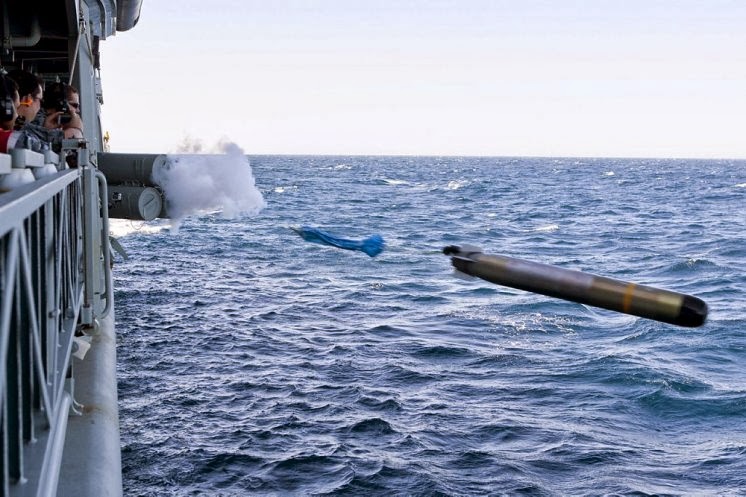
MU90 torpedo enters operational service with Royal Australian Navy *

The Thales-built MU90 lightweight torpedo has entered operational service with the Royal Australian Navy (RAN), following the completion of its final test firing.
During the testing, the MU90 torpedo has been test launched aboard the Australian Navy's Anzac-class ship, HMAS Stuart (FFH 153).
The MU90 lightweight torpedo programme involves the Djimindi Alliance, comprising the Defence Materiel Organisation, Thales Australia and EuroTorp, as well as the Royal Australian Navy and its RAN Test Evaluation Analysis Authority and the Defence Science and Technology Organisation (DSTO).
Thales Australia's CEO Chris Jenkins said MU90 would enhance the Royal Australian Navy's anti-submarine warfare capability.
"We are very pleased that the torpedo has now entered active service, and we look forward to working closely with the DMO and RAN to support the weapon over the coming years," Jenkins said.
"The MU90 is an advanced lightweight anti-submarine torpedo and that can detect and attack deep quiet-running submarines."
Developed by EuroTorp, a consortium between DCNS, Thales and Finmeccanica, Whitehead Alenia Sistemi Subacquei (WASS), the MU90 is an advanced lightweight anti-submarine torpedo and that can detect and attack deep quiet-running submarines.
Commenting on the testing carried out in August, the navy chief vice-admiral Ray Griggs earlier said the MU90 has demonstrated its full capability during the final test and evaluation event and has already completed an extensive test programme using exercise (non-explosive) variants.
Currently, the 3m-long MU90 anti-submarine warfare torpedo is operational with France, Italy, Germany, Denmark and Poland, providing enhanced performance and accuracy in shallow waters and in congested areas.
The DCNS-built MU90 torpedo uses advanced technology to strike any type of nuclear or conventional submarine, including acoustically coated, deep-diving, fast-evasive, deploying anti-torpedo effectors or bottomed in littoral areas.

* Notícia publicada a Naval Technology. La Reial Marina Australiana, amb una reputació d'eficàcia ben guanyada, continua amb el procés de modernització, tot acompassant una excel.lent formació amb bon material.

dimarts, 6 de novembre del 2012

Canberra Class Landing Helicopter Docks (LHDs), Australia*


The Canberra Class Landing Helicopter Docks (LHDs) will be the largest vessels ever constructed for the Royal Australian Navy (RAN). Navantia and BAE Systems Australia are constructing two 27,800t ships of the class under the Joint Project 2048 Phase 4A/4B.
BAE Systems Australia is the prime contractor for the $3bn project, while Navantia is responsible for the design and construction of the ships.
The two Canberra class LHDs, HMAS Canberra and HMAS Adelaide, are scheduled to be commissioned in January 2014 and June 2015 respectively. The ships will replace one of the Kanimbla Class landing platform amphibious ships and the Tobruk Landing Ship Heavy (LSH) vessel.
The Canberra Class LHD can transport over 1,100 troops, 100 armoured vehicles and 12 rotary wing aircraft.


Design features of the Canberra Class LHD

"The Canberra Class LHD can transport over 1,100 troops, 100 armoured vehicles and 12 rotary wing aircraft."
The Canberra class ships incorporate a conventional steel mono hull with the superstructure placed on the starboard side of the flight deck. The shallowest possible draft allows the LHD to operate in shallow waters that are common in the littoral regions.
The ship will comprise four main decks including Well Deck and Heavy Vehicle Deck, Main Accommodation Deck, Hangar and Light Vehicle Deck, and Flight Deck. The ramp at the stern of the ship provides access to the well dock. The heavy vehicle/cargo deck is accessed through two lateral ramp doors on the starboard side. A fixed ramp on the port side allows the vehicles to move between the heavy and light vehicle decks.
The well deck normally accommodates four LCM 1E amphibious landing craft. Four additional rigid hulled inflatable boats (RHIBs) can be carried during emergency situations. The well deck is also capable of housing landing craft utilities (LCUs), amphibious vehicles and landing craft air cushions (LCACs).
The LHD will have an overall length of 230.8m, moulded beam of 32m and a draft of 7.08m. The full load displacement will be 27,500t. The ship can complement a crew of 400 including the watercraft and flight deck crews. It will be jointly operated by crew from Navy, Army and the Air Force.

Construction of the LHDs for Royal Australian Navy

The Canberra class ships are being built using a modular construction approach. Each module is built and fitted out as a separate unit, before being assembled to form the complete ship. The process accelerates the construction as the modules are built at different sites across the shipyard before being brought together for final outfitting.
The construction of the body from the hull up to the flight deck is being carried out at Navantia's Ferrol-Fene shipyard in Spain. The hull will be transported to Williamstown dockyard in Australia for the installation of the island structure.
The construction of the first ship, HMAS Canberra, began in late 2008. Her keel was laid in September 2009 and the ship was launched in February 2011. The first steel was cut for the second ship, HMAS Adelaide, in February 2010. HMS Adelaide was launched in July 2012.


Canberra Class flight deck


The flight deck will be 202.3m long and 32m wide. It will allow the operation of the rotary wing aircraft of Australian Defence Forces (ADF), such as NRH-90, CH-47 Chinook, Blackhawk, Seahawk, ARH, and Future Navy Aviation Combat System. The deck will be provided with six spots on the port side to support the simultaneous operations of medium-sized helicopters. The flight deck will also allow the takeoff and landing of four CH-47 Chinooks simultaneously.
The aircraft elevator at the aft of the flight deck can carry large sized rotorcraft such as the CH 47. The medium-sized helicopters can be accommodated by the elevator at the forward of the island on the starboard side.
The hangar facility and the light vehicle deck will be co-located between the flight deck and the accommodation deck. It can accommodate up to eight medium sized helicopters. The storage capacity will expand up to 18 medium-sized helicopters when the light vehicle deck is also used.

Combat management and weapon systems of the Canberra class

The Canberra Class LHDs will be equipped with a Saab 9LV combat management system (CMS). The system performs threat evaluation, engagement planning and weapon-assignment missions. Elbit Systems was awarded a contract in October 2012 for supplying Battle Management Systems (BMS) to be integrated into landing craft aboard the LHDs.
Each Canberra class ship will be armed with four 20mm automated guns, six 12.7mm machine guns, anti-torpedo towed defence system, and Nulka active missile decoy system.

Sensors/radars of the landing helicopter docks

The sensor suite will consist of a Sea Giraffe 3D air search radar, helicopter control and surface radar, and navigation radar. Other systems include Sagem Infrared Search and Track (IRST) System, and Rafael Gun and Electro-Optical Sight (EOS) system.


Propulsion for the Canberra class LHDs

"The ship can accommodate up to 1,400 personnel including 400 ship's company and 1,000 embarked troops."
The Canberra Class LHD will be powered by a combined diesel and gas turbine (CODAG) propulsion system integrating LM 2500 gas turbine and two MAN 16V32/40 diesel generators. The ship will also be equipped with two Siemens azimuth thrusters and two bow thrusters.
The shipboard power will be supplied by a Progener-Mitsubishi S16MPTA 1,350kW emergency diesel generator. The propulsion system will provide a maximum speed of 20kt and a range of 6,000nm.

Accommodation onboard the Canberra class vessels

The ship can accommodate up to 1,400 personnel including 400 ship's company and 1,000 embarked troops.
The crew accommodation facilities will be located in the main accommodation deck, which will include crew cabins, messing, medical rooms, galley, office spaces and recreation facilities.

Article publicat a Naval Technology. La nova classe Canberra és tot un exemple de construcció parcial ( buc per Navantia i sistemes per BAE Australia, etc...), per prendre'n nota per les futures Forces Navals de Catalunya.

dimarts, 8 de maig del 2012

BATTLE OF THE CORAL SEA


EN EL 70è ANIVERSARI DE LA BATALLA DEL MAR DEL CORALL, BLAU NAVAL HONORA LA MEMÒRIA DELS QUI HI LLUÏTAREN PER UN MÓN  LLIURE.

ON THE 70th ANNIVERSARY OF THE BATTLE OF THE CORAL SEA, BLAU NAVAL HONOURS THE MEMORY OF THOSE WHO FOUGHT FOR A FREE WORLD.

Battle of Coral Sea Remembered by Veterans, U.S. and Royal Australian Navies In Brisbane, Australia*

BRISBANE, Australia (NNS) -- More than 50 U.S. Sailors and distinguished guests attended the Australian-American Association 70th anniversary of the Battle of Coral Sea commemoration ceremony at Newstead Park in Brisbane, Australia, May 5.

Throughout the service, speakers paid tribute to the special connection between the two countries and the service members who made the ultimate sacrifice in defense of their country.

Secretary of Homeland Security Janet Napolitano delivered a speech and a message from President Barack Obama before laying a wreath at the foot of the Australian American War memorial.

"The United States has no stronger ally than Australia," she said. "Aussies and Americans have fought together and given lives together at every single major conflict over the last 100 years."

Also in attendance was Harry Frey, a former Sailor who served aboard USS Lexington (CV-2) during the Battle of Coral Sea.

"It was great to see so many people gathered together in honor of the men and women who fought during the Battle of Coral Sea," said Frey.

Lexington was sunk during the Battle of Coral Sea when the ship was damaged and set on fire by Imperial Japanese torpedo-bombers. Frey is one of few survivors who made it to safety.

"It could've been me, I was just lucky," said Frey. "Right after we came back up from the sick bay to help the doctors, it blew up. I went back up on the flight deck and the guys were abandoning ship. When they were going over the side I kept saying we are going to make it, they are going to salvage us".

"All of a sudden the ship dropped 10 degrees on the port side and I thought she was going to roll then, so we decided it was time to leave."

For Yeoman 2nd Class Robert Raynor, a Sailor assigned to the guided-missile destroyer USS Halsey (DDG 97), being able to pay respects to the veterans who fought for their country during World War II was a humbling experience.

"I've read about the Battle of Coral Sea quite a few times, but being able to hear about it in person from people that were their was an amazing experience," said Raynor.

Distinguished visitors also laid wreaths at the foot of the war memorial at Newstead Park. The ceremony included a flyover by two World War II aircraft from each country, a Wirraway and a PT-6 Texan.
 
* Notícia publicada al lloc web de la US Navy. En motiu del 70è aniversari d'aquella terrible batalla, compartime aquesta notícia com a humil homenatge.

dimecres, 7 de març del 2012

HMAS Parramatta up close and personal with Abraham Lincoln*


The Ship’s Company of HMAS Parramatta has enjoyed a unique experience when the ship joined the USS Abraham Lincoln carrier battle group on 25 February in the North Arabian Sea. 

Parramatta closed in on the carrier group at speed and assumed plane guard station for the USS Abraham Lincoln where she was perfectly positioned to observe the might of the carrier force on display. 

On station for more than two hours, Parramatta's ship’s company witnessed the continuous stream of F-18 Hornets circling the battle group. 

“It is mind boggling” Chaplain Andrew Watters said. “I’d never thought I be so close to a US carrier to witness the full might of a carrier group. It’s not something that I’ll forget”. 

The USS Abraham Lincoln is the fifth Nimitz-class super carrier in the United States Navy.
At 333 metres long, 77 metres wide and weighing in at 100,000 tonnes, the ship is more than 25 times larger than Parramatta. The Abraham Lincoln is powered by two nuclear reactors, four steam turbines and can reach speeds of more than 30 knots with unlimited range. 

Parramatta departed company with the carrier group after the brief encounter to continue with her patrol in the Arabian Sea. 

Parramatta is currently deployed to the MEAO as part of Operation SLIPPER and under the Combined Maritime Forces (CMF), which is responsible for maritime security operations in the Gulf region, the maritime environment around the Horn of Africa, and counter piracy and terrorism operations in the Gulf of Aden. 

Parramatta’s presence is contributing to the inter-operability of 25 CMF nations and demonstrates Australia’s and CMF’s resolve to maintain safe access to vital international straits and the maintenance of good order at sea. 

The Anzac Class Frigate will be relieved on station by HMAS Melbourne in early March and will return to Sydney at the end of the month. 

*Notícia publicada al web de la Royal Australian Navy. La cooperació de dècades entre la US Navy i la Royal Navy permet que ambdues flotes puguin operar sense cap mena de dificultat ni contratemps en qualsevol escenari, com una sola força.

dimarts, 31 de gener del 2012

Austal Multirole Vessel (MRV 80)*


 Key Data

  • Vessel Type Multirole vessel (MRV)
  • Builder Austal
  • Crew 35
  • Armament One x 25mm stabilised naval gun, four x .50 cal general purpose machine gun mounts
  • Propulsion 3 x MTU 20V 4000, 4,300kW at 2,170rpm
  • Speed 26kt
  • Range 4,500nm at 12kt


Multirole vessel (MRV 80) is a long range, high speed patrol ship being developed by Austal. The ship can be deployed in exclusive economic zone (EEZ) border patrol, command and control, hydrographic surveys, surveillance, search and rescue, force transportation, amphibious operations and humanitarian support missions.
The compact and low cost platform will meet the requirements of the world's navies to maintain peace and stability in their respective coastal zones.
The ship supports the special forces deployed in offshore and littoral war environments, long range counter-terrorism and counter piracy operations. It will also be used as a theatre hospital, at sea replenishment and anti-submarine warfare (ASW) platform.
Austal MRV 80 is the reconfigurable platform featuring packaged mission modules. The ship can be reconfigured according to the mission requirements. The MRV will take the load off of major surface combatants by offering increased capability.
The Royal Australian Navy plans to replace its existing patrol boats, minehunters and hydrographic vessels with 20 multirole vessels.


MRV 80 design and features

The multirole vessel incorporates a trimaran hull made from aluminium alloy. The flexible design uses Austal's patented trimaran technology, delivering fuel efficiency and improved passenger comfort.
The unique trimaran design comprises three hulls, including one long slender hull in the centre and two side supporting hulls. The three-hulled configuration delivers higher performance than the traditional high speed boat, employing either catamaran (two-hulls) or monohull (one hull) designs.
This trimaran hull arrangement provides good sea keeping and space for inserting the modules of weapons and sensors. Proven in both commercial and defence operation, the trimaran offers high speeds and slower roll.
The ship can maintain higher speeds in waves and provide greater comfort for passengers and crew when in the same sea conditions. The onboard open architecture systems network provides interoperability to the users.
The multirole vessel will have an overall length of 80m, moulded beam of 21.1m, moulded depth of 6.7m and a hull draft of 3.2m. The dead-weight of the vessel is 400t. The ship can complement a crew of 35.

Multirole vessel cargo capacity

The multirole vessel features three decks.
The mission / logistics deck provides 500m² of area at a clear height of 4m. The deck can accommodate cargo, equipment and military vehicles.
The personnel deck provides personnel seating and 87 berths for accommodation of passengers. The ship provides facilities to recover and launch small boats.
The flight deck located at the aft side offers a deck area of 290m². The flight deck can support the operations of an NH-90 or similar type of medium sized helicopter.
The NH-90 can lift 20 troops or 4,000kg of cargo externally under slung. Hangar facility is provided for embarked helicopter.


Armaments and propulsion of Austal's multirole vessel (MRV 80)

The main gun fitted forward will be a 25mm stabilised naval gun. The gun can protect the hostile ship from small, fast and agile surface threats.
The ship will also be provided with gun mounts for four .50 calibre general purpose machine guns.
The multirole vessel will be powered by three MTU 20V 4000 diesel engines driving three fixed pitch propellers. Each engine will deliver a power an output of 4,300kW at 2,170rpm.
The propulsion system will provide a maximum speed of 26kt and a range of 4,500nm at 12kt. The ship will have an endurance of 28 days.

* Article publicat a Naval Technology. El considerem complementari al que vam compartir fa pocs dies referent a les naus multi-rol

dimecres, 14 de desembre del 2011

HMAS CHOULES COMMISSIONED*


The Royal Australian Navy now has enhanced amphibious warfare capability with the commissioning in Fremantle today of Australia’s newest warship, the Bay Class Landing Ship HMAS Choules. 

Choules, a former Royal Fleet Auxiliary which served the Royal Navy under the name Largs Bay, was renamed after Chief Petty Officer Claude Choules, Australia’s last surviving World War I veteran. Mr. Choules passed away in his home city of Perth in May 2011, aged 110. 

HMAS Choules is now at the forefront of a new generation of amphibious capability for Navy in the period leading up to the arrival of the Landing Helicopter Dock ships in 2014. 

The ship has been proven as a robust amphibious capability, having provided humanitarian relief as a part of the international response to the Haiti earthquake last year.

The 176 metre long vessel has a crew of 158 officers and sailors, and can accommodate two large helicopters, 150 light trucks and 350 troops. She also carries two mexeflotes, which are powerful landing raft designed to move goods and vehicles between the ship and the shore. 

Following her commissioning in Western Australia, HMAS Choules will transit to the east coast to her home port at Fleet Base East in Sydney on 21 December. 

Imagery of the HMAS Choules commissioning ceremony is available on the Royal Australian Navy Media Library. 

* Notícia publicada al web oficial de la Royal Austalian Navy. L'increment de les capacitats de projecció de força d'aquest Estat és quelcom que cal tenir molt present de cara als equilibris de poder a l'Àsia i el Pacífic.

dissabte, 22 d’octubre del 2011

Largs Bay officially handed over to Australian Defence Force*

Largs Bay officially handed over to Australian Defence Force

ADFS Choules leaves the Falmouth Dockyard after the completion of refit and overhaul work.


Minister for Defence Stephen Smith and Minister for Defence Materiel Jason Clare today announced that the Largs Bay, now ADF Ship Choules, had been formally handed to the Australian Defence Force at Falmouth Dockyard in the United Kingdom.
ADF Ship Choules will set sail for Australia next month, arriving in Western Australia in mid-December where it will be officially commissioned, HMAS Choules.
ADF Ship Choules is a Landing Ship Dock (LSD) which was commissioned into service in 2006.
The Government announced it had been successful in purchasing the ship, formally RFA Largs Bay, in April this year for £65 million (approximately $100 million).
The ship weighs 16,000 tonnes. It is 176 metres long and 26 metres wide. Its flight deck has room for two large helicopters and can also carry around 150 light trucks and 350 troops.
Its cargo capacity is the equivalent of the HMA Ships Manoora, Kanimbla and Tobruk combined.
ADF Ship Choules is a proven capability having provided humanitarian relief as part of the international response to the Haiti earthquake in 2010.
The acquisition of this ship will help ensure that the Royal Australian Navy has the amphibious capability it needs for operation and humanitarian support in our region in the period leading up to the arrival of the Landing Helicopter Dock Ships.
Mr Smith and Mr Clare paid tribute to the Officers and Ship’s Company of ADF Ship Choules who have worked very hard to learn new skills and procedures in a relatively short timeframe to operate the ship safely and be ready for the handover.
The ship has been fittingly named after the former Chief Petty Officer Claude Choules, who sadly passed away in May this year at the age of 110.
Claude Choules saw service in World War One and World War Two, as a member of both the Royal Navy and later the Royal Australian Navy.
He was Australia’s last living link to those who served in World War One. It is therefore fitting that this ship bear the name Choules to represent the vessel’s links to both Navies.
In the centenary year of Navy, it honours all of those men and women who, like Claude Choules, delivered quietly and with great dedication, loyal service to the Royal Australian Navy. 

* NOTÍCIA PUBLICADA AL WEB DE LA ROYAL AUSTRALIAN NAVY. Considerem adequada compartir-la amb els lectors de Blau Naval, com a complement a la notícia d'ahir, PACIFIC ARMS RACE. L'Armada Reial Australiana, embarcada en un procés de modernització que li permeti fer front al nou marc estratègic del Pacífic, és una de les principals forces que cal tenir presents.