Es mostren els missatges amb l'etiqueta de comentaris Estats Units. Mostrar tots els missatges

divendres, 31 de juliol del 2015

LCS Anti-Sub Warfare Package Too Heavy; 3 Contracts Issued For Weight Reduction Study*

The Littoral Combat Ship’s anti-submarine warfare mission package needs to shed some weight before it can deploy on a ship, and the Navy awarded three contracts to help find weight-reduction ideas.

The mission package includes two mature and fielded sonar systems, plus the hardware needed to integrate the systems with the ship. LCS Mission Module Program Manager Capt. Casey Moton said Thursday at a Mine Warfare Association lunch that each of his three mission modules is given 105 metric tons of weight on the LCS, but the ASW as it stands today surpasses that limit.

The mission package includes a Variable-Depth Sonar – the Navy chose the Thales UK Sonar 2087, the same VDS used on the Royal Navy’s Type 23 frigate – as well as the Multi-Function Towed Array used on the Arleigh Burke-class destroyers (DDG-51) and eventually the Zumwalt-class destroyers (DDG-1000). The Navy cannot overhaul either mature system, so it has hired Advanced Acoustic Concepts, L-3 Communications and Raytheon to find more creative ways to reduce weight.

In the early stages of the weight-reduction effort, “we got proposals that ranged from modifying the sensors to reduce weight to things as simple as using composites in the handling system,” Moton said.
“So our initial contract is to three companies, and they will do a transition study for us over the next couple months that will give us a lot more insight.”

Each team will submit a package that brings the mission module to under 105 metric tons, and the Navy will then pick and choose which ideas it likes and use them to build engineering development models. Moton said his office had not decided how many EDMs to build but would make that decision over the next few months.

He said he could not recall how many tons over weight the current ASW package is, but “all three companies proposed schemes that would get us to the weight” and he was confident he could meet the requirement to get onboard a ship.

Also during his speech, Moton said his office was making some minor adjustments to the Lockheed Martin AGM-114L Longbow Hellfire radar-guided missile, which the Navy is adapting for use on the ship. The missile currently launches horizontally from a helicopter, and the Navy is making modifications so it can launch vertically and lock on its target after tipping into a horizontal position post-launch. The new version of the missile will be called the Surface-to-Surface Missile Module and should be fully integrated and ready for deployment by late 2017, according to a Navy statement.

The program office began tests on a research vessel at the end of February against “high-speed maneuvering targets out off the Virginia Capes.” That testing wrapped up in June, and based on the results, the office has to do “some tweaking – it’s really that level, tweaking – to the missile seeker and such.”

Another round of testing on the research vessel will take place in Fiscal Year 2016.

Moton also said his office is currently conducting a technical evaluation of the surface warfare mission package on USS Coronado (LCS-4). The package has already deployed twice, but both times on Freedom-variant LCSs. Coronado is an Independence-variant ship, with the same interfaces for the mission package but a different physical layout. Moton said the evaluation is “going very well.”

* Notícia publicada al US Naval Institute. Sembla que el "think big" continua passant factura a les capacitats de combat de la US Navy. Segurament amb el sistemes modulars que tant bé han funcionat a la Reial Marina Danesa es podria millorar, però prèviament requeriria liquidar la plaga de buròcrates del Pentàgon i els comissionistes que el dessagnen.


dilluns, 29 de juny del 2015

If Greece exits the euro, what happens to the US base Souda Bay?*

Stars and Stripes

There has been widespread concern about the consequences for global markets if Greece defaults on its debts and is forced to give up the euro. But how would a tiny American naval base on the island of Crete fare?

The challenges for the base of a Greek exit from the euro would be similar to those of many American companies watching developments in the country, say security and financial consultants.

Greece is in a series of last-minute negotiations with creditors over a deal to avert a looming default on bailout loans from recent years.

Even if a deal is struck by an end-of-the-month deadline, most economists believe this would not solve the country’s underlining financial problems, and a new crisis down the road is likely.

“The potential for chaos and a huge amount of uncertainty and instability is very significant,” Marianna Vintiadis, the managing director for security consultant firm Kroll’s Southern European office, said of a possible Greek default.

Like many overseas American bases, U.S. Naval Activity Souda Bay has hundreds of local employees and contracts with local businesses. American employees live on the local economy and make purchases in euros.

Navy public affairs officials declined to discuss base planning around a possible Greek default, saying they were under strict instructions to refer all matters to the State Department — including unclassified figures such as the number of base employees or the base budget.

A State Department spokeswoman referred to previous White House statements on the issue.

In the event of a default, Greece is expected to drop the euro and replace it with a local currency. Stabilizing that currency, which is expected to immediately fall in value to the euro, would take time, said Naresh Aggarwal, a treasury consultant with PwC.

Because the Greek government will likely close local banks to prevent people from emptying their accounts, businesses typically want more cash at their disposal to make payroll and pay for services.

“What you would want is not to be holding local currency,” Aggarwal said of foreign businesses in Greece. “You would want a foreign currency, whether it’s euros, pound sterling, Swiss francs or U.S. dollars. Or you would want to hold tangible assets.”

For Navy personnel, who have access to U.S. dollars through on-base institutions like Community Bank and Navy Federal Credit Union, access to cash shouldn’t be a problem while a new Greek currency is unavailable.

Whether the base would have an issue paying local employees is less clear. Of Souda Bay’s roughly 900 military and civilian personnel, about 400 are local civilians, according to a military official familiar with the base. Yet its payroll has in the past been made through the Greek government, which then pays the employees, a scheme that could complicate payment in an alternative currency.

Another uncertainty is whether contracts now paid in euros could be switched to the new currency. The base might also worry about the viability of some local service providers, especially smaller businesses that could take a financial hit from the loss of the euro.

“You need to make sure the first group of suppliers you have is resilient,” Aggarwal said of overseas businesses.

That issue, too, could be defused by the fact that the American base is located inside a Hellenic Air Force base, meaning some infrastructure is maintained by the Greek Defense Ministry instead of locals contracted by the U.S.

Social unrest is another concern for foreign businesses operating in Greece, both Aggarwal and Vintiadis agreed. So far, Athens has been the scene of most of the protests and violence surrounding debt negotiations. Aggarwal said that, as symbols of capitalism, larger American companies can become targets in times of financial unrest.

But Vintiadis said the current situation is different because it doesn’t directly involve Americans. Greece’s creditors are European, and Germany in particular has become the target of popular frustration. The U.S. has encouraged any resolution that would keep Greece within the eurozone.

“In this case, would there be anything specifically targeted at Americans? I don’t see it,” she said. “This is not that sort of a crisis; this is not that sort of a problem.”

The likelihood that significant unrest would spread outside Athens depends on how long the Greek government needs to stabilize the currency and return the economy to a sense of normalcy, she added. “What we have at the moment is a situation in flux,” Vintiadis said. “When you’re in a situation in flux, you need to be careful. Things are changing every day.”

* Article publicat a Stars & Stripes. És incerta qualsevol previsió que es faci sobre el futur immediat de Grècia, ara bé, potser a Catalunya algú hauria d'anar pensant alguna contraoferta en cas que la US Navy marxi de Souda Bay.


dilluns, 20 d’abril del 2015

Submarines With Wheels, Underwater Blimps, and a New Nuclear Arms Race*


Every two years, the super scientists at the US Navy's Office of Naval Research host a symposium. There, they talk about grant applications and small business partnerships — but they also discuss the bleeding-edge future of naval warfare.

Amid all the talk of lasers, railguns, and firefighting robots, Dr. Robert Ballard, the man whose accomplishments include finding the Titanic and discovering previously unknown lifeforms near seafloor geothermal vents, gave a talk. A talk in which he casually mentioned a mind-blowing new concept: "terrain-involved submarine warfare."

That means putting wheels on subs.

Generally speaking, submarines really, really hate interacting with the seafloor. In fact, they spend much of their time trying desperately to avoid it. Hitting a sharp rock could (Poseidon forbid!) tear a hole in the hull, and that's a pretty bad thing when the sea is putting a half ton of pressure on every single square inch of it. Subs generally don't have windows, so parking one on the sea floor — which has no shortage of sharp rocks — would be an adventure. Worse yet, subs don't exactly stop on a dime; they have incredible amounts of inertia. Parallel parking would be a nightmare.

Navy bigwigs and eggheads are well aware of these facts. And yet Ballard told an auditorium full of them that Navy subs should get up close and intimate with the seafloor. What made him do such a thing? Once upon a time, Ballard was in the employ of Army intelligence, analyzing maps to figure out if ridges, hills, valleys, and whatnot could, for instance, hide enemy tanks or mask troop movements. Ballard subsequently moved over to the Navy, and based on his Army experience, he started advocating for the embrace of undersea terrain rather than its avoidance.

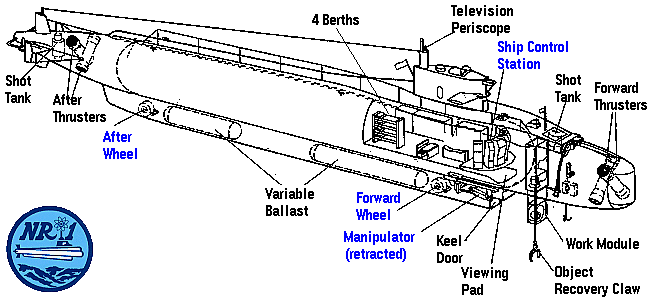
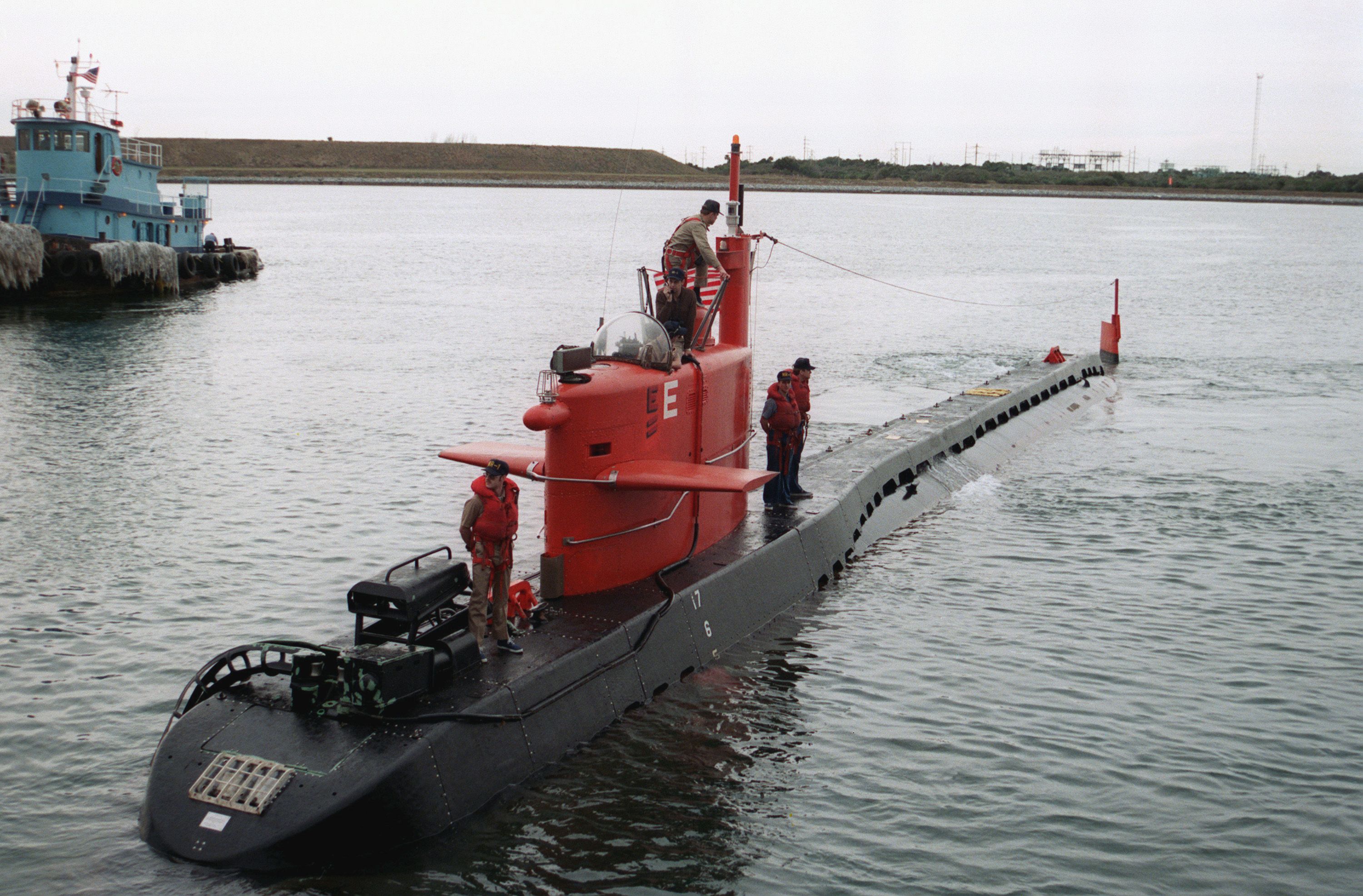
In 1984, Ballard demonstrated the ability to operate on the ocean floor during a two-week exploration near Iceland's Reykjanes Ridge. He took the Navy's deep-sea research submarine, the NR-1, down 3,000 feet and drove it around volcanic peaks; he even hid in the occasional lava tube. At the time, the NR-1 was the Navy's largest deep-sea research submarine and its smallest nuclear sub. At a length of 150 feet and 400 tons, it could support a crew of 13 for up to a month. But most importantly, the NR-1 had retractable wheels and portals. The wheels allowed the NR-1 to roll along the seafloor. The portals allowed the sub drivers to see where the hell they were going.

In addition to the fact that it's kind of badass to drive a submarine around on the ocean floor like a 400-ton, nuclear-powered tank, there are some definite advantages to rolling around in the mud. Submarines (and the surface ships they fight) rely on sonar to search for stuff. This can mean quietly listening for telltale sounds, like engine noises — that's called passive sonar. Or, like bats, subs can emit sound pulses, which bounce off objects, creating echoes that are received by the sub, a technique called active sonar. But in a complex, jumbled terrain with rocks, mountains, and canyons, the sound waves get so jumbled up that it's impossible to make any sense of the sounds that come back.

Navies also use very sensitive magnetic detectors to locate the giant, metallic mass of the submarine as it moves underwater. But this method is less effective in some kinds of seafloor terrain. For example, near basaltic rocks, which interfere with even simple compasses and create downright havoc with sensitive magnetic sub-hunting gear.

Between the jumbled sonar and the magnetic interference of the ocean floor, it can be very hard to find something hiding in the seafloor terrain. Ballard illustrated this point clearly when he dared the Navy to find him while he was tooling around on the Reykjanes Ridge in the NR-1. Two weeks of searching later, the Navy had no clue where he was.

The Navy lost interest in Ballard's display when the Cold War ended, but there are plenty of reasons why it deserves to be revisited. For decades, subs have relied on stealth to protect them. But as a report by the Center for Strategic and Budgetary Analysis notes, the old rules for subs may be changing. For starters, each incremental improvement in the technology that makes subs stealthier is getting exponentially more expensive, narrowing the performance gap between different submarines. In addition, there are a lot of sub-hunting techniques that circumvent traditional submarine stealth. Until now, those techniques required too much computational power to be practical. Soon, advances in computers may make these more exotic sensors a viable option.

That said, there's still one thing to keep in mind about Ballard's idea: how truly goddamn weird it is.

What he's proposing is a whole new war-fighting domain. Domain is wonkspeak for an environment in which fighting occurs, and up until 1,000 BCE or so, humanity fought in one domain: land. In the three millennia since, warfare has expanded into six — land, sea, undersea, air, space, and now cyberspace. For all practical purposes, the undersea domain today extends down a couple thousand feet or so (or to somewhere just above the seafloor if it's shallow enough). If you go deeper than that, it's aqua incognita for most subs; hulls collapse, death ensues, and nobody's happy.

But if you consider the undersea domain from the seafloor looking up rather than from the surface looking down, things start to change. Traditional submarines don't look like stealthy predators running invisible below the ocean waves — they look like big, fat, stupid blimps clumsily floating in the water above. New terrain-involved submarines become aquatic helicopters, landing and taking off from the seafloor. The most advanced seafloor mines, like the US Navy's CAPTOR — it's basically a torpedo that hides and listens for passing ships — become the seafloor equivalent of surface-to-air missile sites. Complex seafloor terrain is no longer a navigational hazard; it's a source of cover and concealment.

So really, this isn't about subs on wheels — it's about treating the ocean like the sky. And by doing that, everything anyone ever thought they knew about fighting in the sea and undersea domains is up for review.

None of this will happen anytime soon; current submarines don't go deep enough to interact with much of the sea floor. Smaller deep-submergence vessels capable of going several thousand feet down are slow, require a mothership, and generally can only operate for a few days at a time. But that will change; an explosion in ultra-deep sea oil drilling and the emerging field of seabed mining will continue to drive advances in Remotely Operated Vehicles (ROVs) and Autonomous Underwater Vehicles (AUVs). Terrain-involved submarines will be a reality.

And here's why all of this is truly creepy: Anything that makes subs easier to find and kill threatens nuclear missile subs. Nuclear ballistic missile submarines are considered the nuclear deterrent of last resort because they've historically been the most reliable and best protected part of the nuclear arsenal. Even if an attacker can hit every single square inch of a country in a surprise nuclear attack, the attacker would still be vulnerable to a devastating counterattack launched by nuclear subs hiding at sea. Because of this, the majority of the US nuclear arsenal is submarine-based. A guaranteed ability to counterattack goes a long way in preventing enemies from getting an itchy nuclear trigger finger.

But seafloor warfare could change that. Nations all around the world — including the US, Russia, and China — are signatories to the Seabed Arms Control Treaty that bans placing nukes on the seafloor (at least outside of the coastal zone that extends 12 miles from a country's shores). If a nation withdrew from the treaty to build a nuclear missile base on the seabed because it no longer felt its nuclear missile subs were secure, it could spark an arms race. Thus, seafloor warfare can threaten the stability of the nuclear deterrent. And if the idea of wheels on subs occurred to Ballard, it's no doubt occurred to other bright folks elsewhere in the world.

The thing about treaties is that they're not forever. Eventually, someone decides to quit or cheat, or technology advances so much that the treaty becomes a historical relic. The US withdrew from the Anti-Ballistic Missile Treaty in 2001 to pursue its missile defense program. In early March, Russia completed its de facto withdrawal from the Treaty on Conventional Armed Forces in Europe, which limits the size of armies deployed to Europe. So there's no reason to believe the existing treaty on WMD on the ocean floor will last forever. So Ballard's mind-blowing concept of today could be a real headache of tomorrow.

Follow Ryan Faith on Twitter: @Operation_Ryan

*Article publicat a Vice News. Interessantíssima informació per totes aquelles persones interessades en les operacions submarines. Certament, el contacte amb el fons sempre ha estat una espasa de doble fulla: una amenaça seriosa per la integritat del casc, però un mantell difuminador davant possibles caçadors. Per pensar-hi.


dissabte, 24 de gener del 2015

The US Navy’s New Surface Warfare Strategy: ‘Distributed Lethality’*

By Franz-Stefan Gady
January 16, 2015

The United States Navy plans to re-organize and re-equip its surface fleet by grouping ships into small surface action groups and increasing the number of anti-ship weapons on more platforms. The U.S. Navy calls this tactical shift “distributed lethality.”

Breaking Defense quotes, Rear Admiral Peter Fanta and his rough summary of the concept of “distributed lethality”: “If it floats, it fights, that’s ‘distributed lethality’ (…) Make every cruiser, destroyer, amphib, LCS, a thorn in somebody else’s side.” Fanta, the director for Surface Warfare on the Navy staff, spoke at the annual Surface Navy Association National Symposium, which took place in Arlington, Virginia this week.

Vice Admiral Thomas Rowden, commander of Naval Surface Forces, further elaborated on the tactical shift at the symposium, as military.com reports: “We’re going to up-gun as many existing platforms as we can to achieve more total lethality.” Speakers at the symposium noted that the Navy will overhaul ships in service with low-cost weapon and sensor upgrades including Aegis destroyers, cruisers, supply ships, and littoral combat ships. However, more details on the specifics of this reshuffle will only emerge when the president’s 2016 budget request comes out next month.

In 2014, the U.S. Navy had to endure politically motivated budget cuts and a hiring freeze delaying retrofits and maintenance of Navy vessels. This trend will likely continue in 2015. “Budget is coming down,” Fanta emphasized. This should be placed in perspective: In 2014, the U.S. Navy deployed tonnage equal to that of the sixteen next-largest navies combined.

The tactical “distributed lethality” shift is largely due to the increasing anti-access/area denial capabilities of the armed forces of China and Iran but also Russia. In an article in Proceedings Magazine, published by the U.S. Naval Institute, Vice Admiral Rowden, Rear Admiral Fanta, and Rear Admiral Peter Gumataotao, outlined the reasons behind the re-organization of the surface fleet by arguing that, “the shift to the offensive responds to the development of increasingly capable A2/AD weapons and sensors designed specifically to deny U.S. naval forces the freedom of maneuver necessary to project power.(…) Adversaries who counter this advantage diminish the deterrent value of forward-deployed forces and negatively impact the assurances we provide to friends and allies. A shift to the offensive is necessary to ‘spread the playing field,’ providing a more complex targeting problem while creating more favorable conditions to project power where required.”

As of now, the U.S. Navy still lacks an adequate long-range, anti-surface weapon to implement a re-organization of the surface fleet based on the “distributed lethality” idea. One possible future acquisition could be the Norwegian Kongsberg Naval Strike Missile, yet no decisions on the procurement of new weapon systems has been made as of now. The authors of the Proceeding Magazine article also outline additional requirements for their vision, such as improved intelligence/surveillance/reconnaissance and data relay, low-cost medium range strike weapons, and new railguns.

This new tactical reorganization is a clear indication that the days when the U.S. Navy’s surface fleet just served as air defense elements for carrier strike groups, floating bastions for ballistic missile defense, and strike platforms for land attacks are over. It remains to be seen how the Chinese and Russian navies will respond to the shift.

* Article publicat a The Diplomat. Recomanem la lectura d'aquest article, i dels seus enllaços, doncs la US Navy fa temps que necessita redistrubuïr la seva potència de foc. Per descomptat, cal alliberar destructors i creurers de les tasques de "pantalla" als CSG, però es l'exessiva concentració de la potència de foc en un determinat tipus de naus, genera vulnerabilitats.


dimarts, 23 de desembre del 2014

SEIZING THE ASUW INITIATIVE WITH LAND BASED PATROL AIRCRAFT*

By Michael Glynn

Recent months have found uniformed officers and naval strategists writing and speaking about regaining the ability of U.S. Navy (USN) ships to conduct offensive anti-surface warfare (ASuW). The discussion has been lively and featured many authors and many different approaches. Some solutions are incremental, such as fielding more capable long-range weapons in existing launch systems.[i] Others are more radical, such as trading large long-range missile defense interceptors for small point defense missiles and building a new generation of multi-role cruise missiles.[ii]


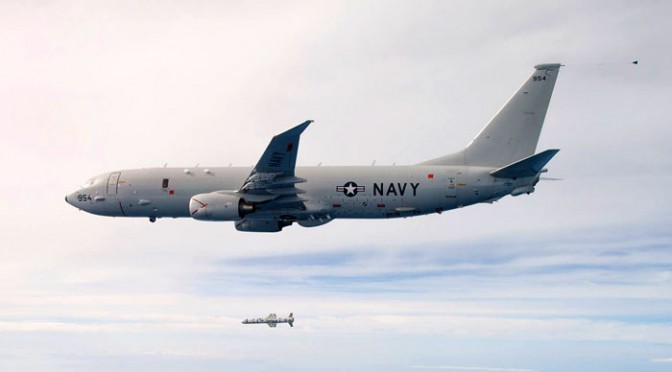
Missing from the discussion of future acquisitions and new weapons is how the USN can leverage existing land-based airpower to seize the offensive in ASuW. The P-8 Poseidon maritime patrol aircraft is deployed today, with the range, persistence, sensors, and network architecture to serve as a self-contained “kill chain.” It is able to disperse and operate in an expeditionary environment during peacetime or contingency operations. If equipped with more suitable long-range anti-ship weapons, this aircraft will provide greatly increased capability for the combatant commander. This will allow more flexibility for USN forces to operate in an A2/AD environment when a carrier is not nearby or in the interim until more capable surface-based ASuW weapons are fielded.


Framing the Challenge

During the last three decades, the USN has divested its surface forces of offensive anti-ship firepower as operations shifted to littoral environments with permissive threat profiles. With the retirement of the Tomahawk Anti-Ship Missile, the service has been left without a weapon that can engage targets at a range beyond that of threat anti-ship cruise missiles (ASCM’s).[iii] Our ships now go to sea armed only with the sub-sonic, medium range Harpoon missile. The removal of Harpoon from Flight IIA DDG-51’s after DDG-79 and proposed cuts to funding for cruisers have exacerbated this glaring deficiency.[iv] The onus for conducting maritime strike has shifted from our surface ships to the aircraft of the Carrier Strike Group (CSG).

As the reach and number of U.S. ASCM’s have decreased, threat systems have proliferated and improved in range, speed and sophistication. China, Russia, and India all possess advanced supersonic long-range ASCM’s. Foreign militaries are equipping themselves not only with the weapons needed to strike, but also the C4ISR capabilities needed to detect and accurately target adversary forces.[v]

Commanders, legislators, and the defense industry have responded with a variety of initiatives, including the development of an Offensive Anti-Surface Weapon (OASuW.) This program is aimed at fielding an advanced cruise missile with sufficient range to allow USN ships to employ outside the reach of threat weapons systems. OASuW Increment 1 will begin fielding the Lockheed Martin Long Range Anti-Ship Missile (LRASM) in FY17 for carriage on the F/A-18 Super Hornet and USAF B-1 bombers. OASuW Increment 2 will provide for integration of a long-range anti-surface capability onboard surface ships.[vi] By equipping the F/A-18 and B-1 with the ability to carry LRASM, the Department of Defense has signaled that regardless of eventual integration of OASuW onboard surface ships, carrier and land-based airpower will remain a key component of the U.S. anti-surface strategy.

Missing from this conversation on OASuW capabilities is the USN’s Maritime Patrol and Reconnaissance (MPR) force. The MPR community is recapitalizing with the P-8 Poseidon aircraft. The sensors, datalink capabilities, and expeditionary nature of this aircraft make it a natural choice to augment the lack of anti-surface punch. The P-8 and RQ-4C UAS are envisioned to play targeting roles in long-range ASuW engagements, so arming P-8 with upgraded weapons is a logical next step. The Poseidon can allow the fleet to seize the initiative in anti-surface employment, especially in situations where the threat makes the reality of deploying the CSG forward politically unpalatable or disadvantageous.

The Solution

The P-8 Poseidon is derived from the Boeing 737 aircraft. It features long-range, high transit speed, solid persistence, and will soon incorporate the ability to perform air-to-air refueling. The open architecture mission systems are easily reconfigurable and allow for rapid improvement of sensor and weapon capabilities. The P-8 features a Mobile Tactical Operations Center (MTOC), which aids in processing data collected during and after mission flights. The MTOC is fully expeditionary, allowing an MPR detachment to quickly relocate in peacetime or disperse away from main operating airfields and continue to fight in wartime.

The ability to disperse is especially critical in an A2/AD environment. The proliferation of theater ballistic missiles (TBM’s) and cruise missiles has allowed previously weak nations to hold an opponent’s forward bases at risk. By deploying aircraft to auxiliary fields away from large military installations, adversary commanders are faced with a much more challenging targeting problem. The increased cost of building more TBM’s may be daunting to a particular military, and the uncertainty of being able to destroy forward forces is a stabilizing influence. P-8’s ability to deploy to medium sized airfields and sustain itself during combat operations is a force multiplier.

P-8 will also carry the Raytheon Advanced Aerial Sensor (AAS) to provide standoff detection and targeting of maritime and land targets. Descended from the highly-classified APS-149 Littoral Surveillance Radar System, AAS will provide Poseidon crews with the ability to detect, classify, and provide targeting solutions of threats even in highly congested littoral areas.[vii] In A2/AD environments with highly advanced surface to air missile systems, this ability to accurately detect threats from long-range and provide targeting updates to net-enabled weapons isn’t just beneficial, it’s critical.[viii]A MPR squadron equipped with AAS and appropriate weapons becomes its own self-contained targeting and strike force.

In short, P-8 offers a weapons platform that is uniquely suited to maritime strikes. Its crews are far more familiar with operating in the ASuW role than USAF bomber crews and culturally more pre-disposed to emphasize this mission set. The ability to act as an armed sensor platform allows the Poseidon to close the kill-chain itself. P-8 armed with suitable standoff weapons has the ability to detect and attrite adversary surface ships, preserving the ability for our surface forces to deploy forward in wartime, and decreasing the need for our carriers to surge forward into extremely high-risk areas to eliminate surface threats with the air wing. This provides increased flexibility to the combatant commander.

Needed Changes

The MPR force has the potential to act as a powerful ASuW strike force, however this capability can grow stronger with upgrades and training. P-8 should be equipped with an OASuW capability, ideally allowing it to carry the LRASM rounds that will enter production in FY17. The largest roadblock will not be carriage capability or weapons system engineering, rather finding the funding to provide integration and testing for this weapon onboard P-8.

The P-8 currently carries the Harpoon Block IC, which is insufficient for high-end ASuW. The Block IC is not net-enabled, meaning it cannot receive in-flight updates from targeting platforms via a datalink. This makes the weapon less flexible and precise in congested environments. The aircraft is slated to receive the Harpoon Block II, which is net-enabled, but is still constrained by its short range.[ix] This lack of reach prevents it from engaging high-end air defense warships without putting the P-8 and its crew at serious risk.

It is best to utilize the synergy that exists in MPR squadrons and equip these aircraft with both the sensors and the weapons required for standoff targeting and strike. Since AAS equipped P-8’s may be required to provide targeting support to OASuW in a complex surface environment, equipping the targeting aircraft with weapons is the logical next step to close the kill chain. Once P-8 is equipped with LRASM, crews must be required to train frequently with AAS equipped targeting aircraft and LRASM equipped shooter aircraft against representative threat pictures. Maritime targeting is a very dynamic and challenging game, and requires practice to execute properly.[x]

Summary

Equipping the MPR force with a long-range strike capability will capitalize on existing sensors, platforms, and aircrew skills. The ability to call on an existing force structure with incremental upgrades provides a solution to a glaring deficiency in the Navy’s ASuW capabilities. The ability to task highly mobile aircraft rather than SSN’s or carriers to provide ASuW firepower provides a commander with increased options and flexibility. This can reduce risk while raising the enemy’s uncertainty about U.S. operational intentions.

American patrol crews gained fame during World War II for their nighttime raids on Japanese shipping. Operating alone and independent of the carrier they provided a critical force to weaken enemy logistics capability and to disrupt sea lines of control. It is fitting that almost three quarters of a century later we consider the role of our current MPR force. The P-8 can add to our ASuW capability if we make the decision now to properly equip it and provide training to aircrews.

Lieutenant Michael Glynn is an active-duty naval aviator and graduate of the University of Pennsylvania. He most recently served as a P-8 instructor pilot and mission commander with Patrol Squadron (VP) 16. He currently serves as an instructor flying the T-45 with the ‘Fighting Redhawks’ of Training Squadron (VT) 21. The views expressed in this article are entirely his own.

[i] Robert Crumplar and Peter Morrison, “Beware the Anti-Ship Cruise Missile,” U.S. Naval Institute Proceedings, vol. 140, no. 1 (January 2014), http://www.usni.org/magazines/proceedings/2014-01/beware-antiship-cruise-missile.

[ii] Bryan Clark, Commanding the Seas: A Plan to Reinvigorate U.S. Navy Surface Warfare, (Washington, D.C.: Center for Strategic and Budgetary Assessments, 2014), http://www.csbaonline.org/wp-content/uploads/2014/11/A-Plan-To-Reinvigorate-US-Navy-Surface-Warfare.pdf.

[iii] Charlie Williams, “Increasing Lethality in Anti-Surface Warfare (ASuW),” Center for International Maritime Security, May 31, 2014,http://cimsec.org/increasing-lethality-anti-surface-warfare-asuw-minor-less-minor-course-corrections/11478.

[iv] “LRASM Missiles: Reaching for a Long-Range Punch,” Defense Industry Daily, October 15, 2014, http://www.defenseindustrydaily.com/lrasm-missiles-reaching-for-a-long-reach-punch-06752/.

[v] Congressional Research Service, China Naval Modernization: Implications for U.S. Navy Capabilities – Background and Issues for Congress, by Ronald O’Rourke, (Washington, D.C., 2014), 34.

[vi] LRASM Missiles, Defense Industry Daily.

[vii] Bill Sweetman, “Navy Moves Forward On Advanced Airborne Radar,” Aviation Week, June 18, 2012, http://aviationweek.com/awin/navy-moves-forward-advanced-airborne-radar.

[viii] Bill Sweetman, Christina Mackenzie, and Andy Nativi, “Net Enabled Weapons Drive Sea Warfare Change,” Aviation Week & Space Technology, September 3, 2012, http://aviationweek.com/awin/net-enabled-weapons-drive-sea-warfare-change.

[ix] Richard R. Burgess, “A ‘Year of Transition’ for the P-8A Poseidon,”Seapower, April 9, 2013, http://seapowermagazine.org/sas/stories/20130409-p-8a.html.

[x] Maksim Y. Tokarev, “Kamikazes: The Soviet Legacy,” Naval War College Review, vol. 67, no. 1, (Winter 2014), 61-84. It should be noted that Soviet Tu-95RT “Bear-D” reconnaissance and targeting aircraft were equipped with Uspekh-1 “Big Bulge” maritime search and targeting radar. This system did not feature Inverse Synthetic Aperture Radar (ISAR) capabilities for standoff imaging and identification. The P-8 AAS system and APY-10 search radar both feature ISAR capabilities, simplifying long-range identification challenges. Modern employment scenarios would find ISR aircraft much better able to identify a contact once it had been located and would not be as chaotic as the Soviet experience that Tokarev describes. Maritime targeting still remains an arena that is inherently dynamic and therefore requires proper training to execute reliably and efficiently.

* Article publicat al CIMSEC. Recomanem una lectura reflexiva d'aquest article per la importància que poden tenir els P-8 en la funció ASuW. En un moment en que la major part dels destructors i creuers de la Navy estan lligats a tasques de protecció d'unitats d'alt valor estratègic, els P-8 podrien complementar el buit que queda en operacions contra unitats de superfície. No obstant, mentre se'n analitzin les possibilitats i s'incorporin a l'entrenament i a la doctrina de la US Navy, no podem esperar que aquesta tecnologia per si sola sigui una veritable solució.

dijous, 18 de desembre del 2014

Cuba shift to buoy maritime sector*

US President Barack Obama's landmark decision to begin normalising relations with Cuba has major implications for the cruise, ferry, cargo vessel and port sectors.

In a special address on 17 December, Obama announced "historic steps to chart a new course" with Cuba, conceding that "decades of US isolation of Cuba have failed".

The ban on most US travel to Cuba remains in place, yet the new policy will grant general licenses to travellers in the 12 allowable categories under current law. This represents the first step in the process of facilitating "an expansion of travel to Cuba".

Import and export restrictions will be eased. US exports to Cuba will be opened up for "certain building materials, goods used by private-sector Cuban entrepreneurs and agricultural equipment for small farmers".

The ban on calls at US ports by vessels that have visited Cuba within the prior six months is also being eased. The new policy will "allow foreign vessels to enter the US after engaging in certain humanitarian trade with Cuba".

As previously reported by IHS Maritime, an end to the embargo would create numerous opportunities for the maritime community. For vessel operators, these include new cruise routes calling in Cuba and cruise ships being used as 'floating hotels'; new ferry services from South Florida; an increased market for US agricultural exports and other US goods; and new demand for building supply cargoes and project cargoes.

UBS analyst Robin Farley addressed the cruise potential in a new research note. "Cuba would represent a new itinerary with significant pent-up demand from American tourists and a lack of developed hotel infrastructure," she explained. "While Havana may not currently handle the largest ships, we believe operators would make the investment to build dockside infrastructure."

Development of new cruise terminals would not be the only potential effect for the port sector. Cuba has long been considered as the potential site of a major transhipment hub for container trades, assuming the embargo is ended. Already, PSA has made inroads in the Cuban port sector via its operation of the new terminal in Mariel.

* Notícia publicada al web d'IHS Maritime. Compartim aquestes primeres reflexions de l'impacte del restabliment de relacions entre els Estats Units i Cuba.


divendres, 5 de desembre del 2014

Coast Guard Admiral: LCS ‘an Incredible Ship’ for Drug Interdiction*

By RICHARD R. BURGESS, Managing Editor

WASHINGTON — The Coast Guard’s deputy commandant for operations has high praise for the littoral combat ship (LCS) as a platform for intercepting drug-running boats.

“What an incredible ship … tailor-made for that mission set,” said VADM Charles D. Michel, speaking of the LCS Dec. 4 to an audience at the Defense Forum, an event sponsored by the U.S. Naval Institute.

The LCS has performed drug interdiction operations in the Caribbean Sea area in support of Joint Inter-Agency Task Force South (JIATF-South), the drug-interdiction headquarters in Key West, Fla. The LCSs supported the task force during transits to their new homeport, San Diego, by way of the Panama Canal.

The high speed of the LCS plus its helicopter capability and now Fire Scout unmanned aerial vehicle capability make it suitable for running down the go-fast boats favored by drug runners.

Michel, a previous director of JIATF-South, said that a shortage of surface vessels was the main challenge in the drug interdiction effort in the Caribbean area. The over-tasked Coast Guard cutters have been augmented for decades by the Navy’s Perry-class frigates, but they are being retired at a rapid rate, with the last ones scheduled for decommissioning in fiscal 2015.

Navy RADM Kevin M. Donegan, acting deputy chief of naval operations for operations, plans and strategy, also speaking at the forum, said the Navy is looking realistically at other platforms for drug interdiction as the frigates are decommissioned, including joint high-speed vessels, coastal patrol ships and other platforms.

“The high-end assets are not going to get placed down there, given the other things that are going on in the world,” Donegan said, speaking of the cruisers and destroyers in high demand for other missions. “There is not an easy answer and there is not going to be an instantaneous fix for that issue.”

The Navy plans to base 10 Freedom-class LCSs at Naval Station Mayport, Fla., some of which could succeed the frigates in the drug interdiction role.

“When times get tough on ships down there, we just get more innovative,” Michel said, naming combatting smuggling networks as the main line of effort.

“It’s all about network identification and attack strategy,” he said. “It’s all about using whole-of-government intelligence to make the assets that we have down there as smart as possible. My goal when I was JIATF-South director was that every turn of a propeller on a ship or a plane down there should be done with specific intent.

“We still do some patrolling in the areas but [we’ve] got to really get inside those networks,” he said, “and there some very sophisticated ways that we do it, working with the intelligence community partners as well as our law enforcement partners. Probably 95 percent of the products removed down there are based on intelligence and different intelligence techniques.

“Last year, JIATF-South facilitated upwards of 100 metric tons of cocaine that was removed off the water before it could get into Central America or into cities in the United States,” he said.

Michel said that 60 percent of the cocaine “removed from planet Earth” was intercepted by the Coast Guard and Navy ships.

* Notícia publicada a Sea Power. Més enllà de la part de propaganda institucional, és bó veure que els LCS encaixin en algun tipus de missió. Si el Departament de Marina dels Estats Units aconsegueix allunyar les grapes dels contractistes de defensa, amb la seva afició a incrementar preus injustificadament, els LCS poden tenir un bon futur.


dilluns, 3 de novembre del 2014

Philippine Sea Pulls into Barcelona*

By Mass Communication Specialist 2nd Class Abraham Loe McNatt, USS Philippine Sea Public Affairs


BARCELONA, Spain (NNS) -- The guided-missile cruiser USS Philippine Sea (CG 58) pulled into Barcelona Spain for a scheduled four day port visit, Nov. 1.

The visit marks the ship's 10th total port visit during deployment and 3rd in the U.S. 6th Fleet area of operations.

"This port visit serves as a perfect reward for all the hard work Philippine Sea Sailors have done during this nine-month deployment," said Command Master Chief Lewis Jackson, the ship's senior enlisted leader. "There is a lot of excitement on board about the opportunity to enjoy such a beautiful city."

The crew will be able to take part in several tours sponsored by the ship's Morale, Welfare and Recreation (MWR) department. The tours offered include wine tasting, museums and the opportunity to attend a professional soccer game. 

"Soccer is by far and away my favorite sport and I'm really excited to be able to attend a game in a place where it's such an important part of the culture," said Quartermaster 3rd Class Seth Dubinski. "I can't think of a better way to finish this deployment."

The crew has also planned to accept a challenge from the Guardia Urbana basketball team, belonging to the Barcelona City Police, to play a game of basketball. Philippine Sea is also expecting to host local media for tours during its stay.

Philippine Sea, homeported in Mayport, Fla., and deployed as part of the George H.W. Bush Carrier Strike Group, conducting naval operations in the U.S. 6th Fleet area of operations in support of U.S. national security interests in Europe.


Imatges cortesia de la US Navy i US Consulate Barcelona


* Notícia publicada al web de la US Navy. Sempre és un plaer acollir un creuer Ticonderoga al Port de Barcelona. Aquestes naus foren un desenvolupament a partir dels esbelts destructors Spruance, per proporcionar cobertura anti-aèria davant l'amenaça que representaven (i representen) els atacs de saturació amb míssils de creuer.

dijous, 25 de setembre del 2014

Navy Successfully Tests Norwegian Missile from LCS 4*

WASHINGTON (NNS) -- The U.S. Navy successfully performed a live-fire demonstration of a Kongsberg Naval Strike Missile (NSM) from USS Coronado (LCS 4) Sept. 23, scoring a direct hit on its intended target, a Mobile Ship Target (MST).
Program Executive Office Integrated Warfare Systems (PEO IWS), together with Program Executive Office Littoral Combat Ships (PEO LCS), coordinated the demonstration for purposes of testing the capabilities of the Norwegian-made missile from a ship.
"We are pleased with the results of this surface warfare capability demonstration," said Rear Adm. Jon Hill, program executive officer, Integrated Warfare Systems. "This event was a well-coordinated effort between the Navy and industry, and I'm proud of the teamwork that made this test a success."
Rear Adm. Brian Antonio, program executive officer Littoral Combat Ships said, "This demonstration provided us with a tremendous opportunity to see the capabilities of both the ship and the missile, and what we saw today has great potential for LCS and other fleet assets."
The Kongsberg NSM is a long-range precision strike missile designed to be launched from a variety of ships against a variety of targets. It is currently used on Norwegian Nansen-class frigates and Skjold Class missile torpedo boats, and the Polish Coastal Missile Division. Kongsberg has previously contracted with the U.S. Navy to supply simulation training tools for Navigation, Seamanship, and Shiphandling Training (NSST) programs.
PEO IWS is affiliated with the Naval Sea Systems Command. The PEO IWS organization is responsible for developing, delivering and sustaining surface ship and submarine combat systems, and for implementing Navy enterprise solutions across numerous ship types.
PEO LCS is affiliated with the Naval Sea Systems Command and provides a single program executive responsible for acquiring and sustaining mission capabilities of the littoral combat ship class, from procurement through fleet employment and sustainment. Delivering high-quality warfighting assets while balancing affordability and capability is key to supporting the nation's maritime strategy.

* Notícia publicada al web de la US Navy. Compartim aquesta notícia per complementar la que us vam anunciar fa pocs dies. 


dissabte, 20 de setembre del 2014

U.S. Submarines: Run Silent, Run Deep... On Diesel Engines?*

"Underway on nuclear power", radioed the skipper of USS Nautilus in 1955, after taking history's first nuclear-powered attack submarine to sea for the first time. Nautilus's maiden cruise left an indelible imprint on the navy. Her success, cheered on by the likes of Admiral Hyman Rickover, the godfather of naval nuclear propulsion, helped encode the supremacy of atomic power in the submarine force's cultural DNA.

Things were never the same after that. America built its last diesel-electric sub, once the state of the art, not long after Nautilus took to the sea. Not since 1990 has the U.S. Navy operated conventionally powered boats. It's been longer than that since they were frontline fighting ships. For a quarter-century, then, it's been all nukes, all the time. No U.S. shipbuilder even constructs diesel boats nowadays.

That was then. Now may be the time to break up the nuclear monopoly. To wit, imagine permanently forward-deploying a squadron of diesel attack boats, or SSKs, to likely hotspots. Such a force would expand America's silent service, reversing the ongoing slide in numbers of hulls. It would do so at reasonable cost in this age of budgetary stress. A standing East Asia squadron would be close to the action. Likely based in Japan and Guam, it would amplify the U.S.-Japanese fleet's prowess vis-á-vis China's navy and merchant marine. It would empower Washington and Tokyo to deny China access to offshore waters without committing the whole fleet of U.S. nuclear-powered boats to the endeavor. And in the process it would open up new vistas for building and reinforcing alliances.

Greater numbers, middling cost, a heavier punch in battle. That's a major contribution from such humble craft. U.S. submariners' diesel-propelled past could be, and should be, part of their future.

There's nothing new or especially radical about conventional U.S. subs' prowling the Western Pacific deep. They did so to devastating effect during World War II. For instance, the Philippine Islands was home to the largest concentration of U.S. submarines in the Pacific on the eve of hostilities. U.S. commanders squandered a golden opportunity to run wild against transports carrying Japanese troops to invade the Philippines. But their missed opportunity doesn't detract from subs' potential to confound opponents amid Asia's intricate nautical terrain. It's an exception that proves the rule.

And indeed, American submarines vindicated their potential in ensuing years. U.S. Pacific Fleet boats were among the first vessels to return to Asia following the Japanese raid on Pearl Harbor. Ordered to sea while the battle line was still ablaze at Ford Island, they helped dismember an island empire. Empires like Japan's depend on ships to ferry all manner of warmaking materiel—raw materials, foodstuffs, finished goods—hither and yon. Take away seaborne movement and you cut the lineaments binding the imperial enterprise together.

The submarine campaign grew more and more effective as the U.S. offensives undulated across the Central and South Pacific. U.S. Navy, Marine and Army amphibious forces wrested outer islands from Japan, letting the navy position, maintenance and logistics outposts closer to the foe. Submarine tenders—floating repair and supply depots for all intents and purposes—staged support operations westward of Hawaii. As the transpacific campaigns progressed, boats wasted less time transiting to and from assigned hunting grounds. They spent more time strewing the seafloor with enemy merchantmen and men-of-war.

Forward bases, then, offset the tyranny of distance—allowing the submarine force to mount a stifling presence in Asian waters. Wartime prime minister General Hideki Tōjō catalogued submarine warfare among three critical determinants of Japan's defeat—high praise from someone in a position to know.

And afterward? Ravaged by undersea combat during World War II, Japan built an impressive submarine force of its own to help prosecute the Cold War. Japan Maritime Self-Defense Force (JMSDF) diesel boats turned geography to advantage, lurking in and around the straits that pierce Asia's offshore island chains. Crews monitored and encumbered east-west movement between the China seas and the Western Pacific. Soviet skippers often balked at attempting the passage. The JMSDF, in short, forged itself into a lethal weapon for a cold war beneath the waves.

*Article complet fent click aquí. Tot i que el debat de recuperar els submarins dièsel/elèctrics no és nou, el professor James R. Holmes, torna a abordar el tema. Aquest tema, que ha estat gairebé tabú per l'obsessió quasi religiosa per la "all nuclear fleet", es suma a una altra " heretgia" com és l'aquisició d'un tipus de submarí dissenyat a l'estranger: AL JAPÓ! Esperem que facin cas a aquestes tesis, doncs l'equilibri de forces al Pacífic en depèn directament.

divendres, 19 de setembre del 2014

Navy to Conduct Strike Missile Demonstration Aboard LCS 4*

WASHINGTON — The Navy is scheduled to conduct a live-fire demonstration of a Kongsberg-built Naval Strike Missile (NSM) aboard the littoral combat ship USS Coronado (LCS 4) while underway in the Pacific Ocean Sept. 24, a Naval Sea Systems Command spokesman announced in a Sept. 18 release.

The Kongsberg NSM is a long-range precision-strike missile designed to be launched from a variety of ships against a variety of targets. This demonstration is intended to test the capabilities of the Norwegian-made missile from a sea-based platform against a Mobile Ship Target (MST) and provide insights into the weapon’s stated capabilities of increased range and lethality. The Navy does not currently have any acquisition or integration requirements for the NSM aboard any of its ships.

“We saw what the missile could do from a Norwegian ship during RIMPAC [Rim of the Pacific exercise], and now have the opportunity to see it perform from one of our ships,” said RDML Jon Hill, program executive officer, Integrated Warfare Systems. “We’re excited to see what potential the missile has as a possible future warfighting tool for the U.S. Navy.”

The planned live firing demonstration of the NSM will take place under the Foreign Comparative Testing (FCT) program and will act as a demonstration of the ship’s potential to execute an increased anti-surface warfare role. The FCT program is designed to test items and technologies of foreign allies that have a high Technology Readiness Level in order to satisfy valid defense requirements quickly and economically.

The NSM currently is used on Norwegian Nansen Class frigates and Skjold-class missile torpedo boats, and in the Polish Coastal Missile Division. Kongsberg has previously contracted with the U.S. Navy to supply simulation training tools for Navigation, Seamanship, and Shiphandling Training (NSST) programs.

Program Executive Office Integrated Warfare Systems, together with Program Executive Office Littoral Combat Ships, will coordinate the demonstration. In the event of inclement weather or an unfavorable sea state, the demonstration will be conducted Sept. 25.

* Notícia publicada a Sea Power. No és cap novetat que la indústria de defensa Noruega fabrica míssils de gran qualitat, i tampoc és el primer cop que la US Navy s'hi fixat. Les properes proves podrien ser un pas per substituïr els veterans Harpoon

dimecres, 3 de setembre del 2014

US Submarine Fleet to decrease by 25%

Some defense and security links to start off the week:

Reviewing the U.S. Navy’s latest 30-year shipbuilding plan, Stars and Stripes notes that the U.S. submarine fleet is expected to shrink from 55 today to just 41 in 2028. That’s more than a 25 percent decline. Furthermore, the current shipbuilding plan assumes that there will be “$19 billion in annual shipbuilding funds during several of those years — $6 billion more per year than the Navy’s historical adjusted average.” After the plan was released in July, friend of The Diplomat, Rep. Randy Forbes (F-VA) remarked: “The new shipbuilding plan lacks the resources to be anything more than a piece of paper.” Thus, the decrease in the U.S. Navy’s submarine fleet could be even greater 25 percent.

Speaking of Rep. Forbes, he and some of his counterparts inserted language into the House of Representatives’ version of the 2015 National Defense Authorization Act (NDAA) directing the Pentagon to better assess China’s military threat to Taiwan. The NDAA needs to be passed by the Senate before it becomes law.

Over at The National Interest, Flashpoints own Rob Farley has a piece on 5 Chinese military game changers. Speaking of Chinese military game changers, in the wake of China’s latest anti-satellite (ASAT) test, Jeffrey Lewis and Aaron Stein have a podcast discussing the spread of hit-to-kill missiles. Lewis has more on the subject at Foreign Policy.

On ASPI’s The Strategist, Nic Stuart reviews the future of air power.

The Lowy Interperter continues its ongoing debate over how sea-based nuclear weapons will impact strategic stability in Asia.

The U.S. has now declassified every single classified document about the Manhattan Project, the massive WWII program to build the first atom bombs (Hat tip: Federation of Atomic Scientists).

* Notícia publicada a The Diplomat. Una notícia molt més trascendent del que pugui semblar. Els Estats Units podria retallar en la mateixa proporció de portaavions, sense veure's afectada la seva dissuasió convencional.

dissabte, 26 d’abril del 2014

Measuring naval power: bigger ain't always better*

Some ideas are undead. Even false ones are hard to kill. Exhibit A: the conceit that the U.S. Navy is bigger, or stronger, or something, than the next X navies combined. The Naval Diplomat was dismayed not long ago to hear a seasoned scholar of maritime affairs retail a version of this line. She, he, or it contended that the navy is “more powerful” than the next sixteen navies.

Implication: the U.S. Navy could fight an alliance among its sixteen strongest potential opponents with a 50-50 chance of victory — or better. Whoa!

And wrong. Egregiously so. This factoid is nothing more than a tonnage figure. It means the U.S. Navy outweighs the next sixteen (or thirteen, the usual figure bandied about during the 2012 election campaign) navies. That’s all. Framed in those terms, the American advantage doesn’t sound so overpowering, does it? Still less is tonnage a sound basis for decisions about how many and what types of ships you lay down, or what combat systems you build into them.

Now, bulk isn’t entirely meaningless. Indeed, it’s a must for a navy like America’s that journeys and does battle across intercontinental distances. Bigger hulls house more fuel, stores, and ammunition. More storage capacity for bullets, beans, and black oil (as U.S. Navy sailors of a certain, ahem, vintage like to say) means more rounds out the barrel, the ability to undertake longer voyages, and greater time on station once in theater. None of these are minor things.

A navy that displaces more, then, may be stronger than a slimmer opponent. But not necessarily. If tonnage were all that mattered — as our factoid maintains — then the Maersk Line, with its heavyweight container ships, would be the world’s strongest navy. The freighter Emma Maersk, after all, displaces a burly 165,000 metric tons, to the supercarrier USS Ronald Reagan‘s welterweight 103,000. Is the unarmed merchantman stronger than the nuclear-powered flattop because it displaces over half-again as much?

Hardly. You have to look past brute tonnage numbers and other simple metrics to take a navy’s true measure. Though necessary when cruising far from home, size is insufficient.

At most, then, tonnage is an enabler for combat strength. It says little about speed, protection, or armament — the crucial determinants of a warship’s combat efficacy. Still less does it take the tactical setting into account. Operating off foreign shores exposes American task forces not just to an enemy fleet but to an array of land-based weaponry, notably anti-ship missiles, combat aircraft, and short-range patrol craft and submarines festooned with missiles and torpedoes.

Such weaponry forms part of an opponent’s sea power. It can augment even a feeble surface fleet, acting as the great equalizer between a weak local power defending its home ground and a global sea power trying to impose its will thousands of miles from its own coasts. The idea that size is power obscures such disquieting yet inescapable realities. It nevertheless refuses to die. All the more reason why we should drive a stake through its heart — lest lawmakers act on it, making ill-informed decisions about the size and shape of the U.S. Navy.

Speaking of which, think about the politics of factoids. If the U.S. Navy is really bigger than the next sixteen, or thirteen, navies combined, and if aggregate tonnage equals battle strength, then it stands to reason that Washington can enact severe cutbacks to the fleet at little to no risk. Reductions will merely narrow an insurmountable U.S. margin of naval supremacy to something less insurmountable but still overbearing. Is that a message maritime advocates really want to send to those holding the power of the purse?

Enter the Royal Navy. At its zenith, from 1889 to World War I, Great Britain maintained a “two-power standard.” London, that is, sized its fleet to match the next two largest navies put together. If perchance these competitors joined forces, a Royal Navy built to this standard still stood an even chance of winning. Better than even, considering Jack Tar’s fame for seamanship and gunnery. British leaders trusted to human excellence to decide the issue.

Yet they had it easy. Navies were largely symmetrical in those thrilling days of yesteryear. That simplified matters. Size was a decent proxy for fighting power when battle fleets made up largely of capital ships bearing big guns squared off. That was before the era — an era that persists to this day — when small craft could carry armament comparable to that of capital ships. A destroyer couldn’t tote big guns back then. A lowly missile boat or sub can fire munitions comparable to those of a capital ship today — and to the same deadly effect.

It gets worse. Seldom, a century ago, did land-based sea power play much part in naval warfare. The range of shore gunnery was measured in a few miles — an afterthought when you consider the vast scale of the oceans and seas. It made more sense back then to measure fleet against fleet, downplaying external variables like guns mounted on land. No longer do maritime strategists and tacticians enjoy the luxury to simplify problems thus.

You get the point. Assuming the U.S. Navy is bigger and stronger than a consortium of many, many prospective competitors means assuming its margin of supremacy dwarfs that of any past seagoing hegemon — including Great Britain in its prime. Yet the U.S. Navy fleet numbers only 288 as of April 7. If we use the British two-power standard as a benchmark, and starting with a U.S. fleet of 288 hulls, how many ships would our supposedly sixteen-power navy need to meet the standard set by history’s greatest empire? Two hundred? One hundred? Fewer?

Absurd results all. So let’s dispense with foolish one-liners about naval power before they get America in real trouble. Where’s that wooden stake when we need one?

* Notícia publicada a The Diplomat. Tot i que resulta obvi que el tonatge d'una flota no és garantia de victòria, heus ací un article de James R. Holmes per aclarir-ho

dilluns, 14 d’abril del 2014

US House approves Frigate Sale to Taiwan

On Monday, the U.S. House of Representatives passed a bill authorizing the sale of four U.S. frigates to Taiwan, while also officially reaffirming U.S. support for the Taiwan Relations Act days before the 35th anniversary of that legislation. The bill, HR 3470, began with a section underlining the importance of TRA before moving on the specifics of the latest arms sale to Taiwan. “The Taiwan Relations Act has been instrumental in maintaining peace, security, and stability in the Western Pacific since its enactment in 1979,” says the bill’s first clause.

The bill, which was introduced by Rep. Ed Royce (R-CA), the Chairman of the House Foreign Affairs Committee, passed with “overwhelming bipartisan support,” according to a Foreign Affairs Committee press release. In a statement, Royce said that “America’s support for Taiwan has allowed this island nation to realize its full potential.” He added, “It is now more important than ever that we reaffirm our strong commitment to Taiwan and the Taiwan Relations Act.” Accordingly, the newly-passed bill contained a clause wherein Congress “reaffirms its unwavering commitment to the Taiwan Relations Act.”

HR 3470 also authorized the sale to Taiwan of four decommissioned Oliver Hazard Perry-class guided missile frigates, the USS Taylor, USS Gary, USS Carr, and USS Elrod. The four vessels, commissioned in 1984 and 1985, can support both surface-to-surface and surface-to-air missiles. Before the transfer of these vessels becomes official, however, the House bill will also need to pass the Senate and be approved by President Obama.

Taiwan’s Ministry of Foreign Affairs welcomed the passage of HR 3470 in a statement, expressing its gratitude for the move. The statement said the bill displayed Congress’ bipartisan support for “trust and friendship” towards Taiwan. The opposition party DPP also weighed in, with Chariman Su Tseng-chang calling the U.S. security commitment to Taiwan and U.S. human rights advocacy “indispensable beacons of hope to Taiwan.”

With Thursday marking the 35th anniversary of the Taiwan Relations Act, this week is a time of reflection on the TRA—and not just for Congress. Taiwan’s President Ma Ying-jeou gave a speech on the subject via videoconference at an event at DC’s Center for Strategic and International Studies. He called the TRA “a landmark piece of legislation that has laid the cornerstone of the robust relationship between the Republic of China and the United States.”

Ma also commented that when he came to office in 2008 it was his “top priority to improve Taiwan’s relationship with the U.S.” Ma attributed the improvement in cross-strait relations to strong ties between Taiwan and the U.S.: “With U.S. support, Taiwan has been able to improve cross-strait relations and confidently engage Beijing from a position of strength.” This has generally been the U.S. position as well: that providing Taiwan with defensive arms can increase the island’s ability to deal with the mainland on an equal footing.

Needless to say, China does not share this view. Chinese scholars believe that, since cross-strait relations are at an all-time high, there is no need for further arms sales. Of course, China also believes such sales are a direct violation of the one-China policy and in violation of previous U.S. promises made in joint communiques with Beijing. A spokesman for China’s Ministry of National Defense told the press back in March, “We urge the U.S. side to adhere faithfully to the one-China policy … and stop arm sales to Taiwan immediately.”

Accordingly, China responded angrily to the passage of HR 3470. A statement from the Ministry of National Defense complained that “The U.S. side ignored China’s strong opposition, and insisted on passing the bill pushing weapons sales to Taiwan.” The statement further warned that the act “doubtless will seriously interfere in and damage the development of Sino-U.S. military ties and the peaceful development of cross-strait relations.”

The timing was especially awkward, with U.S. Defense Secretary Chuck Hagel just finishing up a trip to China designed to boost military ties between the two countries. In the past, mil-to-mil relations have been the major targets of Chinese anger over arms sales. In response to a 2010 $6.4 billion arms sale, the first of Obama’s presidency, China refused to allow then-Defense Secretary Robert Gates to visit China as part of a larger Asia tour.  Should the bill move forward through the Senate and by signed by Obama, China might chose to cut off mil-to-mil contacts in retaliation.

Interestingly, though, the response from China treats the bill as a done deal, even though the bill has currently only passed the Republican-controlled House of Representatives. The statement from China’s defense ministry elides the distinction between Congress and the White House by accusing the “U.S. side” of ignoring Chinese opposition. Such complaints would have been directed more to the executive branch’s foreign policy apparatus than to Congress itself. Since the U.S. Congress is historically very supportive of Taiwan (and very critical of China, especially on human rights issues), it’s dangerous for China to equate Congressional action with White House policy, especially since Congress today is notorious for resisting Obama’s wishes.

*Notícia publicada a The Diplomat. Si bé les fragates de la classe Perry mai han estat el "cutting edge" de la US Navy, a Beijing no ha agradat gaire la notícia.

dimarts, 8 d’abril del 2014

US Navy plans at-sea demonstration of EM Railgun in 2016*

The US Navy has outlined plans to deploy and test a prototype electromagnetic railgun (EM railgun) on-board a joint high-speed vessel (JHSV) in the fiscal year 2016.
The test, which is the first at-sea demonstration of an EM railgun, marks a significant advance in naval combat for the US Navy, as well as the latest in a series of technical maturation efforts intended to provide an operational railgun to the fleet.
Using an electromagnetic force known as the Lorenz Force, the EM railgun technology can rapidly accelerate and launch a projectile between two conductive rails.
Launched at high velocities to achieve greater ranges than conventional guns, the guided projectile maintains enough kinetic energy, while eliminating the need of a high explosive payload when it reaches its target.
The high-energy railguns are designed to be lethal and effective against multiple threats, including enemy warships, small boats, aircraft, missiles and land-based targets.
The navy chief engineer rear admiral Bryant Fuller said that the announcement marks the US Navy's new offensive capability.
"This capability will allow us to effectively counter a wide-range of threats at a relatively low cost, while keeping our ships and sailors safer by removing the need to carry as many high-explosive weapons," Fuller said.
"This capability will allow us to effectively counter a wide-range of threats at a relatively low cost."
In addition to complementing the existing kinetic weapons, the EM railgun will be capable of launching guided, multi-mission projectiles to a range of 110nm.
The cost for each engagement against specific threats is less expensive than comparable missile engagements. Furthermore, the projectile itself is being designed to be compatible with some current powder guns.
Naval research chief rear admiral Matt Klunder said: "The US Navy is at the forefront of this game-changing technology."
The navy is considering JHSV non-combatants for testing the new technology because of its available cargo, topside space and schedule flexibility.

Notícia publicada a Naval Technology. Un graó més en la implantació dels railguns. Caldrà estar atents.

divendres, 14 de febrer del 2014

Tornaran els vaixells de guerra americans al Port de Tarragona*


El Port de Tarragona acollirà un dels vaixells de guerra més grans del món el pròxim mes d'abril. El USS Dwing Eisenhower, de la flota americana, farà escala durant quatre dies a Tarragona, segons ha avançat avui el Diari de Tarragona. El vaixell de guerra porta fins a 90 aeronaus, entre avions i helicòpters, i més de 6.000 persones, entre personal aeri i tripulació. Si s'acaba confirmant l'arribada d'aquest vaixell a les costes de Tarragona, es convertiria en la nau més gran que mai hauria atracat al Port de Tarragona. Ho faria al Dic de Llevant o al Moll de Cantàbria.


Tot i que sembla confirmat que el vaixell de guerra americà farà escala a Tarragona, des del Port de Tarragona expliquen que la confirmació oficial no es farà fins pocs dies abans. Fa poques setmanes un comandament de l'exèrcit americà va ser a Tarragona per analitzar les instal·lacions del Port. Tot i que, Tarragona va ser durant un temps una ciutat contrària als vaixells de guerra americans, el passat 15 de març CiU i el Partit Popular van votar-hi en contra (amb l'abstenció del PSC i només el vot a favor d'ICV) i des de llavors que la ciutat pot tornar a acollir militars al Port. 

Una oportunitat econòmica per la ciutat

La portaveu del Govern municipal, Begoña Floria, en declaracions aNotíciesTarragona.cat ha recordat que el «Port de Tarragona fa molts anys que rep vaixells de guerra i portaavions americans» i que l'Ajuntament de la ciutat «sempre ha treballat des de l'àmbit del respecte a les relacions internacionals». Floria afegeix que «la cultura de la pau a la qual donem suport no té res a veure amb l'antimilitarisme».

La portaveu ha volgut recordar també que l'arribada del portaavions JFK a Tarragona l'any 2004 va tenir una repercussió de 4 MEUR als comerços de la ciutat. «Es tracta d'un impacte positiu molt important i més fora de temporada», afegeix Floria. En aquest sentit, el grup municipal de CiU ha valorat també de forma positiva els beneficis econòmics que pot aportar la tripulació del USS Dwing Eisenhower a la ciutat: «Hem d'aprofitar qualsevol oportunitat que hi ha per promocionar Tarragona i la sisena flota nordamericana ho és».

Per aquest motiu, la coalició demana que l'Ajuntament posi els mecanismes necessaris per aprofitar l'arribada de 6.000 persones «que poden tenir interessos molt diferents». Una promoció en la qual no es començarà a treballar fins que no es confirmi l'arribada del vaixell, segons Floria. «Quan sapiguem més detalls decidirem que fem però com a mínim avisarem als comerços», ha explicat.

Crítiques a l'arribada del portaavions nuclear

Arga Sentís, portaveu d'ICV-EUiA, he explicat a NotíciesTarragona.cat que «el Port és una instal·lació civil i no militar que no hauria d'acceptar aquest tipus de vaixells». Sentis recorda que es tracta d'un vaixell que va amb proporció nuclear i que, per tant, amb la seva visita a Tarragona «no només es perjudica el compromís amb la pau sinó que comporta un risc per la població».

Pel que fa al suposat benefici econòmic que defensen la resta de grups municipals, la portaveu ecosocialista diu que «encara hem de veure les dades i si són acceptables» i recorda que pel JFK «es van omplir autocars de prostitutes». Sentís conclou que «si bé genera demanada en determinats sectors cal veure si és el que vol l'Ajuntament. Entre els casinos de BCNWorld i els soldats no anem pel bon camí».

La plataforma Tarragona patrimoni per la pau recorda que «el Port i l'Ajuntament sempre havien dit que no permetrien l'arribada de vaixells nuclears». Amadeu López, membre del col·lectiu, lamenta que «una vegada més els diners estan per sobre de la voluntat popular» i recorda que «és la primera vegada que ve un vaixell amb propulsió nuclear a Tarragona».

La CUP demana al PSC que es posicioni

La CUP exigeix al grup municipal del PSC que es posicioni d'una vegada sobre aquesta possibilitat, després de l'última abstenció al plenari. Creuen que el govern de la ciutat està sent còmplice de l'acolliment d'aquests bucs i, per tant, dels esdeveniments bèl·lics a l'est del Mediterrani. Apunten que això pot comportar la militarització de Tarragona i futurs perills per a la població —a causa de la propulsió nuclear dels bucs—.

D'aquesta manera, la Candidatura es fa seu l'argumentari de deu punts de la Coordinadora Tarragona Patrimoni per la Pau, entitat antimilitarista referent a la ciutat, que va emetre l'abril passat i en què assenyala, entre d'altres, la falsedat dels motius dels «suposats beneficis econòmics» que podria generar la visita de soldats al port tarragoní. En aquest sentit, demanen a CiU el "dret a decidir" dels tarragonins sobre aquest afer, deu mil dels quals van votar en una consulta popular contra aquests vaixells de guerra.

* Notícia publicada a Nació Digital. És una gran notícia per Tarragona i per Catalunya l'arribada de l'"Ike". Animem a tots aquells qui puguin, si els és possible, anar-lo a visitar.