dilluns, 1 de juny del 2015

Sweden is fighting intruders, naked*

The thought of submarine chases off the Swedish coast may sound a tad dramatic, the stuff of cold warrior fantasies. But after two rumored sightings of Russian submarines in the country’s Scandinavian waters this fall, those fantasies have become all too real.

Swedish Armed Forces were tipped off to the presence of the first submarine on October 17, but called off their search a week later after failing to find enough evidence — it had already snuck away. On October 31, they began searching for a second foreign submarine, but only this month has conclusive evidence surfaced: On May 15, five independent witnesses came forward to say that they spotted a submarine very close to Stockholm on October 31 last year. That dramatically raises the stakes in Sweden’s hunt for aquatic intruders.

The witnesses — local residents with marine experience — described their sightings to the Swedish daily Dagens Nyheter. Their reports of a submarine sighting on October 31, near the suburb of Lidingö and thus much closer to Stockholm than the October 17 submarine, contradict the armed forces, who maintain that the object was a white plastic boat.

Sverker Göranson, supreme commander of the Swedish armed forces, now finds himself in a predicament. He can maintain the armed forces line that the witnesses are mistaken, or he can choose to believe the witnesses, which would raise the question of why the submarine was able to get so close to Stockholm. The Russian media, meanwhile, is already poking fun at what it labels Swedish military incompetence.

“It’s almost impossible to keep mini-submarines out,” notes Tomas Ries, a lecturer in strategy and security policy at the Swedish Defense College. “That would require rebuilding the whole coastal defense system that the armed forces decimated after the 1990s, especially sensor lines and helicopters.” Russian nuclear submarines are usually tailed by the US Navy, and vice versa, while smaller subs are not.

At the end of the Cold War, Swedish submarine hunters commanded an arsenal featuring depth charges, torpedoes, and anti-submarine-warfare grenades, and surface submarine hunters were aided by a large number of helicopters, which easily spot movements in the water. Now, however, “we’ve got rid of our more modern weapons,” says Göran Frisk, a naval commander and top submarine hunter until his retirement 12 years ago. “The Russians can do whatever they like in Swedish waters as long as they’re not careless, because in that case a Swedish warship can shoot and disable them.”

Following a series of budget cuts starting the late 1990s, the naval commandos defending Sweden’s 2,700-kilometer coastline find themselves rather modestly equipped in the fight against underwater intruders, with just seven torpedo-armed corvettes (small warships), four submarines and one marine battalion. In March, the government announced an ambitious naval investment program that includes the purchase of two new submarines and the upgrade of existing corvettes. But that process will take years.

“Today we’re naked,” says retired Admiral Nils-Ove Jansson, a top submarine hunter in Swedish antisubmarine operations during the 1980s and 1990s. “The little equipment we have is good, but otherwise the situation is dreadful. The risks involved with intruding into Swedish waters are so negligible that the biggest risk facing a sub is that it has an accident.”

That is what happened to the Soviet Whiskey-class submarine U-137, which ran aground close to a Swedish naval base in 1981, an incident known as Whiskey on the Rocks. On October 27 that year, local fishermen discovered the submarine, stuck on a rock, and raised the alarm. The sailors, on an espionage mission off the Swedish coast, had misjudged its tricky waters. Though they all survived the accident, it led to a high-stakes diplomatic drama that ended when the Swedish navy escorted the submarine out of Swedish water 10 days later. After that scare Sweden hastily beefed up its submarine-hunting abilities, increasing both equipment and crew training.

And while Sweden’s navy boasts several modern ships and submarines, its sailors haven’t had much submarine-hunting practice since the 1990s. Finding an intruding submarine is harder than it sounds off the Swedish coast, whose archipelagos offer intruders countless hiding places. Philip Simon, a spokesman for the armed forces, is certain, however, that unwelcome guests will be caught. “We can discover an intruding submarine and get it to stop its activity,” he says. “The armed forces have no intention of disabling an intruder but want him to give up his unlawful activity.”

Not unexpectedly, the armed forces maintain that their navy is well-equipped for submarine hunts. “Regarding systems and their abilities, we’re well-equipped, probably the best in the world when it comes to advanced submarine-hunting in shallow waters,” says Simon. “We have weapons and systems to detect and fight intruding submarines both inside and outside our archipelagos.” But, adds Simon, reductions in the number of systems and vessels have had an effect on the navy’s ability to hunt for submarines in a larger area or over a longer period of time.

“The vast majority of security researchers believe that the intrusions are Russian under-water activities,” notes Ries. Following the collapse of the Soviet Union, the number of submarine intrusions in Swedish waters dropped, but started growing again in 2000. Independent naval experts report that the Russian navy uses mini-submarines in the Baltic to spy on Swedish, Finnish and NATO activities. It’s no secret that the Russian signals-intelligence ship Fyodor Golovin also gathers information in the Baltic Sea, and doing so in international waters is not illegal. Russia’s military attaché in Stockholm, Colonel Vladimir Ermachkov, did not respond to a request for comment. Following massive military cuts in the 1990s, Russia is now half-way through a $700 billionmodernization plan.

Jansson, who’s also a former deputy director of the Swedish military intelligence agency, MUST, and a leading authority on Russian military espionage, argues that the Soviet Union’s snooping on its largest Scandinavian neighbor has returned in Russian guise, with an undeniable logic to it. “The Russians suspect that Sweden and Finland are not really independent of NATO,” he explains. “With their submarine activities, they’re preparing to put nuclear mines in Swedish locations likely to host NATO naval units. And their TU-22M supersonic bomber airplanes that fly towards Swedish airspace are testing the course of their missiles, which they’d direct against locations that may host NATO air force units.”

As Captain Marko Ramius says in the Cold War-era thriller “The Hunt for Red October”: “Once more, we play our dangerous game, a game of chess against our old adversary.”

The Russian assumption is, of course, right on target: Though officially non-aligned, Sweden cooperates closely with NATO. A Russian air incursion on May 21 is reported to have targeted a state-of-the-art southern Swedish airbase recently used by the Nordic Battle Group, which includes several NATO members. Until reinforcements arrive, the Swedish navy will have no choice but to keep vigilantly patrolling its waters, hoping that unwelcome guests will do themselves in.

Elisabeth Braw is a correspondent for Newsweek, which she joined following a fellowship at the University of Oxford.

* Article publicat a Politico.eu . No és el primer cop que surten notícies assenyalant la debilitat de la defensa de Suècia. Com veiem altra vegada, el buit estratègic acostuma a omplir-se.


dilluns, 18 de maig del 2015

With Fourth 'Submarine-Killer' Corvette, China Makes ASW Headway*

By Ankit Panda
May 17, 2015

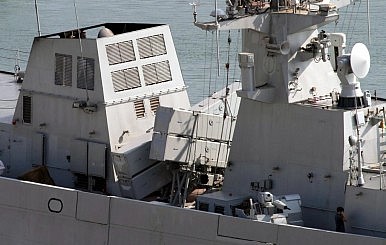
On May 6, China commissioned its fourth anti-submarine warfare (ASW) optimized Type 056 Jiangdao-class corvette, the Huangshi. The Huangshi will join the People’s Liberation Army Navy’s (PLAN) North Sea Fleet as the most advanced PLAN ASW corvette. Since November 2014, China has commissioned two other Jiangdao-class ASW variants, including the Sanmenxia on November 13, 2014 for the East Sea Fleet and Zhuzhou on November 28, 2014 for the South Sea Fleet. The Diplomat reported on the inaugural Type 056 variant last November.

The 1,500-tonne displacement corvettes mark an important step in the PLAN’s ASW capabilities, an area that several analysts have noted as a weakness for China. The ASW variant Jiangdao-class ships feature four YJ-83 anti-ship missiles for surface warfare, and two triple-tube torpedo launchers, according to a report by IHS Jane’s Navy International. Additionally, the corvette’s flight deck allows for the operation of a single Z-9C helicopter (though limited maintenance facilities constrain the length and complexity of any helicopter operations).

What differentiates the ASW variants from the the 17 Jiangdao-class frigates that precede them is the inclusion of a towed array and variable depth sonar system. The inclusion of these systems indicates a focus on anti-submarine operations. China begin inaugurating its Type 056 Corvettes in 2012, and is building variants of the corvette for export. Early customers include Bangladesh, Thailand, and Nigeria.

As analysts, including The Diplomat‘s Robert Farley, have noted, anti-submarine warfare shot up the list of priorities for the PLAN over the last 24 months. In fact, one of the main tells of the PLAN’s “blue water” ambition is seen in its bid to bolster its ASW capabilities — coastal navies generally invest less into ASW capabilities compared to their expeditionary counterparts, who may find themselves on far-flung missions facing variable threats, including submarines. China’s focus on anti-access/area-denial systems was primarily intended to secure an asymmetric advantage for the PLA over a foe with greater conventional offensive strength (such as the United States).

With its new ASW focus, the PLAN is gearing up to offset threats from non-nuclear attack submarines in the East and South China Seas. Southeast Asia, for example, is currently undergoing what some have called a “proliferation” phase where submarine fleets are growing across the board. Vietnam, a claimant state to the Spratly Islands, is in the process of incorporating Russian diesel-electric improved Kilo-class submarines into its navy, posing a potential threat to China (see: “Vietnam’s China Challenge: Making Asymmetric Deterrence Work“). Submarines are seen as a worthwhile investment for smaller states fearing the prospect of a more assertive Chinese navy and coast guard. In reckoning with a South China Sea that is growing increasingly crowded with Chinese grey- and white-hull vessels, submarines are a stealthy and capable option.

Beyond the Type 056 ASW variant, China’s ASW capabilities are limited to its Y-8 maritime patrol aircraft and underwater acoustic sensors. The latter are primarily restricted to coastal use (though China’s South China Sea construction spree could lead to an expansion of its acoustic sensors into the Spratlys and Paracels, improving its anti-submarine capabilities).

* Article publicat a The Diplomat. La producció en sèrie les corbetes 056A demostren que la Xina és plenament conscient del seu put feble: les capacitats anti-submarines. La US Navy faria bé de plantejar-se d'una vegada per totes tornar a disposar de naus de propulsió convencional, però amb sistemes AIP, si no vol tenir sorpreses desagradables. 


dimecres, 6 de maig del 2015

Nato partners start anti-submarine warfare exercise off Norwegian coast*

Naval forces from approximately ten Nato allies and Sweden have commenced a large-scale anti-submarine warfare exercise off the coast of Norway.
Code-named Dynamic Mongoose, the annual exercise involves four submarines from Germany, Norway, Sweden and the US, alongside 13 surface ships from Canada, France, Germany, the Netherlands, Norway, Poland, Spain, Turkey, as well as the UK and the US.
In addition, two research vessels, one Norwegian and one Nato-owned, are participating in the exercise, which focuses on detecting and defending against submarines.
The drill aims to provide all participants with complex and challenging warfare training to enhance their interoperability and proficiency in anti-submarine warfare and anti-surface warfare skills.
During the two-week exercise, the participating vessels will conduct a variety of anti-submarine warfare operations, ranging from warships against submarine scenarios, submarine against submarine scenarios and aircraft against submarines scenarios.
The submarines will take turns trying to approach and target the ships undetected, simulating an attack.
"It will allow us to exercise our anti-submarine warfare capabilities in a complex and challenging environment."
Standing Nato Maritime Group Two (SNMG2) commander rear admiral Brad Williamson said: "Exercise Dynamic Mongoose is a great training opportunity for SNMG2 ships that will allow us to further integrate with other Nato forces to enhance our interoperability and ability to effectively respond to potential submarine threats to our Nato allies.
"It will allow us to exercise our anti-submarine warfare capabilities in a complex and challenging environment."
Norwegian fleet commander commodore Ole Morten Sandquist said: "The presence of Nato in Norwegian waters will enhance interoperability and will allow Nato to familiarise with Norwegian waters."
As the host nation, Norway is providing support from the Haakonsvern Naval Base and the Sola Air Base, located near Bergen, while France and Germany have also deployed maritime patrol aircraft for the exercise.
Exercise Dynamic Mongoose 2015 is scheduled to conclude on 14 May.

*Notícia publicada a Naval Technology. Sembla que les sorpreses de la darrera tardor han fet que Suècia s'incorpori als exercicis ASW de l'OTAN. Sigui com sigui, a uns i altres els hi interessa no oblidar aquesta tasca cabdal de la guerra naval.


dissabte, 2 de maig del 2015

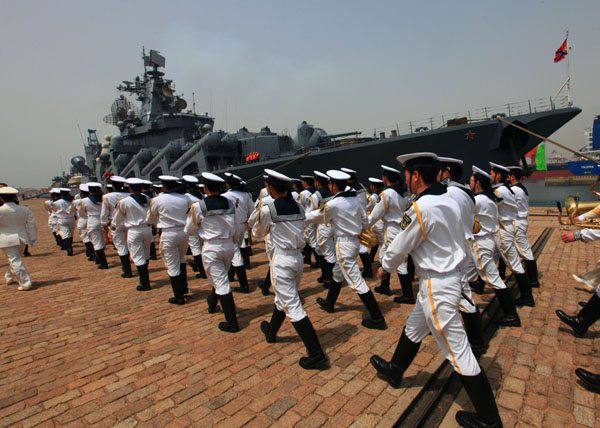
Chinese and Russian Navies to Conduct First Ever Mediterranean Surface Exercises in May

Joint Sea 2015-I will be the first time the two navies have trained in the Mediterranean and is a sign of deepening military-to-military cooperation between Russia and China.

“The purpose of the exercise is to strengthen the pragmatic cooperation between China and Russia and to improve the capabilities of the two navies to deal with maritime threats,” said ministry spokesman Senior Colonel Geng Yansheng on Thursday.
“What needs to be stressed is that, the joint exercise is not targeting any third party and not related to the regional situation.”

The exercises were announced in November following a meeting between Russian Defense Minister Sergei Shoigu and Chinese Defense Minister Chang Wanquan in Beijing.

Following the meeting, Shoigu said U.S. rebalance to the Pacific was a primary concern of both countries.
“We believe that the main goal of pooling our effort is to shape a collective regional security system,” according to the Russian TASS news agency.
“We also expressed concern over U.S. attempts to strengthen its military and political clout in the [Asia-Pacific Region].”

China plans to send the Type 54A Jiangkai II frigates Linyi, Weifang and fleet oiler Weishanhu —currently performing merchant convoy duty off of the Gulf of Aden — to the exercise, Geng said.

It’s unclear what assets Russia will send.

“The drilling items in the exercise include maritime defense, maritime replenishment, escort actions, joint operations to safeguard navigation security as well as real weapon firing drill,” he said.

In addition to the Mediterranean exercise, China and Russia committed to a Pacific exercise later in 2015.

Since the forced annexation of Crimea and a souring relationship with the West, Russia has flexed its surface muscle more in the last year sending more ships further afield than it has in decades — including sending the guided missile cruiser Moscow (or Moskva) to conduct live fire drills in the South China Sea.

Likewise, China continues to venture beyond its regional waters conducting anti-piracy missions near Somalia and drilling with the Iranian Navy.

China and Russia began a regular exercise schedule in 2012 and have since drilled in the Yellow Sea and the East China Sea.

* Notícia publicada al US Naval Institute. Com us avançavem fa uns mesos, els exercicis conjunts de Rússia i la Xina a la Mediterrància tiren endavant. Una recordatori més que els buits estratègics, sempre acaben omplint-se.