|
|
|||
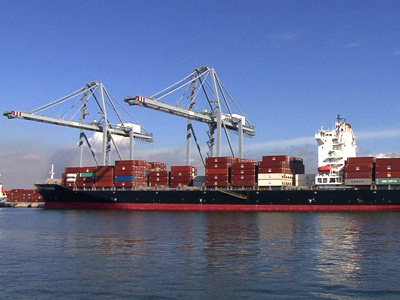 | El passat dijous 10 de novembre el Port va rebre el vaixell de contenidors TARRAGONA de la naviliera ZIM. Podeu veure la vídeo-notícia aquí. |
diumenge, 11 de desembre del 2011
Presentació del nou vaixell ZIM Tarragona (Vídeo)

dissabte, 10 de desembre del 2011

By Mass Communication Specialist 2nd Class William T. Jenkins, USS Essex (LHD 2) Public Affairs SASEBO, Japan (NNS) -- The
forward-deployed amphibious assault ship USS Essex (LHD 2) returned to
Sasebo, Japan Dec. 8 after completing a two-and-a-half month patrol of
the Western Pacific.
Throughout the patrol, Essex Sailors along with the embarked Marines of
the 31st Marine Expeditionary Unit (MEU) participated in two exercises
and steamed more than 13,000 nautical miles.
One of the exercises was a certification exercise (CERTEX) for the 31st
MEU, which tested the Marines ability to project power ashore from
Essex. This exercise, which concluded Oct. 16, validated the MEU's
capability to perform a variety of tasks and to integrate with the Navy
to conduct amphibious operations.
Essex also completed an Amphibious Landing Exercise (PHIBLEX) with the
31st MEU and the Armed Forces of the Philippines (AFP). PHIBLEX is a
bilateral training exercise conducted at sea and ashore in the Republic
of the Philippines, which is designed to improve interoperability,
increase readiness and build professional and personal relationships
between U.S. forces and the AFP.
"The Essex team performed very well during our deployment," said Capt.
David Fluker, Essex commanding officer. "We were able to accomplish all
of our assigned missions, which included working with the 31st MEU to
earn their certification and taking part in the bilateral exercise
PHIBLEX with the Republic of the Philippines. I am very proud of the
crew's performance in accomplishing both exercises."
After PHIBLEX concluded Oct. 30, Sailors, Marines and their equipment and vehicles were back loaded aboard Essex.
The ship and its crew then steamed to the coast of Bali, Indonesia in
support of a presidential visit and to conduct training with the
Indonesian military. While anchored off the coast of Bali, the
Amphibious Squadron 11 Commodore, Capt. Bradley Lee and the Essex
commanding officer hosted an evening reception on the flight deck for
Indonesian and U.S. dignitaries. Additionally, Essex Sailors and
Marines had the chance to experience liberty in Bali during a four-day
port visit.
After Essex departed Bali, the ship steamed to Manila, Republic of the
Philippines for a three-day liberty port visit. For some of the crew,
this was an opportunity for them to visit family who live in the
Philippines. Also during the port visit, Essex Sailors finished the
final series of graded damage control drills to complete its unit level
training assessment certification.
The deployment also marked the first time many Essex Sailors were
underway with the ship. Many took advantage of their time at sea by
earning qualifications.
"This was my first time underway," said Operations Specialist Seaman
Recruit Brinton Irons. "I was able to get all my basic shipboard
qualifications."
More than 280 Sailors earned either their enlisted surface warfare or
enlisted aviation warfare qualification during the deployment.
Fluker said the hard work of the crew and the integration of many units led to a successful deployment.
"The crew came together in true Essex fashion to perform the mission,
whether it was supporting the MEU, executing complex shipboard
evolutions, or supporting theater security cooperation efforts," said
Fluker. "I could not be prouder of the professionalism and dedication of
our Sailors and Marines."
For more news from USS Essex (LHD 2), visit www.navy.mil/local/lhd2/.
* Notícia publicada al lloc web de la US Navy. Creiem indicat reproduür-la donat el poc coneixement que hi ha, en general, de les forces amfíbies dels Estats Units, sovint eclipsades pels imponents portaavions.
|
dijous, 8 de desembre del 2011
Newer Isn't Always Better Enough*

December 4, 2011: Russia has begun construction of its second
"Improved Kilo" class diesel-electric submarine. These are mostly for
the export market, although the Russian Navy is buying a few more of
this improved model as well. The Kilos weigh 2,300 tons (surface
displacement), have six torpedo tubes and a crew of 57. They are quiet,
and can travel about 700 kilometers under water at a quiet speed of
about five kilometers an hour. Kilos carry 18 torpedoes or SS-N-27
anti-ship missiles (with a range of 300 kilometers and launched
underwater from the torpedo tubes.) The combination of quietness and
cruise missiles makes Kilo very dangerous to American carriers. But for
the Russians, their Kilos are mostly for home defense. Nuclear subs are
used for the long distance work. The successor to the Kilo, the Lada,
underwent three years of sea trials before they were declared fit for
service two years ago. One has been built and another is under
construction and eight are planned. The problem with the Lada is that it
is not enough of an improvement on the latest Kilo to attract any
export orders.
The Kilo class boats entered service in the early 1980s.
Russia only bought 24 of them, but exported over 30. It was considered a
successful design, especially with export customers. But just before
the Cold War ended in 1991, the Soviet Navy began work on the Lada. This
project was stalled during most of the 1990s by a lack of money, but
was revived in the last decade.
The Ladas have six 533mm torpedo tubes, with 18 torpedoes
and/or missiles carried. The Lada has a surface displacement of 1,750
tons, are 71 meters (220 feet) long and carry a crew of 38. Each
crewmember has their own cabin (very small for the junior crew, but
still, a big morale boost). When submerged, the submarine can cruise at a
top speed of about 39 kilometers an hour (half that on the surface) and
can dive to about 250 meters (800 feet). The Lada can stay at sea for
as long as 50 days, and the sub can travel as much as 10,000 kilometers
using its diesel engine (underwater, via the snorkel). Submerged, using
battery power alone, the Lada can travel about 450 kilometers. There is
also an electronic periscope (which goes to the surface via a cable),
that includes a night vision capability and a laser range finder. The
Lada was designed to accept a AIP (air independent propulsion) system.
Russia was long a pioneer in AIP design, but in the last decade, Western
European nations have taken the lead. Construction on the first Lada
began in 1997, but money shortages delayed work for years. The first
Lada boat was finally completed in 2005. A less complex version, called
the Amur, is being offered for export.
The Ladas are designed to be fast attack and scouting boats.
They are intended for anti-surface and anti-submarine operations as
well as naval reconnaissance. These boats are said to be eight times
quieter than the Kilos. This was accomplished by using anechoic (sound
absorbing) tile coatings on the exterior, and a very quiet (skewed)
propeller. All interior machinery was designed with silence in mind. The
sensors include active and passive sonars, including towed passive
sonar.
Russia has 17 Kilos in service (and six in reserve) and six
Improved Kilos on order. More than that is on order from foreign
customers, and efforts to sell the Lada continue.
* Notícia publicada a Strategy Page. Creiem convenient anar seguint l'evolució dels dissenys submarins russos, especialment en el cas dels de propulsió convencional ( dièsel / elèctric), doncs són els que tenen més opcions d'exportació.
dimecres, 7 de desembre del 2011

En motiu del 70è aniversari de l'atac a Pearl Harbor, Blau Naval us recomana visitar el lloc web que ha habilitat la US Navy. Malgrat que les relacions entre els Estats Units i Japó estiguin plenament restablertes, no hi ha cap motiu per no commemorar un data tant trascendental. Podriem allargar-nos en aquest tema, però preferim recomanar-vos que visiteu la pàgina.
Subscriure's a:
Missatges (Atom)