dissabte, 24 de gener del 2015

The US Navy’s New Surface Warfare Strategy: ‘Distributed Lethality’*

By Franz-Stefan Gady
January 16, 2015

The United States Navy plans to re-organize and re-equip its surface fleet by grouping ships into small surface action groups and increasing the number of anti-ship weapons on more platforms. The U.S. Navy calls this tactical shift “distributed lethality.”

Breaking Defense quotes, Rear Admiral Peter Fanta and his rough summary of the concept of “distributed lethality”: “If it floats, it fights, that’s ‘distributed lethality’ (…) Make every cruiser, destroyer, amphib, LCS, a thorn in somebody else’s side.” Fanta, the director for Surface Warfare on the Navy staff, spoke at the annual Surface Navy Association National Symposium, which took place in Arlington, Virginia this week.

Vice Admiral Thomas Rowden, commander of Naval Surface Forces, further elaborated on the tactical shift at the symposium, as military.com reports: “We’re going to up-gun as many existing platforms as we can to achieve more total lethality.” Speakers at the symposium noted that the Navy will overhaul ships in service with low-cost weapon and sensor upgrades including Aegis destroyers, cruisers, supply ships, and littoral combat ships. However, more details on the specifics of this reshuffle will only emerge when the president’s 2016 budget request comes out next month.

In 2014, the U.S. Navy had to endure politically motivated budget cuts and a hiring freeze delaying retrofits and maintenance of Navy vessels. This trend will likely continue in 2015. “Budget is coming down,” Fanta emphasized. This should be placed in perspective: In 2014, the U.S. Navy deployed tonnage equal to that of the sixteen next-largest navies combined.

The tactical “distributed lethality” shift is largely due to the increasing anti-access/area denial capabilities of the armed forces of China and Iran but also Russia. In an article in Proceedings Magazine, published by the U.S. Naval Institute, Vice Admiral Rowden, Rear Admiral Fanta, and Rear Admiral Peter Gumataotao, outlined the reasons behind the re-organization of the surface fleet by arguing that, “the shift to the offensive responds to the development of increasingly capable A2/AD weapons and sensors designed specifically to deny U.S. naval forces the freedom of maneuver necessary to project power.(…) Adversaries who counter this advantage diminish the deterrent value of forward-deployed forces and negatively impact the assurances we provide to friends and allies. A shift to the offensive is necessary to ‘spread the playing field,’ providing a more complex targeting problem while creating more favorable conditions to project power where required.”

As of now, the U.S. Navy still lacks an adequate long-range, anti-surface weapon to implement a re-organization of the surface fleet based on the “distributed lethality” idea. One possible future acquisition could be the Norwegian Kongsberg Naval Strike Missile, yet no decisions on the procurement of new weapon systems has been made as of now. The authors of the Proceeding Magazine article also outline additional requirements for their vision, such as improved intelligence/surveillance/reconnaissance and data relay, low-cost medium range strike weapons, and new railguns.

This new tactical reorganization is a clear indication that the days when the U.S. Navy’s surface fleet just served as air defense elements for carrier strike groups, floating bastions for ballistic missile defense, and strike platforms for land attacks are over. It remains to be seen how the Chinese and Russian navies will respond to the shift.

* Article publicat a The Diplomat. Recomanem la lectura d'aquest article, i dels seus enllaços, doncs la US Navy fa temps que necessita redistrubuïr la seva potència de foc. Per descomptat, cal alliberar destructors i creurers de les tasques de "pantalla" als CSG, però es l'exessiva concentració de la potència de foc en un determinat tipus de naus, genera vulnerabilitats.


dijous, 15 de gener del 2015

SNMG2 Arrives in Barcelona for a Port Visit*

BARCELONA, Spain – Standing NATO Maritime Group 2 (SNMG2) ships arrived in Barcelona today for a port visit and to prepare to join forces with France’s Charles de Gaulle Carrier Strike Group for a short period of combined exercises.

SNMG2 leadership will meet with local Allied authorities to discuss items of mutual benefit. Additionally, the groups’ crew members will enjoy a friendly basketball game with a local police force, and explore the city and surrounding areas.

“This visit is an excellent opportunity to engage with our Allies here in Spain, both on a professional and personal level,” said Commander, SNMG2, Rear Admiral Brad Williamson. “We also look forward to our exercises with the French Navy following this visit.”

Upon departure from Barcelona, SNMG2 will operate in conjunction with Task Force (TF) 473, France’s Charles de Gaulle Carrier Strike Group. TF 473 and SNMG2 will conduct a series of exercises formulated to improve cohesion among NATO maritime forces. SNMG2 will then accompany TF 473 as it sails in the Mediterranean en route to support national tasking.

“We will be doing normal underway operations together such as replenishment at sea, coordinated anti-submarine exercises, and air-defence exercises,” said Lt. Grahame Flint, SNMG2 Staff Anti-submarine Warfare officer. “Operating with Allied forces is always a great learning experience and can make a positive impact on how well we can work together in the future on large scale exercises and operations”

SNMG2 is currently comprised of flagship USS Vicksburg (CG 69), Turkish ship TCG Turgutreis (F 241), and Canadian ship HMCS Fredericton (FFH 337) and is deployed in the Mediterranean serving as NATO’s maritime force dedicated to maintaining peace and stability in the region.

For more information about SNMG2, visit "standing NATO Maritime Group 2" on Facebook.


*Notícia publicada al NATO Maritime Command. Considerem una bona notícia el retorn progressiu de vaixells de guerra als ports catalans, tot un símptoma de normalitat.

divendres, 2 de gener del 2015

The Anglo-Japanese Alliance and the Return of the Catalan Navy: British and Japanese Soft Power in the Mediterranean*

The same week in which the Royal Navy held the naming ceremony for the first of its new carriers, HMS Queen Elizabeth, and in which Tokyo approved a reinterpretation of Article 9 of her Constitution to provide for a measure of collective self-defence, was witness to a little-reported but still significant fact which, by stressing both nations' naval soft power, serves as a reminder of the potential for a renewed Anglo-Japanese alliance as an engine of peace and stability all over the world, including the Mediterranean: a draft blueprint for the return of the Catalan Navy, (lost, together with all other state institutions, by force of arms in 1714) outlining its potential initial shape and capabilities, refers to the Maritime Self-Defence Forces (MSDF) when defining “escort duties”, while recommending Catalonia reach an agreement with the United Kingdom whereby the Royal Navy would help train a first generation of naval officers.
 

The adoption of Japanese doctrinal and operational concepts by a Western Navy is a testament of the growing prowess of the MSDF and its prestige in an increasingly wider range of areas. While Japan has not engaged in combat operations since the end of the Second World War, her naval forces have deployed a significant amount of advanced assets, trained intensively, participated in joint drills and cooperated with fellow navies in counter-piracy and anti-terrorism operations, and been responsible (together with the country's Coast Guard) for checking hostile advances into Japanese territorial waters and EEZ. Furthermore, recent years have seen Tokyo help train and equip coastguards in South-East Asia, as a necessary complement to Japan's drive to promote the rule of law at sea and the peaceful resolution of territorial conflicts. Faced with revisionist threats, both Hanoi and Manila have turned their gaze towards Tokyo. Thus, it should not be surprising to see Japanese influence in the blueprint for a new or rather re-born navy. Rather, it is a small but significant gesture confirming that, despite the mistrust still pervading relations with Beijing and Seoul, a growing number of countries not only recognize the technical abilities of the Self-Defense Forces (SDF) but also see Tokyo as an international actor having much to contribute to global peace and security. Of course, Japan's main strategic focus is, and due to the difficult circumstances in the area will remain in the foreseeable future, the Indian-Pacific Ocean Region, limiting the degree of attention devoted to the Mediterranean. However, this should be no bar to regular exchanges with the reconstituted Catalan Navy, in addition to multinational cooperation arising from, for example, participation in RIMPAC exercises. The 100 anniversary of the Great War, in which the Imperial Japanese Navy played a vital role in the Mediterranean, provides the ideal historical background. In addition, the recent relaxation by Japan of her long-standing ban on weapons exports means that procurement and joint development and production are also areas where Catalonia and Japan may cooperate in the future, in a development facilitated by the already extensive presence of Japanese enterprises in Catalonia.[1] Last, but not least, mentions of the MSDF in Catalonia's unofficial white paper should serve as a reminder, and evidence, that despite the rumblings of many pundits in Japan and some other countries, a clear majority of maritime democracies see Tokyo's move towards collective self-defence as right, both in moral and in practical national security terms. 

Concerning the Royal Navy, seeing her cooperate with the Catalan Navy would be nothing new, but rather a resumption of a process cut short by the outcome of the War of Spanish Succession. After all, it was a combined Anglo-Dutch-Catalan force which took Gibraltar in 1704. It is precisely the Rock which provides one of the best reasons why it is in the British national interest to help train the Catalan Navy, since the stronger and more proficient Catalan naval forces are, the more secure Gibraltar will be.[2] In an uncertain world, you need allies near any potential hot spot. Actually, Japan's reasons to help train and equip the Filipino and the Vietnamese coastguards are very similar to London's rationale for contributing to the re-emergence of the Catalan Navy. As made clear by Japanese Prime Minister Shinzo Abe in the debates leading to Tokyo's adoption of a limited version of collective self-defence, nowadays no country can ignore others in preparing to safeguard the security and well-being of its citizens. In case there is any doubt, the 1982 Falklands War should serve as a reminder of the absolute necessity of being able to rely on regional Allies in order to effectively project power. Thus, even if we leave history and shared values (including parliamentary democracy and the rule of law, Catalonia's and England's being the two oldest parliaments in Europe) out of the equation, national security considerations in and by themselves should suffice for London to take a keen interest in the re-emergence of the Catalan Navy. 

To conclude, it is no coincidence that in laying down plans to recover her navy, Catalonia refers to Great Britain and Japan, two island democracies that once stood side by side to defence peace and stability and the rule of law at sea and that today are increasingly working together with these same purposes in mind. Both the Royal Navy and the MSDF have much to teach, and their experience and traditions are invaluable, while London, Tokyo, and Barcelona, share a commitment to parliamentary democracy, the rule of law at sea, and the peaceful resolution of territorial disputes in accordance with International Law. Furthermore, it is in the national interest of any country to help fellow (and in particular nearby) maritime democracies develop their naval and coastguard capabilities, above all when revisionist actors threaten to use force to redraw borders, in contravention of international law. As clear from the Falklands War, regional allies are essential, a lesson not lost on Japan, which has come to the aid of Vietnam and the Philippines in their hour of need, in a move contributing to her own national security. Now the time has come for the Royal Navy help train the Catalan Navy out of the same considerations, with Japan's MSDF ideally also lending a hand.

Alex Calvo is an expert on security and defence in Asia 

[1] In the early 1980s, when many European countries were hostile to foreign direct investment (FDI), British Prime Minister Margaret Thatcher and her Catalan counterpart Jordi Pujol were the only ones actively seeking Japanese FDI, in a move later imitated by many. 
[2] For an outline of some of the harassment endured by the Rock in recent years, see the report by the House of Commons' Foreign Affairs Committee.

* Article publicat a Help Catalonia. Compartim aquest article del professor Àlex Calvo. Reflexions interessants per no oblidar que recuperar la sobirania implica consciència geopolítica i, no cal dir-ho, responsabilitat.

Colors dels Llúria, que s'adoptaren com els de la Marina Catalana

dimarts, 23 de desembre del 2014

SEIZING THE ASUW INITIATIVE WITH LAND BASED PATROL AIRCRAFT*

By Michael Glynn

Recent months have found uniformed officers and naval strategists writing and speaking about regaining the ability of U.S. Navy (USN) ships to conduct offensive anti-surface warfare (ASuW). The discussion has been lively and featured many authors and many different approaches. Some solutions are incremental, such as fielding more capable long-range weapons in existing launch systems.[i] Others are more radical, such as trading large long-range missile defense interceptors for small point defense missiles and building a new generation of multi-role cruise missiles.[ii]


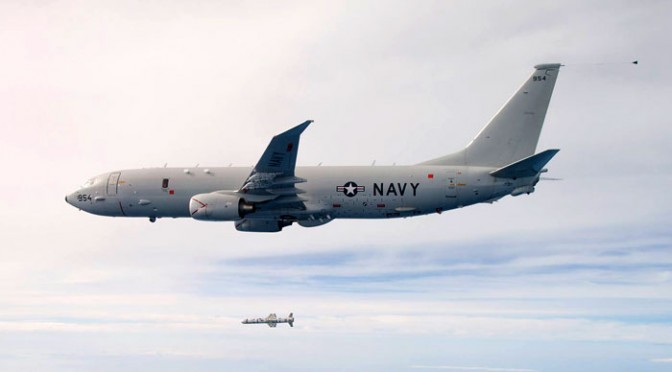
Missing from the discussion of future acquisitions and new weapons is how the USN can leverage existing land-based airpower to seize the offensive in ASuW. The P-8 Poseidon maritime patrol aircraft is deployed today, with the range, persistence, sensors, and network architecture to serve as a self-contained “kill chain.” It is able to disperse and operate in an expeditionary environment during peacetime or contingency operations. If equipped with more suitable long-range anti-ship weapons, this aircraft will provide greatly increased capability for the combatant commander. This will allow more flexibility for USN forces to operate in an A2/AD environment when a carrier is not nearby or in the interim until more capable surface-based ASuW weapons are fielded.


Framing the Challenge

During the last three decades, the USN has divested its surface forces of offensive anti-ship firepower as operations shifted to littoral environments with permissive threat profiles. With the retirement of the Tomahawk Anti-Ship Missile, the service has been left without a weapon that can engage targets at a range beyond that of threat anti-ship cruise missiles (ASCM’s).[iii] Our ships now go to sea armed only with the sub-sonic, medium range Harpoon missile. The removal of Harpoon from Flight IIA DDG-51’s after DDG-79 and proposed cuts to funding for cruisers have exacerbated this glaring deficiency.[iv] The onus for conducting maritime strike has shifted from our surface ships to the aircraft of the Carrier Strike Group (CSG).

As the reach and number of U.S. ASCM’s have decreased, threat systems have proliferated and improved in range, speed and sophistication. China, Russia, and India all possess advanced supersonic long-range ASCM’s. Foreign militaries are equipping themselves not only with the weapons needed to strike, but also the C4ISR capabilities needed to detect and accurately target adversary forces.[v]

Commanders, legislators, and the defense industry have responded with a variety of initiatives, including the development of an Offensive Anti-Surface Weapon (OASuW.) This program is aimed at fielding an advanced cruise missile with sufficient range to allow USN ships to employ outside the reach of threat weapons systems. OASuW Increment 1 will begin fielding the Lockheed Martin Long Range Anti-Ship Missile (LRASM) in FY17 for carriage on the F/A-18 Super Hornet and USAF B-1 bombers. OASuW Increment 2 will provide for integration of a long-range anti-surface capability onboard surface ships.[vi] By equipping the F/A-18 and B-1 with the ability to carry LRASM, the Department of Defense has signaled that regardless of eventual integration of OASuW onboard surface ships, carrier and land-based airpower will remain a key component of the U.S. anti-surface strategy.

Missing from this conversation on OASuW capabilities is the USN’s Maritime Patrol and Reconnaissance (MPR) force. The MPR community is recapitalizing with the P-8 Poseidon aircraft. The sensors, datalink capabilities, and expeditionary nature of this aircraft make it a natural choice to augment the lack of anti-surface punch. The P-8 and RQ-4C UAS are envisioned to play targeting roles in long-range ASuW engagements, so arming P-8 with upgraded weapons is a logical next step. The Poseidon can allow the fleet to seize the initiative in anti-surface employment, especially in situations where the threat makes the reality of deploying the CSG forward politically unpalatable or disadvantageous.

The Solution

The P-8 Poseidon is derived from the Boeing 737 aircraft. It features long-range, high transit speed, solid persistence, and will soon incorporate the ability to perform air-to-air refueling. The open architecture mission systems are easily reconfigurable and allow for rapid improvement of sensor and weapon capabilities. The P-8 features a Mobile Tactical Operations Center (MTOC), which aids in processing data collected during and after mission flights. The MTOC is fully expeditionary, allowing an MPR detachment to quickly relocate in peacetime or disperse away from main operating airfields and continue to fight in wartime.

The ability to disperse is especially critical in an A2/AD environment. The proliferation of theater ballistic missiles (TBM’s) and cruise missiles has allowed previously weak nations to hold an opponent’s forward bases at risk. By deploying aircraft to auxiliary fields away from large military installations, adversary commanders are faced with a much more challenging targeting problem. The increased cost of building more TBM’s may be daunting to a particular military, and the uncertainty of being able to destroy forward forces is a stabilizing influence. P-8’s ability to deploy to medium sized airfields and sustain itself during combat operations is a force multiplier.

P-8 will also carry the Raytheon Advanced Aerial Sensor (AAS) to provide standoff detection and targeting of maritime and land targets. Descended from the highly-classified APS-149 Littoral Surveillance Radar System, AAS will provide Poseidon crews with the ability to detect, classify, and provide targeting solutions of threats even in highly congested littoral areas.[vii] In A2/AD environments with highly advanced surface to air missile systems, this ability to accurately detect threats from long-range and provide targeting updates to net-enabled weapons isn’t just beneficial, it’s critical.[viii]A MPR squadron equipped with AAS and appropriate weapons becomes its own self-contained targeting and strike force.

In short, P-8 offers a weapons platform that is uniquely suited to maritime strikes. Its crews are far more familiar with operating in the ASuW role than USAF bomber crews and culturally more pre-disposed to emphasize this mission set. The ability to act as an armed sensor platform allows the Poseidon to close the kill-chain itself. P-8 armed with suitable standoff weapons has the ability to detect and attrite adversary surface ships, preserving the ability for our surface forces to deploy forward in wartime, and decreasing the need for our carriers to surge forward into extremely high-risk areas to eliminate surface threats with the air wing. This provides increased flexibility to the combatant commander.

Needed Changes

The MPR force has the potential to act as a powerful ASuW strike force, however this capability can grow stronger with upgrades and training. P-8 should be equipped with an OASuW capability, ideally allowing it to carry the LRASM rounds that will enter production in FY17. The largest roadblock will not be carriage capability or weapons system engineering, rather finding the funding to provide integration and testing for this weapon onboard P-8.

The P-8 currently carries the Harpoon Block IC, which is insufficient for high-end ASuW. The Block IC is not net-enabled, meaning it cannot receive in-flight updates from targeting platforms via a datalink. This makes the weapon less flexible and precise in congested environments. The aircraft is slated to receive the Harpoon Block II, which is net-enabled, but is still constrained by its short range.[ix] This lack of reach prevents it from engaging high-end air defense warships without putting the P-8 and its crew at serious risk.

It is best to utilize the synergy that exists in MPR squadrons and equip these aircraft with both the sensors and the weapons required for standoff targeting and strike. Since AAS equipped P-8’s may be required to provide targeting support to OASuW in a complex surface environment, equipping the targeting aircraft with weapons is the logical next step to close the kill chain. Once P-8 is equipped with LRASM, crews must be required to train frequently with AAS equipped targeting aircraft and LRASM equipped shooter aircraft against representative threat pictures. Maritime targeting is a very dynamic and challenging game, and requires practice to execute properly.[x]

Summary

Equipping the MPR force with a long-range strike capability will capitalize on existing sensors, platforms, and aircrew skills. The ability to call on an existing force structure with incremental upgrades provides a solution to a glaring deficiency in the Navy’s ASuW capabilities. The ability to task highly mobile aircraft rather than SSN’s or carriers to provide ASuW firepower provides a commander with increased options and flexibility. This can reduce risk while raising the enemy’s uncertainty about U.S. operational intentions.

American patrol crews gained fame during World War II for their nighttime raids on Japanese shipping. Operating alone and independent of the carrier they provided a critical force to weaken enemy logistics capability and to disrupt sea lines of control. It is fitting that almost three quarters of a century later we consider the role of our current MPR force. The P-8 can add to our ASuW capability if we make the decision now to properly equip it and provide training to aircrews.

Lieutenant Michael Glynn is an active-duty naval aviator and graduate of the University of Pennsylvania. He most recently served as a P-8 instructor pilot and mission commander with Patrol Squadron (VP) 16. He currently serves as an instructor flying the T-45 with the ‘Fighting Redhawks’ of Training Squadron (VT) 21. The views expressed in this article are entirely his own.

[i] Robert Crumplar and Peter Morrison, “Beware the Anti-Ship Cruise Missile,” U.S. Naval Institute Proceedings, vol. 140, no. 1 (January 2014), http://www.usni.org/magazines/proceedings/2014-01/beware-antiship-cruise-missile.

[ii] Bryan Clark, Commanding the Seas: A Plan to Reinvigorate U.S. Navy Surface Warfare, (Washington, D.C.: Center for Strategic and Budgetary Assessments, 2014), http://www.csbaonline.org/wp-content/uploads/2014/11/A-Plan-To-Reinvigorate-US-Navy-Surface-Warfare.pdf.

[iii] Charlie Williams, “Increasing Lethality in Anti-Surface Warfare (ASuW),” Center for International Maritime Security, May 31, 2014,http://cimsec.org/increasing-lethality-anti-surface-warfare-asuw-minor-less-minor-course-corrections/11478.

[iv] “LRASM Missiles: Reaching for a Long-Range Punch,” Defense Industry Daily, October 15, 2014, http://www.defenseindustrydaily.com/lrasm-missiles-reaching-for-a-long-reach-punch-06752/.

[v] Congressional Research Service, China Naval Modernization: Implications for U.S. Navy Capabilities – Background and Issues for Congress, by Ronald O’Rourke, (Washington, D.C., 2014), 34.

[vi] LRASM Missiles, Defense Industry Daily.

[vii] Bill Sweetman, “Navy Moves Forward On Advanced Airborne Radar,” Aviation Week, June 18, 2012, http://aviationweek.com/awin/navy-moves-forward-advanced-airborne-radar.

[viii] Bill Sweetman, Christina Mackenzie, and Andy Nativi, “Net Enabled Weapons Drive Sea Warfare Change,” Aviation Week & Space Technology, September 3, 2012, http://aviationweek.com/awin/net-enabled-weapons-drive-sea-warfare-change.

[ix] Richard R. Burgess, “A ‘Year of Transition’ for the P-8A Poseidon,”Seapower, April 9, 2013, http://seapowermagazine.org/sas/stories/20130409-p-8a.html.

[x] Maksim Y. Tokarev, “Kamikazes: The Soviet Legacy,” Naval War College Review, vol. 67, no. 1, (Winter 2014), 61-84. It should be noted that Soviet Tu-95RT “Bear-D” reconnaissance and targeting aircraft were equipped with Uspekh-1 “Big Bulge” maritime search and targeting radar. This system did not feature Inverse Synthetic Aperture Radar (ISAR) capabilities for standoff imaging and identification. The P-8 AAS system and APY-10 search radar both feature ISAR capabilities, simplifying long-range identification challenges. Modern employment scenarios would find ISR aircraft much better able to identify a contact once it had been located and would not be as chaotic as the Soviet experience that Tokarev describes. Maritime targeting still remains an arena that is inherently dynamic and therefore requires proper training to execute reliably and efficiently.

* Article publicat al CIMSEC. Recomanem una lectura reflexiva d'aquest article per la importància que poden tenir els P-8 en la funció ASuW. En un moment en que la major part dels destructors i creuers de la Navy estan lligats a tasques de protecció d'unitats d'alt valor estratègic, els P-8 podrien complementar el buit que queda en operacions contra unitats de superfície. No obstant, mentre se'n analitzin les possibilitats i s'incorporin a l'entrenament i a la doctrina de la US Navy, no podem esperar que aquesta tecnologia per si sola sigui una veritable solució.