By Claude Berube, Stephanie Chenault, Louis M-v, Chris Rawley
Although the Saudi-led Operation RESOLUTE STORM (alternately translated as DECISIVE STORM) began with air strikes into Yemen on March 26 and continue as of this writing, the heightened level of regional activity also includes maritime operations. These national and multi-national operations highlight the importance of naval platforms and presence. Yemen is strategically located with the heavily-trafficked Red Sea to its west and the Gulf of Aden along its southern coast. Some twenty thousand ships transit the Gulf of Aden annually. Yemen’s ports have been largely closed to commercial traffic.
Evacuation of Citizens
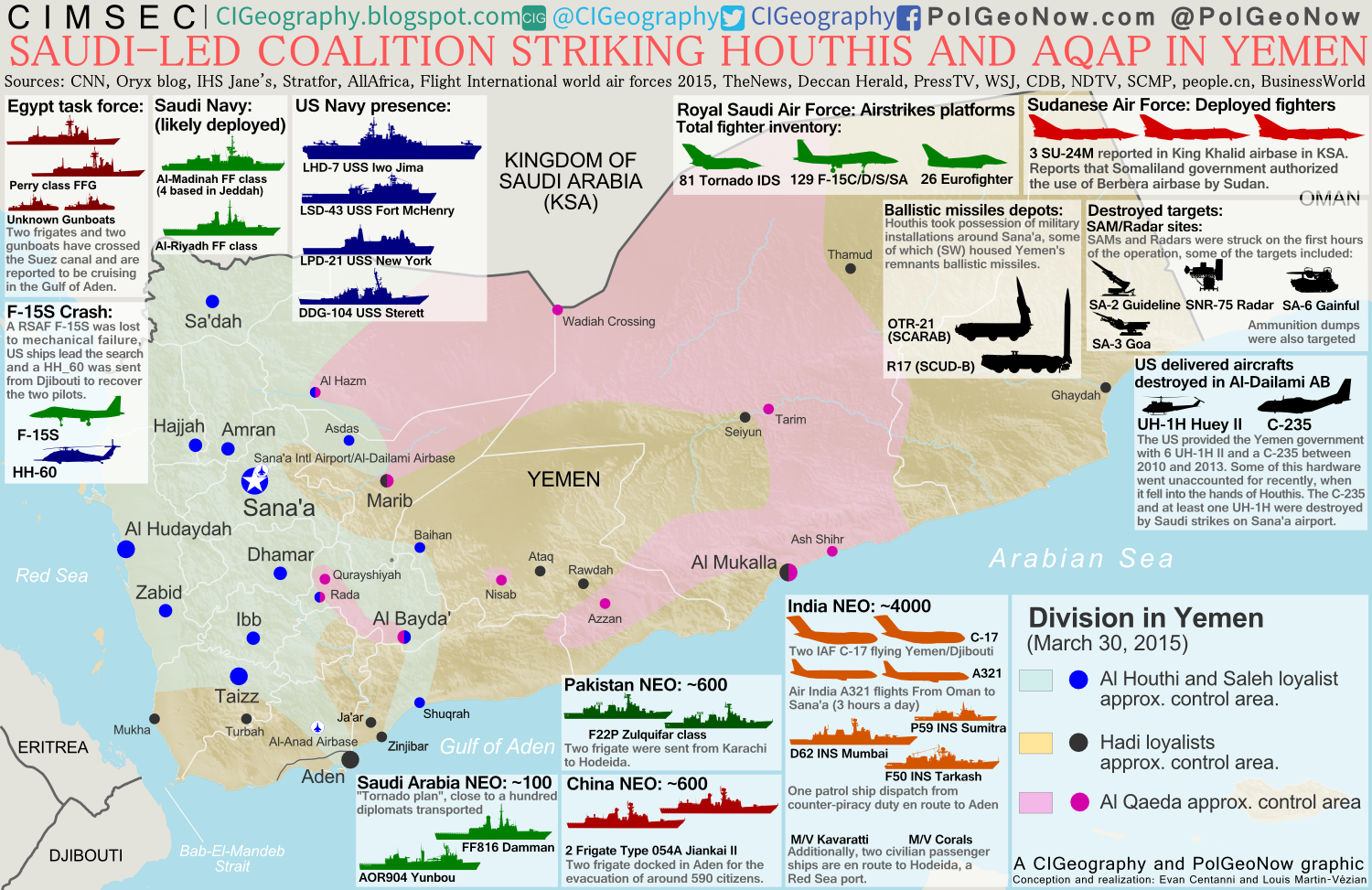
Earlier this year, the US and other nations began pulling out of embassies and recommending their citizens leave Yemen at the earliest opportunity. Once RESOLUTE STORM began, airspace was restricted with limited flights out of the country. Consequently, several countries have been evacuating its citizens via comparatively safer ports such as Aden in the Gulf of Aden and Hodeida situated along the Red Sea. One Pakistan Navy ship got underway from Pakistan on Sunday while a second planned to depart the following day, both for the port of Hodeida where some 600 Pakistani citizenswere converging.
India sent five ships to evacuate approximately four thousand nationals from Hodeida. The passenger ships include the M/V Kavaratti and M/V Corals. The Indian Navy ships include the Delhi-class destroyer Mumbai, the Talwar-class frigate Tarkash, and the Saryu-class patrol vessel Sumitra.
China also interrupted the duties of its 19th anti-piracy flotilla off the Horn of Africa to evacuate citizens from Yemen. The PLA/N frigate Weifang was sent to Yemen and evacuated 449 Chinese citizens and others. Evacuations had taken place at both Aden and Hodeida. Chinese citizens were then taken to Djibouti.
Saudi Arabia’s “Tornado Plan” was employed to transport diplomats in Yemen. The ships included the Al-Riyadh (Lafayette)-class Al-Damman, and a modified Durance-class replenishment ship Yunbou
Maritime Security
Several countries have some concern about the Bab el-Mandeb Strait, approximately 18-20 miles wide at its narrowest point“limiting tanker traffic to two 2-mile-wide channels for inbound and outbound shipments.” According to the U.S. Energy Information Administration, approximately 3.8 million barrels of crude oil and petroleum products transited the Bab el-Mandeb every day in 2013. Although the Iranian-backed Houthis leading the insurgency in Yemen have announced that they would not seek to impact transitthrough the strait, the more likely threat would be from Al Qaeda in the Arabian Peninsula (AQAP). In 2013, for example, the Yemeni government reportedly disrupted one AQAP plot to attack ships in the Bab el-Mandeb.
According to Reuters, four ships from the Egyptian Navy transited the Suez Canal to secure the region on the first day of the air strikes.
Search and Rescue
The Flight IIA Arleigh Burke-class destroyer USS Sterrett (DDG 104)rescued two Saudi Arabian airmen from the Gulf of Aden after their two-seater F-15 fighter jet crashed on the first day of the air strikes.
Naval Gunfire Support
According to one source, Egyptian warships began shelling Houthis outside Aden on March 30. The Egyptian flotilla includes the U.S. produced Perry-class frigate Alexandria (F911), whose 76 mm OTO-Melara gun can bombard surface targets out to 16 km away.
Analysts’ Assessment
While the majority of Operation RESOLUTE STORM activities have been air strikes with the possibility of a future ground conflict, the domestic instability in Yemen and on-going military operations underscore the importance of naval platforms, presence, and the varied operations that can be conducted by navies. Naval activity in the region by regional and international actors can be expected to continue for the foreseeable future. Possible future naval missions could include patrols designed to prevent Iran’s resupply of Houthi forces from the sea. Previous attempts by the Iranians to smuggle modern weapons to Houthi forces, such as the Jeehan 1 in January 2013, were foiled by Yemeni government forces. It is doubtful such naval capability still exists in non-Houthi Yemeni elements so multi-national forces will need to take on the maritime interdiction role.
The operations also highlight the PLA/N’s increasing capability. China began sending anti-piracy flotillas off the Horn of Africa in 2008 at the height of Somali pirate activity. To date, the PLA/N has sent nineteen flotillas, each comprised of two warships and one supply ship. These uninterrupted operations have enabled the Chinese to become familiar with long-term operations, logistics, and the importance of presence. Without the PLA/N’s experience in the region, it is unknown how or if it could have extracted its citizens from Yemen in a timely fashion.
A new op-ed in a Chinese newspaper on March 30 points out that“China has evacuated hundreds of its nationals from war-torn Yemen by Monday, in demonstrating responsibility and humanistic care toward its citizens. In the era of globalization, coupled with China’s increasing presence in the world, more Chinese nationals are living and working overseas.” Another online commenter on China’s Sina Weibo stated:“The strength of the motherland is not about the visa-free agreements with other countries, but that it could bring you home from danger.” Put simply: The Navy protects you.
One might ask, given budget priorities, have Americans and Europeans forgotten this?
Claude Berube is a history instructor at the U.S. Naval Academy and author.
Stephanie Chenault is the Chief Operating Officer of Venio Inc. and a Policy & Strategy Consultant for the Department of Defense.
Louis Martin-Vézian is the co-president of the French chapter at CIMSEC.org, and the founder of CIGeography, where he post his maps and infographics on various security and defense topics. He is currently studying Geography and Political Science in Lyon, France.
Chris Rawley is an entrepreneur and reserve naval officer.
* Notícia publicada al CIMSEC. Compartim aquest article doncs resulta aclaridor sobre els moviments al Iemen.

