Es mostren els missatges amb l'etiqueta de comentaris guardacostes. Mostrar tots els missatges

divendres, 5 de desembre del 2014

Coast Guard Admiral: LCS ‘an Incredible Ship’ for Drug Interdiction*

By RICHARD R. BURGESS, Managing Editor

WASHINGTON — The Coast Guard’s deputy commandant for operations has high praise for the littoral combat ship (LCS) as a platform for intercepting drug-running boats.

“What an incredible ship … tailor-made for that mission set,” said VADM Charles D. Michel, speaking of the LCS Dec. 4 to an audience at the Defense Forum, an event sponsored by the U.S. Naval Institute.

The LCS has performed drug interdiction operations in the Caribbean Sea area in support of Joint Inter-Agency Task Force South (JIATF-South), the drug-interdiction headquarters in Key West, Fla. The LCSs supported the task force during transits to their new homeport, San Diego, by way of the Panama Canal.

The high speed of the LCS plus its helicopter capability and now Fire Scout unmanned aerial vehicle capability make it suitable for running down the go-fast boats favored by drug runners.

Michel, a previous director of JIATF-South, said that a shortage of surface vessels was the main challenge in the drug interdiction effort in the Caribbean area. The over-tasked Coast Guard cutters have been augmented for decades by the Navy’s Perry-class frigates, but they are being retired at a rapid rate, with the last ones scheduled for decommissioning in fiscal 2015.

Navy RADM Kevin M. Donegan, acting deputy chief of naval operations for operations, plans and strategy, also speaking at the forum, said the Navy is looking realistically at other platforms for drug interdiction as the frigates are decommissioned, including joint high-speed vessels, coastal patrol ships and other platforms.

“The high-end assets are not going to get placed down there, given the other things that are going on in the world,” Donegan said, speaking of the cruisers and destroyers in high demand for other missions. “There is not an easy answer and there is not going to be an instantaneous fix for that issue.”

The Navy plans to base 10 Freedom-class LCSs at Naval Station Mayport, Fla., some of which could succeed the frigates in the drug interdiction role.

“When times get tough on ships down there, we just get more innovative,” Michel said, naming combatting smuggling networks as the main line of effort.

“It’s all about network identification and attack strategy,” he said. “It’s all about using whole-of-government intelligence to make the assets that we have down there as smart as possible. My goal when I was JIATF-South director was that every turn of a propeller on a ship or a plane down there should be done with specific intent.

“We still do some patrolling in the areas but [we’ve] got to really get inside those networks,” he said, “and there some very sophisticated ways that we do it, working with the intelligence community partners as well as our law enforcement partners. Probably 95 percent of the products removed down there are based on intelligence and different intelligence techniques.

“Last year, JIATF-South facilitated upwards of 100 metric tons of cocaine that was removed off the water before it could get into Central America or into cities in the United States,” he said.

Michel said that 60 percent of the cocaine “removed from planet Earth” was intercepted by the Coast Guard and Navy ships.

* Notícia publicada a Sea Power. Més enllà de la part de propaganda institucional, és bó veure que els LCS encaixin en algun tipus de missió. Si el Departament de Marina dels Estats Units aconsegueix allunyar les grapes dels contractistes de defensa, amb la seva afició a incrementar preus injustificadament, els LCS poden tenir un bon futur.


divendres, 17 d’octubre del 2014

Coast Guards in the Arctic – Troubles Ahead?*

Coast guards are the maritime workhorses of coastal states, intent on protecting their sovereign rights to fisheries and petroleum resources, while also safeguarding lives and the environment. In an Arctic Klondike, this institution – which often operates in the shadow of national navies – does the heavy lifting. Yet, striking the right balance on fleet structure, investments, and Arctic presence in times of budget austerity is no easy task for Arctic coastal states.

Waking up to a New Reality
Maritime activity levels in the Arctic are increasing, compared to low levels throughout the 1990s and early 2000s. It is not the number of trans-arctic voyages, but the number of ships with a destination in the Arctic itself that has predominately increased. This comes as a result of an increase in the transport of goods to and from the Arctic, and from an increase in cruise ship tourism offering “Arctic Cruises” [1]. Similarly, exploratory drilling in Greenlandic, Alaskan or North Norwegian waters, and record yielding fish stocks in the Barents Sea and North Sea, contribute to this trend [2].


Coast Guard Prerogatives
As activity increases, the need for an active management of the maritime domain increases as well. When fisheries grow in volume, so does the need for fisheries inspections and research to determine the sustainable yield of the stocks. When more vessels operate further north, search and rescue incidents grow in numbers, and as the number of exploratory drillings rises, the potential for accidents related to oil exploration similarly increases. The pressure on coast guards to provide aid to navigation is also increasing, sometimes demanding an ice breaking capacity that requires relatively costly investments in icebreakers [3]. Consequently, this large relative growth in activity spurs demand for a number of coast guard tasks in the Arctic, as depicted below.
The coast guard institutional structure in one Arctic state is very different from the next, ranging from a civilian model without a law enforcing mandate (Canada), to military structures separated from (USA, Russia), or part of (Norway, Denmark), national navies [4]. Yet, as the amount of tasks in northern waters increases, all of the various Arctic coast guards find themselves in a similar position, weighing priorities and resources [5]. In particular, they encounter challenges concerning budget restraints, aging equipment and large areas of operation.


Solving problems together?
Investments in coast guards, on the other hand, in particular in the North American side of the Arctic, are pending. This is mainly a consequence of limited public investments in an area where the return rate of such investments – at least in according to strict economic calculations – can be questioned. In the context of low temperatures and remote operating areas, however, the consequences of a cruise ship accident or an oil spill is likely to become more fatal in the Arctic, than in more densely populated areas further south.
In 2011, Arctic states responded to this challenge by creating a legally binding search and rescue agreement under the auspices of the Arctic Council, dividing the Arctic into areas of responsibility (see map) [6]. In 2013, another agreement was signed on oil pollution, preparedness and response, implementing the same mechanisms for oil spill response [7]. Forming alliances and initiating collaboration across borders with partners in similar situations provides a practical solution to a fiscal challenge. It is also an easier and less expensive remedy than building up domestic assets in isolation.
However, agreeing on zones of responsibility does not inherently enhance maritime capabilities in the Arctic, which ultimately fall under the prerogatives of the various national coast guards. Operational collaboration across borders is also not necessarily an adequate response to new maritime challenges in the Arctic. The share distance between the Arctic maritime zones and the differences in coast guard structures provide barriers to effective collaboration. Additionally, coast guard tasks are often closely linked to the protection of sovereign rights and enforcing national law. Such tasks are not easily transferred or outsourced.

Planning for the future
Working across Arctic maritime borders with your neighbor is undoubtedly beneficial, if not crucial, to jointly manage natural resources and protect the environment. The establishment of an Arctic Coast Guard Forum – building off the already well-functioning North Atlantic Coast Guard Forum – is one such measure.  
Such collaboration will not, however, disband the need for national and local investments in future Arctic capabilities. The processes of coast guard procurement and capacity building are additionally costly and lengthy. Showcasing this challenge, the US Coast Guard has been calling out for more investment in District 17 (Alaska) for almost a decade, while in Canada the acquisition of a much-needed new Coast Guard icebreaker is delayed [8].

Littoral states in the Arctic have to carefully contemplate future investments and needs to avoid finding themselves in a situation where the former and the latter do not match. Arriving in 2030 in a direr state than today will be detrimental to any Arctic development. Preventing disaster is of interest to all littoral states as they determine the future potential of their Arctic maritime areas.


Sources:
[1] Steinicke, S., & Albrecht, S. (2012). Search and Rescue in the Arctic Working Paper (Vol. 2012/05). Berlin: Stiftung Wissenschaft und Politik. & Brigham, L. W. (2013). The Fast-Changing Maritime Arctic. In B. S. e. Zellen (Ed.), The fast-changing Arctic: rethinking Arctic security for a warmer world (pp. 1-17). Calgary: Calgary Unversity Press.
[2] Fred Olsen Cruise Lines. (2014). Greenland & Arctic Cruises. Retrieved June 5, 2014, from http://www.fredolsencruises.com/places-we-visit/region/arctic-greenland-cruises & Østhagen, A. (2013a). Arctic oil and gas. The role of regions. In IFS (Ed.), (Vol. September 2). Oslo: Norwegian Institute for Defence Studies (IFS).
[3] Brigham, L. W. (2013). The Fast-Changing Maritime Arctic. In B. S. e. Zellen (Ed.), The fast-changing Arctic: rethinking Arctic security for a warmer world (pp. 1-17). Calgary: Calgary Unversity Press. & Mitchell, J. R. (2013). The Canadian Coast Guard in Perspective: A paper prepared for Action Canada (Vol. August). Ottawa: Action Canada.
[4] Andreas Østhagen (2014). "Coast Guard Collaboration in the Arctic: Canada and Greenland (Denmark)", Toronto: Munk-Gordon Arctic Security Program.
[5] Terjesen, B., Kristiansen, T., & Gjelsten, R. (2010). Sjøforsvaret i krig og fred: Langs kysten og på havet gjennom 200 år. Bergen: Fagbokforlaget.
[7] Arctic Council. Agreement on cooperation on marine oil pollution, preparedness and response in the Arctic Final - Formatted version. http://www.arctic-council.org/index.php/en/document-archive/category/425-main-documents-from-kiruna-ministerial-meeting
[8] http://www.adn.com/article/20140916/us-icebreaker-fleet-will-need-makeover-about-2020-coast-guard-says & Byers, M. (2012, March 27). You can’t replace real icebreakers, The Globe and Mail. Retrieved from http://byers.typepad.com/arctic/2012/03/you-cant-replace-real-icebreakers.html

* Article publicat per The Artic Institute. No és el primer cop que parlem de guardacostes i l'Àrtic. Recomanem una lectura reflexiva d'aquest article així com les seves fonts documentals.

dimecres, 7 de maig del 2014

Austal launches third patrol boat for Australia’s border force*

Austal has launched the Cape Nelson, the third of eight cape-class patrol boats (CCPB) intended for the Australian Customs and Border Protection Service (ACBPS).

The Cape Nelson's launch, held at the company's Henderson facility in Western Australia, marked its first lowering in water, and paves the way for full completion and sea trials. The final delivery to the ACBPS is expected in the third quarter of this year.
Austal president and general manager Graham Backhouse said the vessel will play a vital role in protecting Australia's borders from multiple maritime threats.
"It has been designed to have greater range, endurance and flexibility, as well as enhanced capability to operate in more severe sea conditions and across [a] longer range than the current fleet of Customs and Border Protection vessels and indeed [the] Royal Australian Navy Armidale patrol boat fleet," Backhouse said.
Powered by two Caterpillar 3516C main engines, the 58m-long patrol boat also integrates two ZF 9055A gearboxes and two fixed pitch propellers, in addition to a HRP 2001 TT 160kW bow thruster that boosts manoeuvrability. It has a maximum speed of 25k and 4,000nm range at 12k.
"The vessel will play a vital role in protecting Australia's borders from multiple maritime threats."
Designed for their role in maritime law enforcement, the Cape-class patrol boats can also undertake 28-day patrols, combat the full range of maritime security threats and ferry a larger crew.
Furthermore, these boats can also launch two tender-response vessels simultaneously, as well as detect, track and intercept an extended range of threats in the maritime domain and collect intelligence and store data.
Accommodating a crew of 18, CCBS also incorporate two electronic chart display and information systems (ECDIS), a pair of gyro compasses, two differential global positioning systems (DGPS), a secure marine-automatic identification system (AIS-S), an electro-optical sensor system (EOSS) and radars and voyage data recorder (VDR).

*Notícia publicada a Naval Technology. Continua la renovació de la flota de patrulleres australianes. Aquest país, cal recordar-ho, té una enorme línia de costa despoblada que ha de cobrir constantment davant les diverses amenaces a la seva seguretat provinents del nord.

dimarts, 30 de juliol del 2013

No, China’s Coast Guard Won’t Reduce Tensions *

The China Coast Guard officially took to the seas last week, to considerable fanfare.An international conference on marine safety descended on Beijing to mark the event. The organizer of the gathering, former deputy assistant secretary of state Susan Shirk, hailed the debut of a unified coast guard as a "positive development." Why? "It's good for China's neighbors and the United States," she opined, "because we know who is responsible and who we can hold responsible." Shirk predicted that the China Coast Guard will pattern itself on its American and Japanese counterparts. As Chinese coast guardsmen "develop a sense of professionalism in accordance with international law," furthermore, "it should make for lower risk of accidents."Well … maybe. An influential Western verdict on China's misconduct at places like Scarborough Shoal or the Senkaku Islands faults skippers for overstepping their authority, whether through an excess of zeal, unclear bureaucratic lines of authority, or situations that fall outside their service's narrow purview. Unifying the hodgepodge of agencies that once policed Chinese-claimed waters — China Marine Surveillance, the fisheries police, and so forth — under one high command should assure that the China Coast Guard executes its duties uniformly, and in keeping with national law and decrees from the political leadership. If not, as Shirk notes, outsiders will at least know where to affix blame.And sure, streamlining and simplifying the bureaucratic wiring diagrams may make some difference — at the margins. Cutting down on accidents that might escalate into something nasty can't be a bad thing. But bear two things in mind. One, even if we stipulate that the controversies agitating the China seas got their start through ship crews' mistakes, Beijing deliberately chose to double down on those mistakes. Just ask Manila, which has effectively lost jurisdiction over an atoll deep within its exclusive economic zone. Or ask Tokyo, whose own coast guard has been run ragged by Chinese enforcement ships — and now, it bears noting, is being run ragged by the four China Coast Guard vessels that took station off the Senkakus around the time Susan Shirk was uttering her hopeful words. These prolonged struggles are no accidents; they reflect conscious political choices made in Beijing.And two, let's not take too much comfort in the idea that the fledgling coast guard will conduct itself according to Chinese domestic law, let alone international law. The Chinese Communist leadership transcribed its island claims into domestic law in 1992, enacting itsLaw on the Territorial Sea and Contiguous Zone. That's the law the coast guard will uphold. Chinese officialdom, moreover, insists in effect that the claims codified by the famous "nine-dashed line" and other such artifacts predate, and thus supersede, the UN Convention on the Law of the Sea and other newfangled treaties and accords — never mind China's assent to those agreements. Again, this provides scant comfort.With admirable frankness — you've gotta like a stand-up guy — military researcher Zhang Junshe states in the PLA Daily that the new agency's purpose is to "show the international community that China has undisputable jurisdiction over the waters." Zhang, of course, is repeating the standard line that China holds "indisputable sovereignty" over all sea areas and geographic features it claims. And sovereignty means a monopoly of force if it means anything. The coast guard will help impose that monopoly.So in reality, the advent of the China Coast Guard furnishes little cause for cheer among Asian sea powers. In all likelihood, as my friend Arthur Ding of Taiwan's National Chengchi University observes, the new agency will step up enforcement actions. If so, it will generate new frictions rather than smooth them out. It will prosecute Beijing's territorial claims more efficiently and effectively than the previous, motley crew of maritime enforcement services ever could. But hey, at least we'll know whom to hold responsible!Sci-fi master Robert Heinlein had a thumb rule for life: never attribute to malice that which can be adequately explained by stupidity, but don't rule out malice. Creating the China Coast Guard helps rule out bureaucratic stupidity as an explanation for Chinese behavior at sea. Which leaves … hmm.

* Notícia publicada a The Naval Diplomat. Continua l'increment de les tensions entre la Xina i els seus veïns.

dilluns, 1 d’abril del 2013

U.S. Coast Guard meets Corbett*

Reporters say the nicest things. One called the office on Tuesday to talk about the U.S. Coast Guard in the Arctic Ocean
. This person confessed that the idea of entrusting polar waters primarily to the Coast Guard, rather than the U.S. Navy, seems really "out there." Groovy!
But naval historians might disagree. Over the centuries, seafaring states have experimented with many different ways of applying force at sea. Best known as a sea-power theorist, Sir Julian Corbett also authored an excellent series on Sir Francis Drake and the English navy under the Tudor dynasty. Corbett points out that armed merchantmen once fought off pirates — insert obligatory "aaargh, matey"here — and even joined the battle line when war loomed on the high seas.
Ships festooned with guns and missiles can accomplish a lot, whether their hulls are slathered in haze gray, or in white accented with blue and red stripes. Why not let the U.S. Coast Guard spearhead maritime strategy in offshore waters where it will already be performing police and disaster-response duty? The force on scene is the obvious one to manage events there, provided it's up to the task. Let's not needlessly duplicate resources and effort.
Or put a theoretical gloss on this question. The U.S. Navy, Marines, and Coast Guard now operate under a triservice Maritime Strategy. The 2007 Cooperative Strategy for 21st Century Seapower
 directs the services to work together, and with foreign allies and partners, to prosecute both combat and noncombat — that is, coast-guard-like — missions. It erects no firewall between the services or their functions. This merger of maritime forces is an extension of longstanding policy holding that that the Navy and Coast Guard comprise a joint National Fleet.
If so, how do national fleets transact business? Corbett divides any navy roughly into two fleets: the battle fleet that duels enemies for command of the sea, and the "cruiser" contingent and "flotilla" that exercise command once enemies have been subdued. The latter are light, inexpensive, and thus numerous combatants and auxiliaries, unfit for slugging it out with capital ships but capable of handling lesser threats. Such craft fan out to safeguard the sea lanes and do the host of things navies do.
If this second fleet runs into trouble, it can summon the battle fleet to come steaming to its rescue, restoring control in the face of new challenges. Indeed, Corbett depicts protecting the cruiser force and flotilla as the battle fleet's chief purpose in life. This is rather like the Navy-Coast Guard division of labor I've bruited about. The Coast Guard would assume the role of cruisers and flotilla while the Navy and Marines supply the backstop. The Coast Guard just needs enough warfighting capability to execute limited combat missions until the cavalry arrives.
That's not a far-out concept; it's classic maritime strategy. Corbett is smiling.

* Notícia publicada a The Naval Diplomat. En temps de crisi cal deixar-se de corporativismes i actuar racionalment. La Guàrdia Costanera nordamericanac pot complir moltes funcions, tot reservant la Marina per les més dures, i cares...

dissabte, 23 de març del 2013

America’s AirSea Battle, Arctic Style*

Call them American strategy's Odd Couple. Working together, the U.S. Coast Guard and Air Force could be the best defenders of U.S. policy in the Arctic Ocean, a theater that will expand and contract each year and where threats will — cross your fingers — remain modest in scope. Light combat forces patrolling the sea under the protective umbrella of land-based fighter cover may well be enough to manage events in northern waters. Ergo, it's worth thinking ahead about the material and human adaptations necessary to help such an Odd Couple fight together.
Think about it. One partner is an aviation force, the other a sea service. One operates under Pentagon jurisdiction, the other under the Department of Homeland Security. One is a combat arm designed to break things and kill people
, the other a constabulary agency meant primarily to execute U.S. law in offshore waters and skies and render aid and comfort following natural disasters.
Getting unlike institutions to work together smoothly is invariably an arduous chore involving not just hardware fixes but cultural transformation. The officers who would superintend such an unconventional joint force are now entering the service. Acquainting them with the brave new world they may face seems only prudent — and will help instill the right habits of mind. Gradual generational change will equip the services to manage unfamiliar challenges.
You guessed it: ever faithless, the Naval Diplomat has been stepping out again
. This time, I hold forth on maritime strategy for a fully navigable Arctic. This isn't a strategic question that demands an answer today, but it is an important one. A former U.S. Navy chief oceanographer, Rear Admiral David Titley, projects that the polar sea could be ice-free for a month each year by 2035. That's a mere tick of the clock in historical time.
If events bear out Titley's timetable, the Arctic promises to be a peculiar theater. Within its outer boundaries — traced by the coastlines of the five nations
 that front on polar waters, along with nautical entryways such as the Bering Strait — the ocean's size and shape will presumably fluctuate along with global temperatures. The ice will advance and retreat unevenly, and at varying rates, as the icecap thaws and refreezes. Thus the sea lines of communication may shift from year to year, if not within each summer. A combat theater that morphs from one thing into another and back again as time passes is a strange beast indeed. The Western Pacific may be a difficult zone of operations, but at least you know where geographic features are. The Arctic map may need to be continuously amended for shipping to safely transit the region.
Such quirks matter. The prospect of an ice-free polar ocean raises the possibility of geopolitical competition or conflict. Undersea resources such as oil and natural gas beckon. Russia leapt at the opportunity, for instance, by symbolically planting
 its flag on the ocean floor underneath the North Pole. Canada has been mulling over its own posture now that Russia will be a much closer maritime neighbor than before. The United States is belatedly getting into the act, along with Denmark and Norway. Staking claims to this new, old frontier under the law of the sea constitutes an obvious step. Economic development is Job One for any government worth its salt. In northern waters, as in warmer climates like the South China Sea, the chance to extract natural resources — and accelerate economic development — could propel nations into diplomatic feuds or even armed strife.

The Arctic could also become an arena for more traditional power politics.
 Geopolitical thinkers such as Halford Mackinder, Alfred Thayer Mahan, and Nicholas Spykman long debated the relative merits of land and sea power. They argued ceaselessly about whether a continental power whose seat was the Central Asian "Heartland," or sea powers operating around the East Asian, South Asian, and Western European "rimlands," held the upper hand in struggles for geopolitical supremacy. A navigable Arctic would open the northern rimland predictably for the first time, letting sea power impinge on Eurasia from northern points of the compass while enabling the Heartland power — Russia, roughly speaking — to radiate power and influence outward. Furthermore, seemingly inescapable dilemmas confronting Moscow — such as how to swiftly unify a fleet fragmented between coasts thousands of miles apart — would become soluble, at least intermittently, by exploiting northern routes.
The rhythmic character of a navigable Arctic Ocean makes it doubtful that Washington would deploy the U.S. Navy and Marine Corps as its primary weapon along the northern rampart. Surface forces could campaign for only a short time each year. The warfighting sea services, moreover, have bigger fish to fry in the Western Pacific
 and Indian Ocean, where the 2007 U.S. Maritime Strategy envisions staging preponderant combat power for the foreseeable future. Both services appear certain to shrink amid congressional budget-cutting, leaving them little to spare to mount a standing northern presence. They will have to concentrate where the demand is greatest rather than scattering across the globe.
The polar expanse is also unusual from Washington's standpoint because Arctic waters lap against North American shores. Territorial defense is something with which U.S. leaders seldom have to concern themselves. The U.S. military has played no home-court games since World War II, when land-based bombers hunted U-boats in the Atlantic in concert with U.S. Navy jeep carriers and convoy escorts. During U-boat skippers' "happy time"
 in 1942, German boats rampaged up and down the American eastern seaboard and into Caribbean and Gulf of Mexico waters. Navy units also dueled U-boats during the United States' brief but massive foray into World War I. The German High Seas Fleet posed at least a hypothetical threat to the Western Hemisphere around the turn of the century, but the Kaiser's and Admiral Tirpitz's imperial vision never really took shape. Though dire, these were fleeting menaces.
To find the last true threat to U.S. territory, in fact, you have to look all the way back to the War of 1812, when seaborne British expeditionary forces burned the White House and the Royal Navy throttled American commerce. Should the Arctic indeed open, U.S. leaders thus may find themselves compelled to relearn habits of strategic thought that have lain dormant for two centuries. Washington can turn the logic of anti-access and area denial to its advantage, harnessing land-based engines of war — combat aircraft, anti-ship cruise missiles, and so forth — as implements of sea power. But that's different from projecting power onto faraway coasts, and demands a different mindset.
Which could leave the U.S. Coast Guard — the chief steward of offshore maritime security, and the service with the most experience plying northern waters — occupying the forefront of U.S. Arctic strategy. Suitably augmented for combat missions, Coast Guard cutters could represent the vanguard of America's Arctic strategy. My recent
 article raises and ventures preliminary answers to such questions as: why are the Coast Guard and Navy different despite operating in the same, aquatic, medium? Why is strategy different for navies and coast guards? Who's the "enemy" for a coast guard, and why does that matter in practical terms? And how well equipped is the Coast Guard to hold the line during a hot war, until the Navy and Marines can rush heavy firepower to its rescue?
One nagging question lingers. The Coast Guard might have to rediscover its roots as an auxiliary combat force, commanding offshore waters for a time. But where would its air arm come from? The Coast Guard's modest inventory includes no combat aircraft. Nothing would keep enemy warplanes from walloping Coast Guard flotillas unless the Pentagon supplied tactical air power. And if you want air cover over waters adjoining American seacoasts, the U.S. Air Force would be an obvious partner to enlist. The Air Force has reinvented itself as an expeditionary service since the Cold War. Why not plan to configure anexpeditionary air wing
 for polar operations; temporarily stage that force in, say, Alaska during the warm months each year; and develop skills and doctrine that allow Air Force airmen to back up their brethren of the sea? Such a joint force could deter conflict or, failing that, supply some interim combat power until the heavy cavalry arrived on scene.
Coast Guard and Air Force capabilities might look like a strange alloy for a weapon of sea power. But it's worth experimenting with such mix-and-match force packages as American commanders contemplate a radically different maritime future. Call it AirSea Battle
, Arctic style!
James Holmes is professor of strategy at the U.S. Naval War College and coauthor of Red Star over the Pacific.

* Article publicat a The Naval Diplomat. El desgel de l'Àrtic genera un nou marc de confrontació pels recursos. Anem-hi pensant.

divendres, 1 de març del 2013

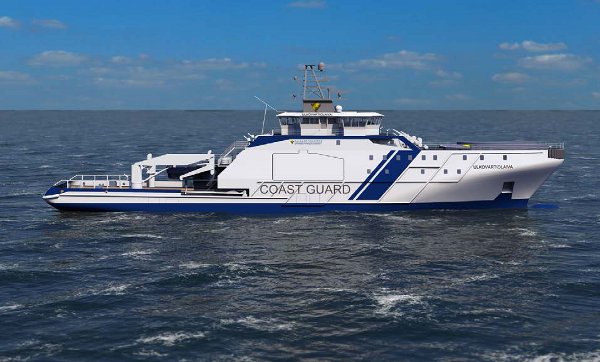
Construction starts on the Finnish Border Guard's new OPV*

Construction on the Finnish Border Guard's new offshore patrol vessel (OPV) has started with the keel laying at STX Finland Oy's Rauma Shipyard, as part of an agreement signed on 21 December 2011.
Built by STX Finland, the new OPV is expected to boost Finland's maritime search-and-rescue capabilities, especially during events that lead to multiple consequences.

The 96m-long and 17m-wide vessel, which has yet to be named, will feature advanced, environmentally friendly technologies to meet government requirements for decision-in-principle on sustainable public procurement.
STX Finland Oy's Rauma Shipyard director Toivo Ilvonen said: "Now it is time to begin the assembly of the ship's hull, and thus the ship will gradually find its final form by the end of July."
Scheduled for delivery in November 2013, the OPV will be powered by liquefied natural gas (LNG) and diesel, for energy efficiency and safe operations to suit individual accident situations."The new colour scheme of the vessel has been designed to provide support for our operations on the open sea, in an international operating environment."
Capable of supporting a variety of underwater assignments both independently and in collaboration with other authorities, the vessel will be used by the Finnish Border Guard to conduct border safety and frontier supervision missions, such as maritime search-and-rescue and military national defence.
In addition to damage control capacity to ensure reliability of operation at sea, the ship will feature emergency towing capabilities for enhanced protection of sea transport from damage.
Finnish Frontier Guard headquarters technical department navy chief captain Jukka Jaakkola said: "The new colour scheme of the vessel has also been designed to provide support for our operations on the open sea, in an international operating environment."
Cassidian has been awarded a contract to deliver and integrate its TRS-3D naval radar on board the new OPV by mid-2013. *

* Notícia publicada a Naval Technology. Finlàndia, un dels referents de Catalunya, continua mantenint i millorant una potent Guàrdia de Fronteres i unes Forces Armades realment dissuasòries. Prenguem-ne nota.