Es mostren els missatges amb l'etiqueta de comentaris corbetes. Mostrar tots els missatges

divendres, 31 de juliol del 2015

LCS Anti-Sub Warfare Package Too Heavy; 3 Contracts Issued For Weight Reduction Study*

The Littoral Combat Ship’s anti-submarine warfare mission package needs to shed some weight before it can deploy on a ship, and the Navy awarded three contracts to help find weight-reduction ideas.

The mission package includes two mature and fielded sonar systems, plus the hardware needed to integrate the systems with the ship. LCS Mission Module Program Manager Capt. Casey Moton said Thursday at a Mine Warfare Association lunch that each of his three mission modules is given 105 metric tons of weight on the LCS, but the ASW as it stands today surpasses that limit.

The mission package includes a Variable-Depth Sonar – the Navy chose the Thales UK Sonar 2087, the same VDS used on the Royal Navy’s Type 23 frigate – as well as the Multi-Function Towed Array used on the Arleigh Burke-class destroyers (DDG-51) and eventually the Zumwalt-class destroyers (DDG-1000). The Navy cannot overhaul either mature system, so it has hired Advanced Acoustic Concepts, L-3 Communications and Raytheon to find more creative ways to reduce weight.

In the early stages of the weight-reduction effort, “we got proposals that ranged from modifying the sensors to reduce weight to things as simple as using composites in the handling system,” Moton said.
“So our initial contract is to three companies, and they will do a transition study for us over the next couple months that will give us a lot more insight.”

Each team will submit a package that brings the mission module to under 105 metric tons, and the Navy will then pick and choose which ideas it likes and use them to build engineering development models. Moton said his office had not decided how many EDMs to build but would make that decision over the next few months.

He said he could not recall how many tons over weight the current ASW package is, but “all three companies proposed schemes that would get us to the weight” and he was confident he could meet the requirement to get onboard a ship.

Also during his speech, Moton said his office was making some minor adjustments to the Lockheed Martin AGM-114L Longbow Hellfire radar-guided missile, which the Navy is adapting for use on the ship. The missile currently launches horizontally from a helicopter, and the Navy is making modifications so it can launch vertically and lock on its target after tipping into a horizontal position post-launch. The new version of the missile will be called the Surface-to-Surface Missile Module and should be fully integrated and ready for deployment by late 2017, according to a Navy statement.

The program office began tests on a research vessel at the end of February against “high-speed maneuvering targets out off the Virginia Capes.” That testing wrapped up in June, and based on the results, the office has to do “some tweaking – it’s really that level, tweaking – to the missile seeker and such.”

Another round of testing on the research vessel will take place in Fiscal Year 2016.

Moton also said his office is currently conducting a technical evaluation of the surface warfare mission package on USS Coronado (LCS-4). The package has already deployed twice, but both times on Freedom-variant LCSs. Coronado is an Independence-variant ship, with the same interfaces for the mission package but a different physical layout. Moton said the evaluation is “going very well.”

* Notícia publicada al US Naval Institute. Sembla que el "think big" continua passant factura a les capacitats de combat de la US Navy. Segurament amb el sistemes modulars que tant bé han funcionat a la Reial Marina Danesa es podria millorar, però prèviament requeriria liquidar la plaga de buròcrates del Pentàgon i els comissionistes que el dessagnen.


dilluns, 18 de maig del 2015

With Fourth 'Submarine-Killer' Corvette, China Makes ASW Headway*

By Ankit Panda
May 17, 2015

On May 6, China commissioned its fourth anti-submarine warfare (ASW) optimized Type 056 Jiangdao-class corvette, the Huangshi. The Huangshi will join the People’s Liberation Army Navy’s (PLAN) North Sea Fleet as the most advanced PLAN ASW corvette. Since November 2014, China has commissioned two other Jiangdao-class ASW variants, including the Sanmenxia on November 13, 2014 for the East Sea Fleet and Zhuzhou on November 28, 2014 for the South Sea Fleet. The Diplomat reported on the inaugural Type 056 variant last November.

The 1,500-tonne displacement corvettes mark an important step in the PLAN’s ASW capabilities, an area that several analysts have noted as a weakness for China. The ASW variant Jiangdao-class ships feature four YJ-83 anti-ship missiles for surface warfare, and two triple-tube torpedo launchers, according to a report by IHS Jane’s Navy International. Additionally, the corvette’s flight deck allows for the operation of a single Z-9C helicopter (though limited maintenance facilities constrain the length and complexity of any helicopter operations).

What differentiates the ASW variants from the the 17 Jiangdao-class frigates that precede them is the inclusion of a towed array and variable depth sonar system. The inclusion of these systems indicates a focus on anti-submarine operations. China begin inaugurating its Type 056 Corvettes in 2012, and is building variants of the corvette for export. Early customers include Bangladesh, Thailand, and Nigeria.

As analysts, including The Diplomat‘s Robert Farley, have noted, anti-submarine warfare shot up the list of priorities for the PLAN over the last 24 months. In fact, one of the main tells of the PLAN’s “blue water” ambition is seen in its bid to bolster its ASW capabilities — coastal navies generally invest less into ASW capabilities compared to their expeditionary counterparts, who may find themselves on far-flung missions facing variable threats, including submarines. China’s focus on anti-access/area-denial systems was primarily intended to secure an asymmetric advantage for the PLA over a foe with greater conventional offensive strength (such as the United States).

With its new ASW focus, the PLAN is gearing up to offset threats from non-nuclear attack submarines in the East and South China Seas. Southeast Asia, for example, is currently undergoing what some have called a “proliferation” phase where submarine fleets are growing across the board. Vietnam, a claimant state to the Spratly Islands, is in the process of incorporating Russian diesel-electric improved Kilo-class submarines into its navy, posing a potential threat to China (see: “Vietnam’s China Challenge: Making Asymmetric Deterrence Work“). Submarines are seen as a worthwhile investment for smaller states fearing the prospect of a more assertive Chinese navy and coast guard. In reckoning with a South China Sea that is growing increasingly crowded with Chinese grey- and white-hull vessels, submarines are a stealthy and capable option.

Beyond the Type 056 ASW variant, China’s ASW capabilities are limited to its Y-8 maritime patrol aircraft and underwater acoustic sensors. The latter are primarily restricted to coastal use (though China’s South China Sea construction spree could lead to an expansion of its acoustic sensors into the Spratlys and Paracels, improving its anti-submarine capabilities).

* Article publicat a The Diplomat. La producció en sèrie les corbetes 056A demostren que la Xina és plenament conscient del seu put feble: les capacitats anti-submarines. La US Navy faria bé de plantejar-se d'una vegada per totes tornar a disposar de naus de propulsió convencional, però amb sistemes AIP, si no vol tenir sorpreses desagradables. 


dijous, 23 d’octubre del 2014

Visby Class, Sweden*


The Visby Class of stealth corvettes were built for the Swedish Navy by the Swedish company Kockums (a subsidiary of ThyssenKrupp Marine Systems of Germany).

Construction began in 1996 at Kockums' Kalrskrona yard. The lead ship of the class, Visby (K31), was launched in June 2000 and was delivered to the FMV (the Swedish Defence Materiel Administration) in June 2002 for fitting with weapons and combat systems. The second, HMS Helsingborg (K32), was launched in June 2003 and delivered in April 2006. Harnosand (K33) was launched in December 2004. HMS Visby and Harnosand were officially delivered to the FMV in June 2006.

The other hulls are: Nykoping (K34), launched in August 2005 and delivered in September 2006, and Karlstad (K35), launched in August 2006.

Two corvettes, HMS Helsingborg and Harnosand, were delivered to the Swedish Navy in December 2009. The Swedish Navy has cancelled an option on a sixth vessel (Uddevalla K36).

The first four Visby corvettes for the Swedish Navy are for mine countermeasures (MCM) and anti-submarine warfare (ASW). The last vessel will be primarily for the attack and anti-surface warfare role.

A helicopter, such as the AgustaWestland A109M selected by Sweden, can land, take off, and refuel on the upper deck.

Design

The design of the Visby aims to minimise the optical and infrared signature, above water acoustic and hydroacoustic signature, underwater electrical potential and magnetic signature, pressure signature, radar cross section and actively emitted signals.

A stealth corvette of the YS 2000 design has a detection range of 13km in rough seas and 22km in calm sea without jamming. In a jammed environment, the Visby would be detected at a range of 8km in rough sea and 11km in calm sea.

The hull material is a sandwich construction comprising a PVC core with a carbon fibre and vinyl laminate. The material provides high strength and rigidity, low weight, good shock resistance, low radar and magnetic signature.

Command and control
The vessel's CETRIS C3 (command, control and communications) system consists of the Saab Systems 9LV mk3E combat management system, the MAST decision support aid and the integrated communications system.

The 9LV mk3 is based on open system architecture and uses the Windows NT operating system.

The SaabTech CEROS 200 radar and optronic fire control system has been ordered for the Visby and will be fully integrated into the combat management system.

The communications system has a high-capacity digital communications switch, developed by Danish company Maersk Data Defence (formerly Infocom) together with Karlskrona, which interconnects the voice and data communications channels. The system provides internal communications or open conference lines and access to external communications with various radio links and land-based networks.

Missiles

Visby vessels were not initially fitted with an air defence missile system, but could later be equipped with one. It has been reported that the Swedish government has selected the Umkhonto surface-to-air missile system, produced by Denel of South Africa. Umkhonto has infrared guidance, range of 12km and ceiling of 10,000m. The system is capable of engaging up to eight targets.

The corvettes are equipped with eight Saab Bofors Dynamics RBS 15 mk2 anti-ship missiles. The RBS 15 mk2 uses active Ku-band radar homing and has a range of more than 200km. The missile has a high subsonic speed, Mach 0.9, and is armed with a 200kg warhead. The missiles will be installed below deck and be fired through special hatches to maintain the vessel's stealth. The missiles' exhaust plumes will be managed in separate canals.
Anti-submarine warfare

The Visby is equipped with a suite of ASW 127mm rocket-powered grenade launchers, depth charges and torpedoes. There are three fixed 400mm torpedo tubes for Saab Underwater Systems Tp 45 anti-submarine homing torpedoes.

Gun

The Visby is equipped with a Bofors 57mm 70 SAK mkIII general purpose gun. The gun has a fully automatic loading system containing 120 rounds of ready-to-fire ammunition. The gun fires up to 220 rounds a minute to a maximum range of 17,000m.
Mine countermeasures (MCM)

The Visby carries Saab Bofors Underwater system ROVs (remotely operated vehicles) for mine hunting and the Atlas Elektronik Seafox ROV for mine disposal. The minehunting ROVs are a development of the Double Eagle mkIII.

The Visby corvettes are fitted with the Hydra multisonar suite from General Dynamics Canada (formerly Computing Devices Canada), which integrates data from a Hydroscience Technologies passive towed array sonar, C-Tech CVDS-26 dual-frequency active Variable Depth Sonar (VDS), C-Tech CHMS-90 hull-mounted sonar and data from the ROVs.

Sensors

Saab Microwave Systems (formerly Ericsson) Sea Giraffe AMB 3D C-band multi-role radar provides air and surface surveillance and tracking and target indication to weapon systems. It features 3D agile multi-beam technology and can handle multiple threats up to 20,000m (65,000ft) at elevations up to 70°.

ECCM (electronic counter countermeasures) capabilities include ultra-low antenna sidelobes and both frequency and code agility. The antenna has a rotation rate of 30rpm for surveillance and 60rpm for air defence.

There is also an I-band surface search and I/J-band fire control radar.

Countermeasures

The CS-3701 tactical radar surveillance system (TRSS) from EDO Reconnaissance & Surveillance Systems provides electronic support measures (ESM) and radar warning receiver (RWR) functions.

Visby Class vessels are equipped with the MASS (multi-ammuntion softkill) decoy system from Rheinmetall Waffe Munition (formerly Buck Neue Technologien) of Germany.

MASS can launch up to 32 omni-spectral projectiles in a time-staggered configuration against anti-ship missiles and guided projectiles. The MASS decoy covers radar, infrared, electro-optic, laser and ultraviolet wavebands.

Propulsion

The Visby is equipped with a combined diesel and gas (CODAG) turbine arrangement. Four TF 50 A gas turbines from Honeywell and two MTU 16V 2000 N90 diesel motors are connected to two gearboxes which run two Kamewa waterjet propulsors.

The motors provide a maximum speed of 15kt for long duration and 35kt for short duration. The ship has rudders and bowthrusters for harbour manoeuvring.

* Article publicat a Naval Technology. Compartim aquest article per ampliar la informació, sobre les corbetes Visby, molt vistes els darrers dies als nostres mitjans, i de les quals se'n comença a parlar a casa nostra per la futura Força Naval Catalana.


diumenge, 19 de gener del 2014

Russian Missile Corvettes Ready to Enter Service in Caspian*


MOSCOW, January 13 (RIA Novosti) – A pair of new missile corvettes have completed acceptance trials and will enter service in Russia’s Caspian Flotilla in the first quarter of this year, the Southern Military District said Monday.
The two ships, the Grad Sviyazhsk and Uglich, are the first in the new Buyan-M class and are equipped with anti-ship and anti-aircraft missiles.
The vessels began sea trials in August and completed four test launches of the Kalibr-NK missile, which can engage surface, underwater and coastal targets.
The five countries bordering the Caspian Sea – Russia, Azerbaijan, Turkmenistan, Kazakhstan and Iran – all maintain a naval presence in the sea.

 * Notícia publicada a RIA Novosti. Malgrat que sembla que la tensió amb l'Iran pot haver baixat, Moscou nou perd l'oportunitat d'assegurar la seva posició a la Mar Càspia.

diumenge, 1 de desembre del 2013

What is a Corvette? And What Next?*

Classification of surface warships as cruisers, destroyers, frigates, or corvettes, has become like pornography. There are no generally accepted definitions, but “I know it when I see it”–except that everyone sees it a little differently.
Since this is “Corvette Week” what are we really talking about?
(Note: unless otherwise specified, lengths are over all and displacements are full load)
My Combat Fleets of the World, 16th Edition, which I have used here extensively for reference, defines Corvettes as, “Surface Combatants of less than 1,500 tons but more than 1,000 full load displacement–essentially, fourth rate surface combatants.”  but goes on to note that “…the designation as used here essentially refers to smaller frigates and does not correspond to the European concept of corvettes as any warship larger than a patrol craft but smaller than a frigate.” I feel to confine the definition within a 500 ton range is too restrictive. in fact it would have excluded the Castle class corvettes of WWII as too large, and other corvettes as too small.

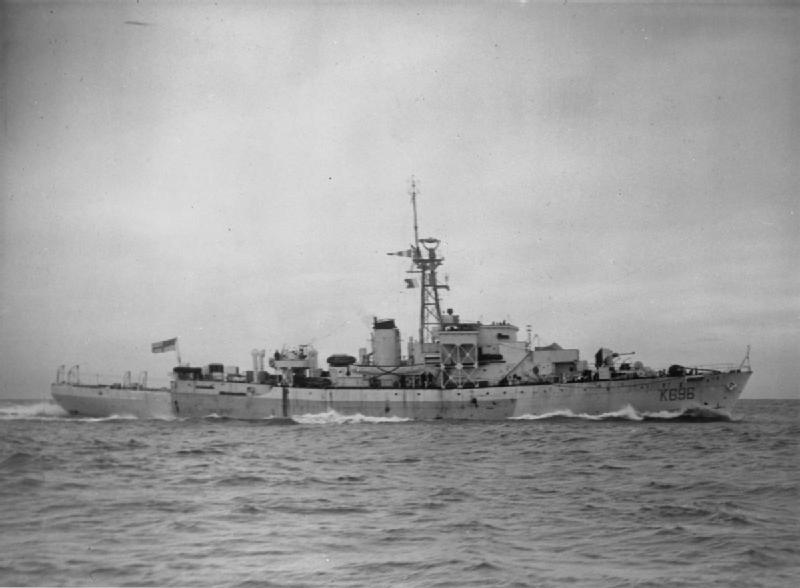
Royal Navy Photograph of Castle class corvette HMS Denbigh Castle (K696)
Pre-WWII
During the age of sail, corvettes were originally warships typically smaller than a frigate, but larger than a sloop, usually with guns on a single deck. Some ships continued to be called corvettes as steam was introduced, but in the Royal Navy, in 1877, corvettes along with sloops and frigates were subsumed under the new designation “cruisers.” Corvettes, as a type, essentially disappeared from the English naval lexicon until 1939. The term was kept alive in some navies (including the French, German, and Italian) as a rank that translated corvette-captain, a rank generally equal to Lieutenant Commander.
World War II:
Corvettes as a type reemerged just prior to WWII. As it became clear that U-boats would be a major threat, Britain saw the need for an escort vessel that could be built quickly and in large numbers, in yards that had not been considered capable of building warships. Just before WWII, they ordered the first of 267 “Flower Class” corvettes that were built in the UK and Canada. They modified the design for a whale catcher named Southern Pride, enlarging it to 205 feet overall and a displacement of 1245 to 1390 tons. They were terrible warships, weakly armed, cramped, uncomfortable, and slow. Single screw, reciprocating steam propulsion gave them a maximum speed of only 16.5 knots, a knot slower than a typical (Type VII) surfaced U-boat. They were originally intended only for coastal operations, but because of their long range, they were thrown into the Battle of the Atlantic, where they were by far the most numerous transatlantic convoy escorts for the critical early years, taking slow merchant convoys across the mid-Atlantic air gap, while the Home Fleet’s more capable, but shorter legged, fleet destroyers were generally held back to escort the battle fleet or met convoys only as they approached the British Isles.

Flower Class Corvette HMS Polyanthus, Source =www.oldships.org.uk, Author =Leidseplein Date =1943-09-
Reportedly Winston Churchill had a hand it designating this new class “corvettes,” probably in an attempt to make them appear more glamorous than the term “patrol vessels” which had been applied to similar vessels previously. Two years after the re-introduction of the term “corvette,” the term “frigate” was also resurrected to describe another war emergency escort program, this one more complex and more capable but still using reciprocating steam propulsion. Larger commercial yards converted to making frigates (301 to 307 ft, 1920 to 2420 ton), but smaller yards continued to make corvettes of the improved Castle class (252 ft, 1590 to 1630 tons), while naval yards continued to produce small numbers of sloops like the Black Swan class that were the true premier ASW escorts of the Royal Navy.
Australia also built corvettes, 60 ships of the similar but even smaller, slower Bathurst Class (186 ft). Initially they were classified as minesweepers, but found more employment as escorts, so were more frequently referred to as corvettes.

Bathurst-class corvette, HMAS Fremantle, State Library of Victoria
Japan, Germany, and Italy all made similar escort ships, but only the numerous Italian  Gabbiano class (193 foot, 728 tons, with combined diesel or electric propulsion no less),  were actually referred to as corvettes.
All of the WWII corvettes were primarily ASW escorts, but their were a number of classes of vessels, many built prior to the war, that share DNA with today’s missile armed corvettes. These were small, fast, torpedo armed vessels that resembled destroyers, but most had a standard displacement of 1000 tons or less. Usually they were referred to as “torpedo boats.”  Japan built twelve, The Germans built 48 (the last 15 were large enough to have been considered destroyers in other navies). The French Navy completed twelve. The Italians completed 69 (some of which were closer to frigates or destroyer escorts). The Italian Spica class (269 ft, 885 to 1,030 ton, 34 knots) may serve as an example.
Italian Spica Class torpedo boat
Generally, the war emergency programs had one thing in common. They were not the ships these navies would have chosen to build in peacetime. In wartime priorities change; planning horizons contract. Producibility may trump quality. They were all compromised in some fashion–in their speed, survivability, weapons, or economy of operation. Corvettes filled a need for large numbers of escorts, but after the war, most were quickly discarded.
The MCM Connection:
The Flower Class Corvettes were originally also equipped to sweep mines. As noted the Australian Bathurst Class began life as minesweepers. While the US built no “corvettes” during the war, the minesweepers of the Raven (220 foot/1040 tons), Auk (221 foot/1,250 tons), and Admirable ((180 foot) classes frequently functioned in this role. In fact, with minor modification Admirable class ships were redesignated PCEs (Patrol Craft, Escort). All these minesweepers were built with sonar. By the end of the war, most were equipped with hedgehogs, depth charge projectors (K-guns) and dual depth charge racks, having enjoyed priority for ASW equipment second only to destroyer escorts.

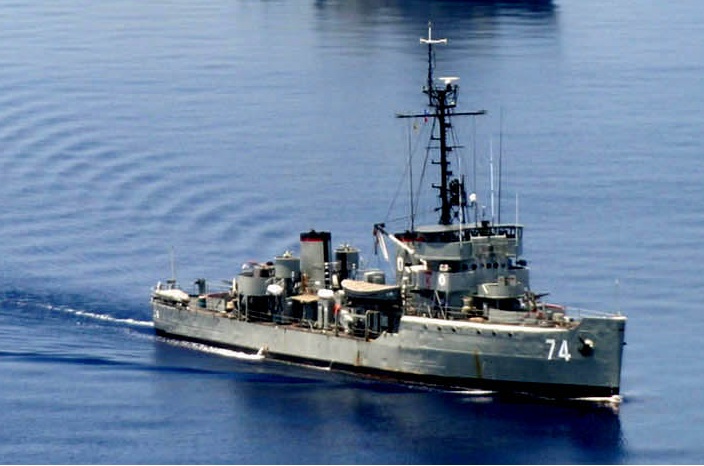
File:PS-74 Rizal.jpg

Former Auk class minesweeper still serving in the Philippine Navy as Corvette BRP Rizal (PS-74), US Government photo, 050822-N-6264C-145 Sulu Sea (Aug. 22, 2005)

Post WW II:
Since the end of WWII corvettes have generally fallen into two categories, with some designs attempting to incorporate elements both types. They tend to be either:
—Small, fast, missile armed vessels optimized for ASuW, like Sweden’s Visby Class (40 knots, 239 ft, 650 tons) usually expected to operate in groups, either with others of their kind or acting as flagships for even smaller missile boats, or
—Smaller versions of frigates with moderate speed optimized for patrol and presence in peacetime and escort during wartime like the Damen designed SIGMAs or  India’s Kamorta Class (25 knots, 358 foot oa, 3100 tons).
File:K33 HMS Haernosand Karlskrona Marindagen2008.jpg
Visby class Corvette, HMS Härnösand, Source: Xiziz at en.wikipedia
File:Kri-diponegoro-1600-1200.jpg
SIGMA class corvette
Largest Operators of Corvettes:
The largest operator of corvettes is Russia with approximately 53 (3 Buyan, 1 Buyan M, 7 Parchim II, 23 Grisha V, 4 Grisha III, 2 Dergach Project 1239, 13 Nanuchka) (80 if you count the 27 Tarantuls that fall slightly below the 500 ton threshold I have assumed).
India, China, South Korea, Indonesia, and Italy also maintain large numbers of corvettes.
File:Type 056 corvette 583 Ganzhou.jpg
Chinese Type 056 corvette 583 Ganzhou, by 樱井千一
Corvettes in the USN:
While the US Navy has never built corvettes for its own use, the type is not without precedence in the US.
In the early days of WWII, when the US navy was desperately short of escorts, 18 Flower class corvettes were transferred to the USN. Eight of those were manned by USCG crews.
File:USS Intensity (PG-93).jpg
Coast Guard manned Flower Class Corvette USS Intensity (PG-93), mid-1943. Former  HMCS Fennel (K194) [http://www.history.navy.mil/photos/images/h97000/h97406.jpg]
In the 50s the Navy was interested in experimenting with types that might be built hurriedly in an emergency. The result was the four ships of the Claude Jones class (DE-1033-1036) built by Avondale between 1956 and 1959. At 312 feet long and 2000 tons, they were essentially the same size as the preceding Dealey Class, but they were  simplified, diesel powered, slower, and more lightly armed. These ships were really a update of the corvette concept of a cheap simple escorts that lent itself to rapid construction. (Similarly about the same time the British were building 14 HMS Blackwood Class  (Type 14) that were “2nd Rate Frigates” of 1536 tons, powered by a single shaft steam turbine plant with no gun larger then 40mm.)
File:USS Claude Jones (DE-1033).jpg
USS Claude Jones (DE-1033), US Navy photo, www.navsource.org
In the late 1960s the US built four corvettes, given US hull numbers PF-103 to PF-106, that were immediately turned over to the Iranian Navy. They became the Bayandor Class (275 feet long, 1,135 tons).
In the early ’70s, two additional PF-103 class ships (PF-107 and 108), built to a modified design, were delivered to Thailand’s Navy. These were the Tapi Class.
Between 1977 and 1983 Tacoma Boat built a class of four CODOG powered “PCG” for Saudi Arabia, the Badr class, 245 feet, 1,038 tons, 30 knots.
Between 1983 and 1987 Tacoma Boat built two diesel powered “PFMMs” for the Thai Navy Ratanakosin class 252 foot, 960 tons, 26 knots.
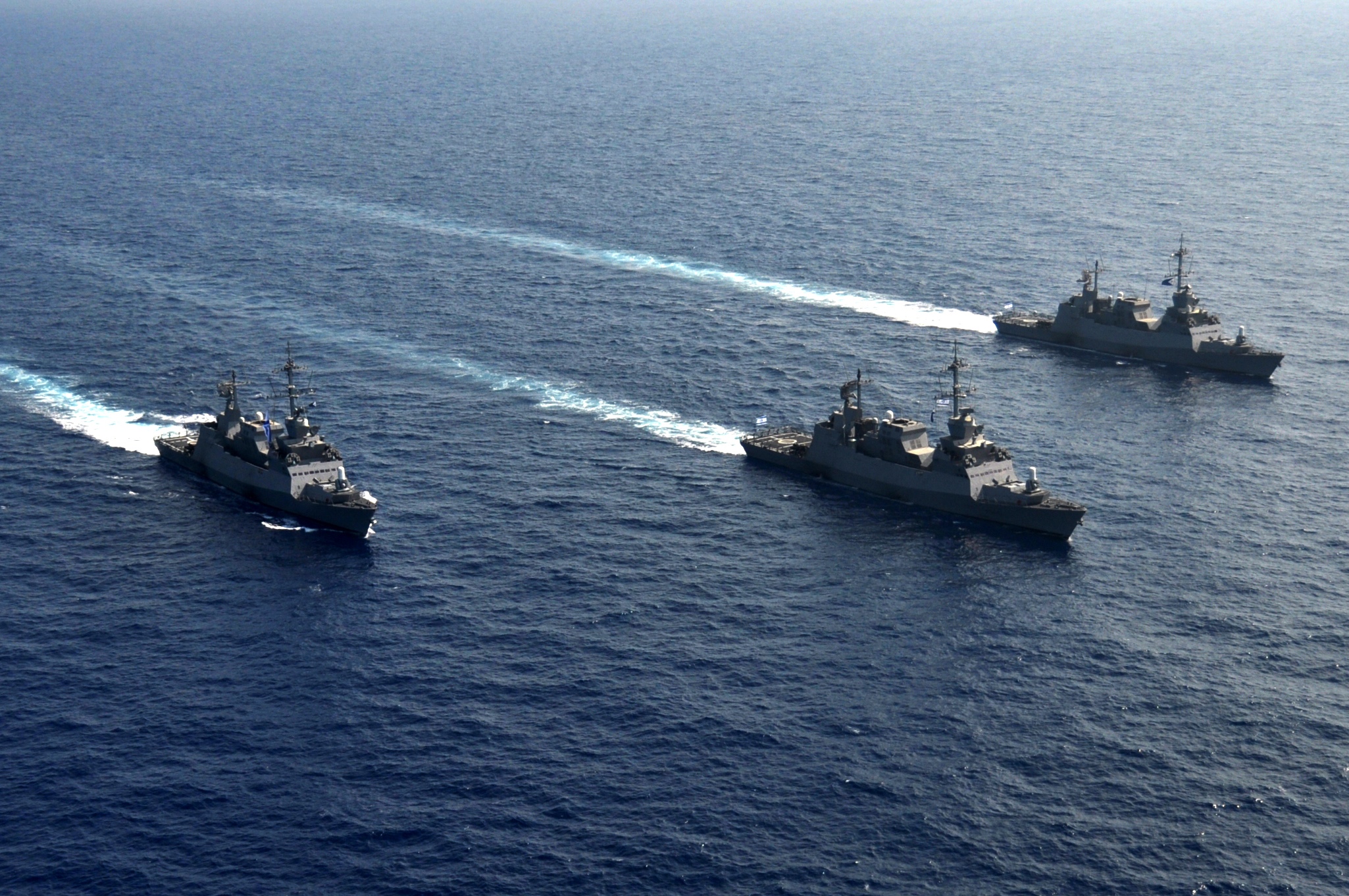
Between 1989 and 1995 Northrop Grumman Litton built three CODOG Corvettes for the Israeli Navy, the Sa’ar 5 class, (281 foot, 1,275 tons, 33 knots).
File:Three Sa'ar 5 Class Missile Corvettes Going For a Cruise.jpg
American built Israeli SA’AR5 corvettes, http://www.flickr.com/photos/idfonline/6871983192/in/photostream
Between 2008 and 2013, VT Halter Marine has been building a class of four missile corvettes for the Egyptian Navy, the  Ambassador MkIII class (205 feet, 700 tons, 41 knots). The first has already been delivered.
An undated photo of the ENS S. Ezzat, an Egyptian Fast Missile Craft. VT Halter Marine Photo
While the Littoral Combat Ships are not normally considered corvettes, on June 10, 2013, Rear Admiral John F. Kirby, the Chief of Information for the Navy called them Corvettes. Without a mission module or aviation detachment, they are really more like OPVs. But when the Mine Warfare module is mounted they become MCM vessels. When an ASW or ASuW module is mounted, they start to look like corvettes.
The Claude Jones class ships were transferred to the Indonesian Navy and continued in service there until 2006. Of the six PF-103 class ships, two Iranian ships were lost in combat with Iraq, but the remaining four are still in service with the Iranian and Thai Navies and have been updated. The Badr class and the  Ratanakosin class are still in service with their respective navies, and the Sa’ar Vs are still the most advanced surface ships in the Israeli Navy. All but the two Thai Navy Ratanakosin class (PF-107 and 108) have been equipped to launch anti-ship cruise missiles.
The Coast Guard Connection:
During WWII Coast Guard Cutters were frequently used as ASW escorts, some quite successfully, filling corvette and frigate roles. After the war, new construction frequently included provision for ASW systems either as built or as planned upgrades in the case of a major conflict.
The 16 Reliance class Medium Endurance Cutters (210 feet, 1,050 tons, 18 knots) delivered 1964 to 1969, were built with provision for adding sonar, hedge hogs, and torpedo tubes. They were originally to have been designated PCs. a designation shared with the sub chasers of WWII.
The 12 Hamilton Class High Endurance cutters (378 feet, 3,050 tons, 29 knots) completed 1967 to 1972, were built with ASW systems installed and their systems were upgraded and provision for harpoon installed 1989 to 1992. As built, they were not the equal of contemporary Destroyer Escorts with their AN/SQS-26 sonars, but were comparable to those built only a few years before. An argument can be made that these ships, as built and later modified, could be considered, if not frigates, at least corvettes.

USCGC Mellon after upgrades including Harpoon, CIWS, and support for LAMPS

The thirteen Bear class cutters (270 feet, 1,780 tons, 19.5 knots) completed 1983 to 1990, were built without ASW systems, but had provision for adding a towed array and supporting a LAMPS I helicopter. If these systems had been provided, then the ships might have also been considered corvettes.
The Coast Guard’s National Security Cutters, of the Bertholf class (eight ships planned, 418 ft/4,500 tons) have no installed ASW systems or ASCMs, but they do have excellent aviation support facilities and the ship has been marketed as the basis for a frigate program. Aside from Exocets carried by the French ships, they are in most respects more capable warships than the Floreal “light surveillance frigates” (307 ft/2950 tons) and similar to the French Lafayette Class frigates (410 ft/3,600 tons) which also currently have no sonar.
File:USCGC Waesche by Yerba Buena Island.jpg
USCGC Waesche, U.S. Coast Guard photo ID: 100228-G-2129M-004
File:Ventose 1.jpg
French frigate Floréal-class Ventôse (F733)
The Coast Guard is in the process of procuring a new class to replace its Medium Endurance Cutters. The resulting ship is likely to be similar to the Floreal class (90 to 100 meters in length and 2500 to 3500 tons) but faster and will share sensors and some weapons with the Bertholf class and the Littoral Combat Ships. Addition of ASW or ASCM systems would result in ships many would classify as light frigates or corvettes.
Bottom Line–What is a Corvette?:
Corvettes slot under frigates but above patrol boats or missile boats as a classification of surface combatants. To me, this means that they are the smallest or perhaps least capable ocean-going warships. This is a bit of a stretch for Corvettes like the Visby, but in fact the Swedes have deployed even smaller warships to the Indian Ocean for counter piracy operations. That sets the low end of the the displacement range at about 500 tons, but when we look for an upper limit, it seems a moving target, with no similar performance based limit.
The US and Britain already build destroyers the size of WWII cruisers. Germany and in the near future Britain will build frigates over 6,000 tons full load. Japan’s Coast Guard has OPVs displacing 9,350 tons full load.  If we tripled the displacement of WWII corvettes as we have done with WWII Frigates and Destroyers, Corvettes could displace almost 5,000 tons, so I don’t think displacement is a reliable determinant.
Strict naval vessel construction standards don’t necessarily distinguish a corvette from an OPV either. They were not applied to the original “Flower” class, and they don’t apply to the Damen designed Sigma class, built or building for Indonesia, Morocco, and Vietnam, or to the French Lafayette class (also operated by Taiwan, Singapore, and Saudi Arabia) and Floreal class (also operated by the Moroccan Navy) which are rated as frigates but which it might be argued are actually corvettes.
The only metric that doesn’t seem to have changed much over the last 70 years is crew size. Corvettes generally have crews of 120 or less, frigates from 120 to perhaps a bit over 200, while destroyer crews begin slightly under 200 and go up to about 350, and cruiser crews are larger still. The DDG1000s will apparently have a frigate sized crew, but their final crew may be larger than currently planned. OPV crews tend to be corvette sized or smaller.
Just as the difference between Spruance Class Destroyers and Ticonderoga Class cruisers was mission and associated equipment, not displacement, the differentiation between the various types of warships and between Offshore Patrol Vessels (OPVs) and corvettes may simply comes down to their missions and equipment. OPVs include a wide range of ships, but the common thread, generally accepted, is that they have no ASW weapons, no heavy anti-ship cruise missiles, and only a self-defense AAW capability. Adding an ASW capability and/or cruise missiles would convert an OPV into a corvette. Perhaps they would not make very good warships, but then the original Corvettes weren’t very good warships either, but they served a vital role. Conversely an old frigate or corvette, stripped of all its weapons except a medium caliber gun and heavy machine guns would become an OPV, even if it nominally retained its frigate or corvette designation as in the case of Portugal’s Joao Coutinho and Baptista de Andrade class or some of Italy’s Minerva class.
If we had no history, and we could start ship designations on “a clean sheet of paper” we might define ships types based on their missions and equipment, saying destroyers are vessels designed with robust capacity to perform well in all three major surface combatant warfare areas, AAW, ASuW, and ASW. Frigates are designed to perform well in only two missions areas  (with possibly modest self defense capability in the third). Corvettes would be single mission specialists with only modest capability in the other two missions (if at all). OPVs would be vessels equipped for missions that did not require robust capabilities in any of these three mission areas. All four types might be called generically “cruisers” which would bring that designation back to its original meaning, a vessel smaller than a ship of the line that can operate independently.
The Future of Corvettes:
WWII corvettes were small ships packed with crew and weapons.They were small because there was an urgent need for many ships that could not be met by the shipyards that normally built warships. They were a way of making the small commercial yards serve the war effort. If we are ever engaged in a prolonged conflict against a near peer adversary we may again resort to a similar expedience. If so, the resulting corvette is more likely to be based on a petroleum industry offshore support vessel rather than a whaling or fishing vessel.
But when ships are built in peace time, for a 20 to 40 year life, other factors beside construction cost start to dominate. In the West, crew costs weigh heavily, while increasing hull size appears less important, provided we do not load up the larger hull with additional systems which will in turn drive up crew costs. Larger hulls are more seaworthy, allow greater endurance, and may be made quieter. They may even be more economical to operate and maintain because of easier access.
Some European Countries that formally operated a number of Corvettes seem to have abandoned the type in favor of ships with more range and better seakeeping including The Netherlands, Denmark, and Norway. Denmark has instead produced frigates and a novel class of ships, the Absalon Class “support ships,” (450 ft/6,600 tons) that include a relatively large hull of modest speed, with a relatively small crew of about 100, and a large reconfigurable spaces–an open one topside midships where missile systems can be placed and a “garage” area under the flight deck that can accommodate vehicles and containerized loads. These ships are perhaps too large to be considered corvettes, but they are not nearly so well armed as the frigates of the similarly sized Iver Huitfeldt-class. They do have characteristics I would expect to see on future corvettes, a relatively commodious hull (because “steel is cheap and air is free”), a relatively small crew (because that is the most expensive component over the life-cycle of the ship), and reconfigurable spaces and weapon systems, that allow the ships to be adapted to different missions (because that is allow us to hedge our bets regarding what capabilities will be needed, while allowing that minimal crew over most of the life of the ship).
Because Corvettes are always compromised, they are likely to be controversial. Many will not agree with the compromises accepted. That is certainly true of the new American Corvette, the Littoral Combat ship.
In some respects the LCSs may be the prototype of the future corvette, in that it is not particularly small, but they were made cheap to operate with a minimal crew, and they are single mission ships, but with the advantage that the mission can be changed over time, although not as quickly as once advertised. Other aspects of the ship were perhaps not as well thought out, but they will serve a purpose, and perhaps the next generation LCS  or convertible corvette will better meet our needs.

 * Article publicat al CIMSEC. Interessant i molt necessària reflexió al voltant de la definició de les corbetes. Lectura obligada per totes aquelles persones interessades en la futura configuració de les forces navals catalanes.




dimarts, 2 de juliol del 2013

Royal Navy of Oman accepts first new ship from BAE Systems

Colourful streamers covered the jetty as the Omani navy accepted its first new ship from Portsmouth shipbuilders.
There was a ceremony this morning at Portsmouth Naval Base to mark the Omani navy’s interim acceptance of RNOV Al Shamikh.
In front of invited guests, workers lowered the BAE Systems flag before Omani sailors raised their own.
The ship, a Khareef-class corvette, will now embark on trials before a full acceptance by the Omani navy.
Nigel Stewart is the commercial director for BAE Systems’ maritime division.
He said: ‘It’s a huge and very proud moment for us.
‘It’s a major milestone in the project.
‘The ship will go out and deliver the capability that it was sent out to do.
‘The people of Portsmouth can be proud at having the skills required to build ships such as these.’
Work will continue on RNOV Al Shamikh’s sister ships, Al Rahmani and Al Rasikh.

* Notícia publicada a The Portsmouth News. Les corbetes Khareef, a banda de les seves qualitats, són una bona mostra de que l'aliança entre el Regne Unit i Oman segueix vigent

dijous, 28 de març del 2013

Indian Navy launches third Kamorta-class P-28 ASW corvette*

The Indian Navy
's Directorate of Naval Design has launched the third Project-28 (P-28) Kamorta-class anti-submarine warfare (ASW) corvette, Kiltan, in Kolkata, India.
Built by Garden Reach Shipbuilders & Engineers (GRSE), INS Kiltan has been named after an island, Kiltan, located in the Lakshwadeep archipelago of India.
GRSE has been previously awarded a contract by the Indian Navy to build and deliver four 109m-long Project-28 ASW corvettes by 2016.
Capable of cruising at a speed of 25k, the 2,500t P-28 ASW corvettes will provide anti-submarine warfare capabilities with a low-signature of radiated underwater noise and operate under nuclear, biological and chemical (NBC) environment.
Featuring advanced stealth technology, the ships will be equipped with domestically manufactured state-of-the-art weapons and sensors, which include a medium-range gun, torpedo tube launchers, rocket launchers and close-in weapon system.
In addition to Bow mounted Sonar, the vessels will be fitted with advanced integrated platform management system for controlling and co-ordinating propulsion, auxiliary and power generation equipment."The vessels will be fitted with advanced integrated platform management system for controlling and co-ordinating propulsion, auxiliary and power generation equipment."
The ships are powered by a CODAG propulsion system, consisting of twin gas turbines, twin diesel engines and twin diesel generators, which will drive two-shaft, controllable-pitch propellers, according to globalsecurity.org.
Designed to accommodate a crew of 85, the ASW corvettes are armed with Klub-N 220km-range supersonic anti-ship cruise missiles, AK-630M close-in weapon systems and 76-mm guns.
Launched in April 2010, the first GRSE-built ASW corvette, INS Kamorta is scheduled to be delivered to the Indian Navy by the year-end, while the second corvette, INS Kadmatt is currently under construction.
Scheduled for launch in 2014, the fourth ASW corvette INS Kavaratti will undergo trials prior to its delivery to the Navy in more than 20 months.

* Notícia publicada a Naval Technology. La Indian Navy segueix, continua el seu procés d'indigenització del material.

dimecres, 27 de febrer del 2013

China Navy receives first Type 056 Jiangdao-class corvette


The Chinese People's Liberation Army (PLA) Navy has received its first Type 056 Jiangdao-class corvette in Shanghai, aimed at boosting its maritime defence capabilities amid the East China Sea Islands regional ownership disputes with Japan.
Designed as part of the ongoing military modernisation programme, the first helicopter-equipped Type 056 corvette, with hull number 582, will be deployed to patrol and escort ships and submarines during missions in waters it claims in the South and East China Seas.

A total of 20 Type 056 Jiangdao-class vessels have been ordered by China to replace its ageing existing fleet.
Featuring increased stealth and a sleek design to reduce clutter, the new corvette is armed with a 76mm main gun, 30mm remote weapon systems, YJ-83 sea-skimming anti-ship cruise missiles in two twin-cell launchers, as well as FL-3000N short range missile system, as reported by RTnews."A total of 20 Type 056 Jiangdao-class vessels have been ordered by China to replace its ageing existing fleet."
With a full load displacement capacity of 1,440t, the vessel has a range of 2,000nm and can cruise at a speed of 28k.
Capable of accommodating a crew of 60, the Jiangdao-class corvette also features strong electromagnetic compatibility and a wide application of advanced technologies.
Primary missions of the new frigate include patrolling, guarding and escorting, as well as anti-submarine operations, in addition to carrying out independent missions against sea targets or in coordination with other forces.
The PLA Navy aims at enhancing capabilities to defend its national security and territorial integrity, while safeguarding China's maritime sovereignty, rights and interests.

* Notícia publicada a Naval Technology. La transformació de la PLAN continua en tots els camps tant qualitativament con quantitativa. Una assumpció del "think big" versió xinesa._________________________________________

diumenge, 1 de juliol del 2012

Eilat Class, Israel*

In the early 1980s, the Israeli Navy awarded a contract to Northrop Grumman Ship Systems (formerly Litton Ingalls Shipbuilding) to supply three Sa'ar 5 Classcorvettes for the Israeli Navy. The first of class, INS Eilat, was launched in February 1993, followed by INS Lahav in August 1993 and INS Hanit in March 1994.


In July 2006, while taking part in the Israeli Navy blockade of Lebanese ports, INS Hanit was struck by an anti-ship missile fired by Hezbullah. Four crew members were killed. A fire resulted from the attack and the ship was able to return to Ashdod port under its own power. Following repairs, the vessel was reported to have resumed its combat role in August 2006.

Command and control systems

The unified combat system is integrated by IAI (Israel Aircraft Industries) MBT division, with Elbit (combat data systems) and Tadiran (communications systems) as major subcontractors. The ship's combat system provides multiple offensive and defensive capabilities. Target, weapon status, and threat evaluation information is available to all fire control and launcher systems via the ship's databus.


El-Op's MSIS electro-optic surveillance and fire control system is fitted on the Eilat, which contains an 8–12-micron thermal imager, TV camera and laser rangefinder. El-Op received a contract in January 2003 to upgrade the MSIS. The upgraded system will include a new third-generation thermal imager with increased sensitivity and resolution.

Barak and harpoon missiles

The ship's anti-air capability is based on the Barak missile system developed by IAI and Rafael. Two 32-cell vertical launch systems are installed on the raised gun deck at the bow of the ship. The range of the Barak missile is 10km and it is armed with a 22kg warhead. It also has an anti-surface target capability.


The ship has two four-cell Boeing Harpoon missile launchers. The Harpoon surface-to-surface missile has a range of up to 130km. The speed is high subsonic and the warhead weighs 227kg.
The ship's short to medium-range anti-ship missile is the IAI Gabriel II. There are eight launchers for the Gabriel II missile which uses dual mode semi-active and active radar homing with a 100kg warhead. The range is from 6km to 36km and missile velocity is 0.6 Mach.

Guns

The ship is equipped either a Raytheon / General Dynamics mk15 Phalanx close-in weapon system (CIWS) or Oto Melara 76mm gun.

Phalanx has a 20mm gun which can fire at 3,000 rounds/min and Ku-band search and tracking radar. Range is 1.5km.

Alliant Techsystems mk46 torpedoes

The ship is fitted with six 324mm mk32 torpedo tubes for ATK (Alliant Techsystems) mk46 torpedoes which have active and passive homing. They are armed with a 44kg warhead and range is 24km. The launch tubes are mounted in the superstructure about halfway along the length of the ship.


Helicopter

Airborne anti-submarine warfare capability is provided by the ship's helicopter. The ship's helicopter hangar can accommodate an AS565 Panther, Kaman SH-2F or Sikorsky S-76N helicopter.

Countermeasures

Countermeasures include the AN/SLQ-25 Nixie towed torpedo decoy system from Argon ST of Fairfax, Virginia, which seduces approaching torpedoes away from the ship. The Sa'ar 5 corvette's radar warning receiver Elisra NS-9003/9005 is also installed on the Israeli Navy Sa'ar 4 and Sa'ar 4.5 patrol craft. Three Elbit Deseaver stabilised chaff rocket launchers are mounted on the forward and aft towers.

Eilat vessels are fitted with the Rafael Wizard (wideband zapping anti-radar decoy) passive RF corner reflector decoy system, effective against anti-ship missiles with chaff discrimination algorithms.

Sensor suite

The air search radar antenna is installed on the aft tower. The Elta EL/M-2218S air search radar operates in E/F bands. The 2D/3D radar antenna, the fire control director and the I-band navigation radar antenna are installed on the forward tower. The fire control radar is the I/J/K-band EL/M-2221 GM STGR from Elta.
The Sa'ar is equipped with type 796 hull-mounted search-and-attack sonar, which operates at medium frequency and is supplied by EDO of New York. The ship's towed sonar array is supplied by Rafael.

Propulsion system
 
The ship's propulsion system is in a CODOG combined diesel or gas configuration. The two MTU 12V 1163 TB82 diesel engines are rated at 6,600hp. The GE LM 2500 gas turbine system is cross-connected and provides 30,000hp. The propulsion system drives two shafts.


The propulsion system provides a maximum speed of 33kt. The cruise speed on the diesel engines is 20kt and the endurance is 4,000 nautical miles. A large twin rudder provides manoeuvrability at high speed and controllable reversible pitch (CRP) propellers at low speed.

* Article publicat a Naval Technology. Les naus de la marina israelianes, tot i no ser tant conegudes com l'aviació o els vehicles blindats, són tot un exemple d'alta tecnologia adaptada a les necessitats.

dimecres, 30 de maig del 2012

Russia Floats Out New Corvette*


St. Petersburg's Severnaya Verf shipyard floated out a new stealth corvette for the Russian Navy at an official ceremony on Wednesday.

The Stoyky is the fourth Project 20380 or Steregushchy class corvette designed by the Almaz Central Marine Design Bureau. The ship is expected to join Russia’s Baltic Fleet in November 2013 after a series of sea trials.

The first Project 20380 corvette, the Steregushchy, was put into service with the Baltic Fleet in October 2008 and the second, the Soobrazitelny, joined the Russian Navy in October 2011.
The third ship of the same series, the Boyky, is undergoing sea trials to be commissioned in November 2012.

The Steregushchy class corvette is capable of engaging enemy surface ships, submarines and aircraft, and providing naval gunfire support for beach landings. Advanced stealth technology is used to reduce the ship's radar, acoustic, infrared, magnetic and visual signatures.

Russia plans to have up to 30 vessels of this class to ensure the protection of its coastal waters, as well as its oil and gas transportation routes, especially in the Black and the Baltic seas.

Each corvette has a displacement of 2,000 metric tons, maximum speed of 27 knots, and a crew of 100.
The ship's armament includes Kh-35 (SS-N-25 Switchblade) anti-ship cruise missiles, a 100-mm gun, a variety of air-defense and anti-submarine systems, and a Ka-27 Helix ASW helicopter.

* Notícia publicada a RIA Novosti. Com hem anat comentant en aquest bloc, la renovació de l'Armada russa és un fet en curs. En aquest cas les corbetes Steregushchy, són unes interessants mostra de polivalència, encara que estiguin pensades per operacions litorals.

dimecres, 7 de març del 2012

LCS Freedom Back In Dry Dock*


Barely a month after leaving dockyard hands, the Freedom, first of the U.S. Navy’s new Littoral Combat Ships (LCS), is back in dry dock in San Diego, this time to fix a broken shaft seal that caused minor flooding on board the ship a month ago.

“The Freedom is undergoing a six-week drydocking availability to repair the damaged inboard port shaft mechanical seal,” Lt. Jan Shultis, a spokesman for the Naval Surface Forces command in San Diego, said March 1.

While in dry dock, engineers from the Naval Sea Systems Command and Lockheed Martin, prime contractor for the LCS 1-class ships, will pull the propeller shaft and examine the shaft and its seals to determine why and how the newly-installed seal broke.

Repairs for the Freedom are covered under an Initial Support Plan contract with Lockheed-Martin, Shultis said. The company is responsible for the conduct of the repairs, she added, but may, at their discretion, sub-contract out specific portions of a job or jobs to other service providers.

The flooding took place on the evening of Feb. 1 while the ship was under way off Southern California on post-overhaul sea trials. All four of the ship’s shafts had been removed for examination during that overhaul, then reinstalled with new seals. The trials were to test the work, which began last fall.

“Minor flooding” took place in the ship’s shaft alley and bilges before an inflatable boot seal was deployed to contain the flooding, Shultis said. The ship returned to San Diego under her own power.

LCS ships use waterjets rather than conventional propeller shafts to reach very high speeds. The 3,300-ton Freedom is fitted with four Kamewa 153 SII waterjets that drive the ship at speeds that have topped 47 knots.

The Freedom entered a graving dock at the 32nd Street Naval Base in San Diego early on morning of Feb. 26, Shultis said.

The evaluation of the seal break and the repairs will put a crimp in the Freedom’s schedule for the rest of the year. The ship already had been planned to begin the second portion of her post-shakedown availability in mid-July to finally fix issues leftover from construction and post-commissioning evaluation — a dockyard period expected to last at least nine weeks.

The Freedom will also need to test a new mission module put together for a demonstration cruise to Singapore, planned to begin late this year. The Pentagon announced last year a plan to forward-base some LCS ships in Singapore, and Adm. Mark Ferguson, vice chief of naval operations, visited the island nation last month to discuss arrangements for the visit.

The ship’s Blue and Gold crews will also need to get back up to speed on handling their vessel at sea.
“This is definitely something that will impact the testing and evaluation schedules,” Shultis said. “But those schedules are never static.”

The ship’s schedule for the rest of this year will be fine-tuned after the repairs are finished and the ship gets back in the water, she added.

The second LCS, the Independence, continues to test components of the mine module from Panama City, Fla., and is on track to leave in a few weeks to shift to San Diego.

* Notícia publicada a Defense News. Tot i que les avaries, tant en la classe Freedom com en la Independence han estat freqüents, sembla que tant la US Navy com els seus contractistes no resten de braços creuats i hi estan trobant sol·lucions. Un fet que sempre ha caracteritzat la US Navy és la capacitat d'aprendre dels errors i trobar sol·lucions imaginatives.

dilluns, 20 de febrer del 2012

Russia Lays Down New Corvette for Pacific Fleet*

The Amur Shipyard in Russia’s Far East has started the construction of a new Steregushchy class corvette for the Russian Pacific Fleet, the Khabarovsk Territory government said.
“A Steregushchy class corvette will be built for the Pacific Fleet,” the Khabarovsk Territory government said in a statement on Friday. “It will be delivered in 2015.”
The Gromky corvette is the sixth Steregushchy class vessel designed by the Almaz Central Marine Design Bureau and second being built at the Amur Shipyard.
Two corvettes of this class, the Steregushchy and the Soobrazitelny have been already put into service with the Russian Navy, while three others are under various stages of construction and trials.
The Steregushchy class corvette can be deployed to destroy enemy surface ships, submarines and aircraft, and to provide artillery support for beach landings. Advanced stealth technology is used to reduce the ship's secondary radar field, as well as its acoustic, infrared, magnetic and visual signatures.
Russia plans to have up to 30 vessels of this class to ensure the protection of its coastal waters, as well as its oil and gas transportation routes, especially in the Black and the Baltic seas.
Each corvette has a displacement of 2,000 metric tons, maximum speed of 27 knots, and a crew of 100.
The ship's armament includes SS-N-25 Switchblade anti-ship cruise missiles, a 100-mm gun, a variety of air defense and anti-submarine systems, and a Ka-27 Helix ASW helicopter.

Notícia publicada a RIA Novosti.

dilluns, 31 d’octubre del 2011

Vietnam Negotiate Buying four Sigma Corvettes from the Netherlands*


Vietnam’s growing economy, and China’s aggressive stance in the South China Sea, are pushing the country to begin a long-delayed military modernization program. Most of the equipment comes from Vietnam’s traditional Russian sources, but a purchase of Next-Gen DHC-6 Twin Otter maritime patrol aircraft from Canada showed the country’s willingness to consider other suppliers. Now comes word that Vietnam’s new Russian Gepard Class corvettes may be joined by another Western entry: 4 SIGMA ships from the Dutch Schelde shipyard.

SIGMA actually stands for Ship Integrated Geometrical Modularity Approach. Block construction has become almost routine for ships, but block design at this level is unique…


The SIGMA design uses standard, 7.2m sections, separated by bulkheads with watertight doors. That block size allows the ship to meet international requirements for surviving 6m wide damage to the ship. To add capabilities, people, or space, just add blocks to the design, and a base 50m OPV design can morph all the way to a 90m corvette (Indonesia) or even a full-featured 105m – 150m frigate (Morocco). Necessary standardization within compartment interfaces, beams, doors, portals, stairs and other key construction components adds more efficiencies. 

Early reports in October 2011 indicated that an agreement was in progress, whereby the first 2 SIGMA ships would be built in Vlissingen, the Netherlands, and the last 2 would be built in Vietnam, under Dutch supervision. That would represent a big step forward for Vietnam’s shipbuilding industry.

SIGMA ships usually use Thales for combat systems and radars, and MBDA for missiles, but customers like Vietnam can change that if they want. Vietnam certainly has a long history with France, who would undoubtedly be interested in resuming some level of defense ties. On the other hand, compatibility with the Russian weapons on its other naval ships would offer advantages of its own. If they choose to change the SIGMA’s standard armament, the most likely substitutions involve incorporating a Russian 76.2mm AK-176M naval gun instead of Oto Melara’s 76mm, SA-18 very short range anti-aircraft missiles instead of MBDA’s Mistral, and/or Kh-53E anti-ship missiles, instead of the French Exocet
* Notícia publicada a Defense Industry Daily. El rearmament vietnamita en matèria naval, és tot un símptoma de la por que genera el creixement xinés. Sens dubte, les darreres declaracions dels mitjans estatals xinesos, no contribueixen a la calma.

dimecres, 26 d’octubre del 2011

MISÈ A DOSPOSITION ET PRISE DE COMMANDEMENT DE L'ADROIT*


Vendredi 21 octobre 2011 à 11h30, au cours d’une cérémonie à Lorient, DCNS a mis officiellement à disposition de la Marine nationale, le patrouilleur hauturier L’Adroit.
Le vice-amiral d’escadre Xavier Magne, commandant de la Force d’Action Navale, représentant le chef d’Etat-major de la Marine, a ensuite présidé la première cérémonie des couleurs. Il a ensuite fait reconnaître le capitaine de frégate Loïc Guyot comme commandant du navire.


Prévue par une convention signée en octobre 2010 lors du salon Euronaval, la mise à disposition de cet outil industriel est un partenariat «gagnant-gagnant»:
- La Marine met en œuvre ce navire, acquiert l’expérience opérationnelle à la mer sur ce type de bâtiment et développe une capacité d’expérimentation de différents systèmes (optronique, communications, drones, etc.).
- DCNS, qui a développé ce bâtiment sur ses fonds propres et qui en reste propriétaire bénéfice du retour d’expérience d’une marine de haut rang ainsi que du label «sea proven» pour ce navire à l’exportation.
Ce bâtiment, né d’une proposition de DCNS, est mis à disposition de la Marine pour 3 ans et sera employé dans le cadre régulier de ses missions de sauvegarde maritime (secours en mer, lutte contre l’immigration clandestine, police des pêches, lutte contre les pollutions, lutte contre le narcotrafic, surveillance maritime).


Les grandes dates du bâtiment :
  • 7 mai 2010 : découpe de la première tôle
  • 18 mai 2011 : mise à l’eau (équipage civil avec quelques marins en appui)
  • 27 juillet 2011 : premiers essais à la mer
  • 5 sept 2011 : constitution d’un équipage Marine
  • 21 oct 2011 : prise en charge par la Marine et mise en condition initiale (MECI)
  • Fin oct : Début de la vérification des caractéristiques militaires (VCM)
Caractéristiques
  • Déplacement : 1 500 tonnes
  • Taille : 87 m x 11,7 m
  • Autonomie : 8 000 Nq
  • Vitesse : 21 nœudsCapacités : abri hélicoptère pour HLO 5 tonnes (Dauphin / Panther)
  • Équipage : 32 personnes (avec capacité d’accueil de 27 passagers). Dès avril 2012, le bâtiment fonctionnera avec 2 équipages (relève tous les 4 mois).
  • Armement : 1 canon de 20 mm, 2 mitrailleuses de 12.7mm, canons à eau.


 * Notícia publicada al lloc web oficial de la Marine Nationale. L'Adroit pertany a la sèrie de corbetes i patrulleres Gowind, fabricades per DCNS, que s'adapten a un ampli espectre de missions, tant convencionals com asimètriques, així com operacions militars diferents a la guerra.