Es mostren els missatges amb l'etiqueta de comentaris Itàlia. Mostrar tots els missatges

dilluns, 8 de setembre del 2014

Fincantieri delivers Kalaat Beni-Abbes LPD to Algerian Navy*

Italian shipbuilding firm Fincantieri has delivered the new Kalaat Beni-Abbes amphibious vessel to the Algerian Navy at its Muggiano Shipyard.
Commissioned in 2011 by the Ministry of Defence of the People's Democratic Republic of Algeria, the 143m-long, BDSL class landing platform dock (LPD) vessel is powered by two diesel engines that allow it to cruise at a maximum speed of more than 20k, while accomodating 600 personnel.
"The vessel boasts a displacement capacity of 8,800t and integrates a whole flight deck."
Its internal floodable dock is designed to carry a 20m-long landing craft.
The vessel boasts a displacement capacity of 8,800t and integrates a whole flight deck, with two helicopter landing areas, fore and aft.
The LPD features a 60-bed hospital and some operating theatres that support humanitarian missions by offering medical support to both troops and civilians.
In addition to the vessel delivery, the company is tasked with offering logistical support in addition to overseeing the design, management and coordination of the three smaller vessels being built locally at naval shipyards in Algeria.
Dubbed Chaland, the smaller vessels are integral elements of the vessel's equipment and can carry 140 individuals or a heavy tank, with a maximum weight of 30t.
* Notícia publicada a Naval Technology. Publicat amb retard per problemes tècnics. Resulta curiós com a casa nostra hi ha qui s'exclama perquè es demanin unes quantes corvetes i patrulleres mentre a l'altra riba de la Mediterrània es compren LPDs...

dimecres, 12 de febrer del 2014

Italian warship training Mozambican Navy*

by Dean Wingrin, February 10, 10:04 am
The Italian Navy vessel Borsini is in Mozambican waters for the next two months as it trains the southern African nation's small navy, following the signature of a maritime collaboration agreement between the two countries.
The 30th Naval Group of the Italian Navy, comprising the aircraft carrier Cavour (CVH550), frigate Bergamini (F590), patrol ship Borsini (P491) and supply ship Etna (A5326), left Italy on 13 November on a circumnavigation of the African continent. Commanded by Rear Admiral Paolo Treu, the Naval Group arrived in Maputo, Mozambique, on 27 January.
Titled "A Country on the Move", the Naval Group is a joint Italian Navy and industry campaign involving multiple objectives, such as training, maritime security operations, confidence building, naval diplomacy, humanitarian assistance and the promotion of Italian industry.
The technical agreement for collaboration with the Mozambique Navy was signed by the Italian Chief of Navy during his visit to Maputo between 28 and 30 January.
In terms of the agreement, the Italian and the Mozambican navies will carry out naval cooperation activities in Mozambican waters for two months. In particular, training will be organized at sea and on land with specific emphasis placed on anti-piracy and patrolling in Mozambican territorial waters. Other areas of cooperative training include protection of commercial shipping, the fight against trafficking and rescue at sea.
The Italian Navy has experience with anti-piracy operations in the Indian Ocean, being a participant in Operation Atalanta, the European Union's counter-piracy operation off the coast of Somalia.
As a result of the cooperation agreement, the patrol ship Borsini detached from the Naval Group on 1 February and will remain in Mozambican waters for the next two months.
Speaking to defenceWeb, Treu said that the Borsini will be helping the Mozambican Navy to grow. "It's a small navy, so we are trying to provide them (with) our experience in maritime security operations, in particularly in anti-piracy activities and protecting the ships from terrorist attacks," he said.
In light of the recent natural gas deposits discovered in Mozambique, Treu noted that the country has to learn how to protect its resources.
"We are there just to help them grow as a navy, providing them with our experience," he explained. "We will show them how to perform operations (like anti-piracy patrols). If there is a real event going on, of course we could be tasked to do a real operation to fight piracy in case of need," he continued.
The South African Navy, supported by the South African Air Force, has maintained a permanent anti-piracy patrol in the Mozambique Channel since early 2011, under Operation Copper. The frigate SAS Spioenkop is currently on station.
Having departed Maputo on 31 January, the three remaining vessels of the Naval Group arrived in Cape Town on 5 February.
Following their departure from Cape Town on 11 February, the Naval Group will continue its circumnavigation of the African continent, visiting Luanda in Angola next.
Mozambique's small navy has only a few serviceable vessels, including two Namacurra boats (donated by South Africa), eight patrol vessels (including RHIBs) and a Conejera class patrol craft (Pebane - donated by Spain). However, last year French firm Constructions Mecaniques de Normandie (CMN) was given a $200 million contract to build three Ocean Eagle 43 patrol vessels, three HSI 32 interceptors and 24 CMN 23.5 trawlers for the Mozambican navy. Deliveries are scheduled to take place by 2016.

* Notícia publicada a Defence News. Un altre exemple de col·laboració en matèria de lluïta contra la pirateria. Caldrà veure si aquesta és efectiva, doncs d'això en depèn que les flotes europees puguin reduïr el nombre d'unitats en desplegament permanent a les aigües orientals de l'Àfrica.

divendres, 5 de juliol del 2013

Maestrale Class Frigates*

The Maestrale class frigates were built by Fincantieri for the Italian Navy (Marina Militare). A fleet of eight frigates is currently in service with the Italian Navy. These frigates are expected to be replaced by the FREMM multi-purpose frigates
 by 2013. FREMM is designed by DCNS / Armaris and Fincantieri.
The Maestrale class frigates are primarily equipped for anti-submarine warfare (ASW). However, they also possess anti-aircraft warfare (AAW) and anti-surface warfare (ASuW) capabilities. They were deployed in various international missions and in the normal operations of the Italian Navy.
The first ship in the class, Maestrale (F570), was launched in February 1981 and commissioned in March 1982. Four frigates were commissioned in 1983 and the rest of the fleet was commissioned by May 1985.Maestrale class frigate design
The Maestrale class is derived from the Lupo class frigates, but has some differences in displacement and weapons fit. It has a larger displacement of around 500t and incorporates more sophisticated and powerful antisubmarine weapons than the Lupo class.
The large superstructure is made of light alloys. It extends without interruption until the hangar and includes one large turret and a single funnel. The hull is divided into fifteen watertight compartments.
Two non-retractable fin stabilisers provide stability to the ship and reduce the body roll by 30° to 3° at a speed of 18kt.Command and control
The IPN-20 command and control system, developed by Alenia Marconi Systems (now Selex Sistemi Integrati), is interfaced with the combat system and integrates the sensors and weapon systems.
It collects data from the onboard sensors and communications and data networks and provides tactical information.Maestrale missiles
The Maestrale class is armed with an Albatros / Aspide octuple launcher, firing Aspide medium range air-to-air and surface-to-air missiles. The system is reloaded by a Riva-Calzoni system.
The ship can carry an additional 16 missiles. Four TESEO Mk 2 missile launchers fitted above the hangar can launch Otomat / TESEO anti-ship missiles. The missile can engage targets within a 160km range, while carrying a 210kg warhead.Naval guns
The main gun mounted on the foredeck is an Otobreda 127mm gun. It can fire 40 rounds a minute at a range of 30km. Two Oto Melara Twin 40L70 DARDO close-in weapon systems (CIWS) are fitted on the vessel.
The CIWS can fire high explosive shells against anti-ship missiles, unmanned aerial vehicles and other precision guided weapons. The fire control system and fire control radar assist the unmanned turret to react rapidly to incoming missiles.Torpedoes
The Maestrale class is fitted with two sets of 324mm triple torpedo tubes for Mk 32 torpedoes. There are two 533mm dual-purpose (ASW and AsuW) launch tubes for Whitehead A-184 wire-guided torpedoes.Sensors / radars
The sensor suite includes an RAN10S air and surface search radar, an SPN703 navigation radar, an RTN-10X fire control radar and two RTN-20X radars for the DARDO systems. DE 1164 variable depth sonar and DE1160B hull mounted sonar are fitted to detect and track submarines.Aircraft
The Maestrale class has a flight deck measuring 27m in width, allowing for the operation of AB-212 helicopters. The hangar can accommodate two helicopters.Countermeasures
Two SCLAR rocket-launchers onboard can launch chaff and infra-red (IR) decoys to deceive incoming missiles.
Payloads include Buck DUERAS chaff and IRRAS IR decoys, SNIA 105 LR-C chaff distraction, 105 LR-I illumination, 105 MR-C chaff seduction, 105 MR-IR IR seduction rounds, FR Countermeasures 105mm chaff and IR decoy rounds.
The system is controlled by an ESA-24 calculating system.Propulsion
The vessel is powered by a combined diesel or gas propulsion system integrating two shafts with five-bladed propellers. Two Fiat-General Electric LM-2500 gas turbines and two D Grandi Motori Trieste BL-230-20-DVM diesel engines deliver a total power of 50,000kW. The electrical system consists of two plants providing 3,120kW.
The engine is remotely operated by an electronic system known as the SEPA-7206 digital control system. The direction is changed by activating the two hydraulic rudders. The ship incorporates vibration and noise abatement measures to reduce noise and improve the survivability of the ASW vessels.

* Article publicat a Naval Technology. Compartim aquesta fitxa tècnica per complementar l'anterior informació.

divendres, 6 d’abril del 2012

Second Italian FREMM frigate launched*


The Italian Navy's second FREMM multimission European frigate, Virginio Fasan, has been launched at the Riva Trigoso (Genoa) shipyard.

The Italian Navy ordered a second batch of four FREMM frigates in February 2008, of which three will be equipped with Thales Type 4929 active very-low-frequency towed array sonars for use in anti-submarine warfare (ASW).

The 139m-long Virginio Fasan, has a full load displacement capacity of 5,900t, a beam of 19.7m, a maximum speed of 27k and can accommodate a crew of 145.

The Italian FREMM frigates, scheduled for deliver in 2013, feature SAAM Aster 15 missile system, Teseo mk2 sea-skimming anti-ship missiles and two Sylver A43 vertical launch systems.

The FREMM family of frigates is being designed to counter threats from air, sea and land and is equipped with a sensor suite based on Herakles multifunction radar, naval cruise missiles and MU90 torpedoes.

Launched in July 2011, the Italian Navy's first FREMM frigate, Carlo Bergamini is undergoing sea trials and is scheduled for delivery at the end of 2012.

Orizzonte Sistemi Navali (51% Fincantieri, 49% Finmeccanica) is the prime contractor for Italy while Armaris, a joint venture between DCNS and Thales is the prime contractor for France.

The FREMM frigates will replace the aging Fincantieri-built Lupo and Maestrale-class frigates currently in service with the Italian Navy.

* Notícia publicada a Naval Technology. El llançament de la segona unitat de classe FREMM, confirma la viabilitat d'aquest projecte internacional.

diumenge, 15 de gener del 2012

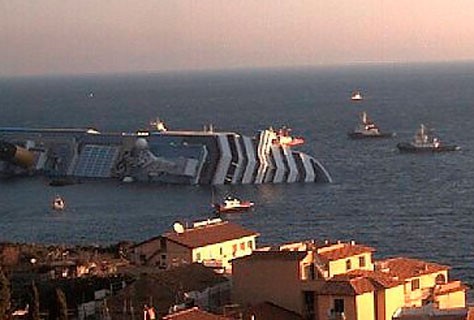
Un mallorquí entre els desaparegurts del creuer naufragat*


Tot i que el govern espanyol havia anunciat a la tarda que els 177 ciutadans de l'estat que viatjaven al creuer de luxe naufragat a la costa de la Toscana, es trobaven sans i estalvis, més tard s'han donat per desapareguts tres malloquins. I ara, mentre la informació continua essent encara confusa, diverses fonts apunten que dos d'aquests tres desapareguts ja han estat localitzats. Resta desaparegut Guillermo T., un home de Palma, de 68 anys, que viatjava amb un grup de nou mallorquins, i del qual no es tenen notícies des del naufragi.
Vicente Salvador, mallorquí de 20 anys que vitajava en aquest grup de passatgers, ha explicat que van perdre la pista de Guillermo, oncle de la seva nòvia, quan intentaven abandonar el creuer. Salvador es troba ara, juntament amb els altres mallorquins, a Santo Steffano, capital del l'illa Giglio, on hi ha hagut el naufragi, a l'espera de notícies.
Les autoritats italianes han confirmat que de moment hi ha tres morts, però a mesura que han anat passant les hores --ja n'han passades més de vint-- s'ha anat confirmant el que la premsa italiana insinuava al principi amb molta prudència: hi ha desenes de desapareguts i aquest naufragi es pot convertir en una gran tragèdia. Vegeu en aquesta webcam en directe del port de l'illa com el vaixell, dins el qual no s'estima que hi hagi quedat ningú, s'acaba d'enfonsar.
El comandant, a la presó
Aquesta mateixa tarda el comandant del vaixell ha entrat a la presó després d'haver estat interrogat durant hores per la fiscalia. El comandant s'ha limitat a dir que el vaixell ha topat amb roques que no constaven a cap carta nàutica.
Amb tot, diverses fonts apunten que el vaixell s'ha desviat de la ruta, com Giorgio Fanculli, l'únic periodista a l'illa de Giglio, que gestiona el diari Giglio News, el qual ha quedat desbordat per l'allau de visites. Per Fanculli, que ha vist en directe el naufragi des de la costa, el vaixell era massa a prop de terra ferma, més que no pas habitualment. Aquest és el vaixell més gran que mai s'ha enfosat a tot el món. Era de construcció nova i comptava amb l'última tecnologia en seguretat.
Polèmica per les instruccions de la tripulació
Les causes són encara per determinar i les investiga la justícia. Però ja ha esclatat una altra polèmica. Segons diversos testimonis, la tripulació va informar d'un problema elèctric quan va marxat el corrent i després va instar els passatgers a anar als bóts salvavides per precaució. Però a partir d'aquest moment, no hi va haver cap mena d'instrucció ni es va explicar com calia deslligar les barques, cosa que va generar escenes de caos i fins i tot violència entre els passatgers i que, sempre segons els testimonis, va retardat hores l'evacuació del vaixell.
Els fets
Cap a les deu de la nit de divendres, a l'hora de sopar, el vaixell va quedar encallat, es va començar a inclinar i va marxar el corrent elèctric. Aleshores la tripulació va fer sortir els passatgers en bóts salvavides i helicòpters, però es van viure autèntiques escenes de pànic i diversos passatgers van saltar a l'aigua.
A bord hi viatjaven 3.200 passatgers, la majoria alemanys, francesos i italians, i un miler de tripulants. Els que han estat evacuats s'han allotjat en escoles i esglésies de l'illa. El vaixell havia sortit de Civitavecchia i tenia previst fer aturades a Savona, Marsella, Barcelona, Palma, Càller i Palerm. Els passatgers del nostre país que hi havia són tots fora de perill.
La companyia, Costa Cruceros, diu en un comunicat a la seva web que investiga el naufragi i que és una tragèdia que afecta profundament l'empresa.

* Notícia publicada a Vilaweb. Lamentem aquest accident, i mostrem el nostre condol amb les famílies dels morts. Esperem que es trobin tots els desapareguts.