Es mostren els missatges amb l'etiqueta de comentaris Índia. Mostrar tots els missatges

dissabte, 4 de juliol del 2015

INS Viraat to turn into a museum*

Suresh Dharur
Tribune News Service
Hyderabad, July 3

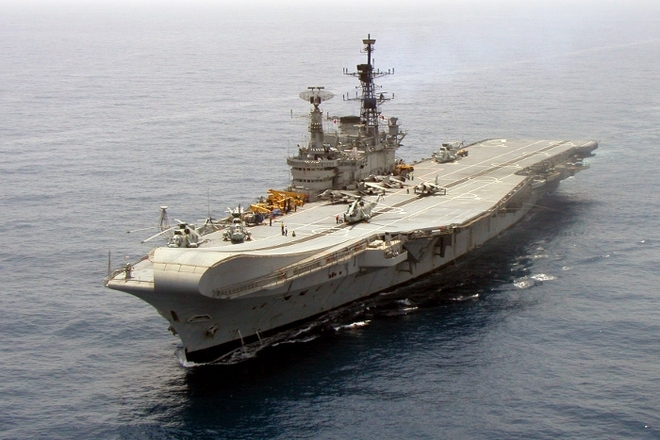
INS Viraat, the oldest aircraft carrier in the world, will soon be converted into a museum.


The Andhra Pradesh Tourism Development Corporation (APTDC) authorities have received an in-principle approval from the Ministry of Defence to convert the Centaur-class aircraft carrier into a museum.

“The Centre has agreed to hand over INS Viraat to the state on the request of Chief Minister N Chandrababu Naidu,” the APTDC executive director Amarendar said.

The warship will be docked at the shores of Kakinada port in coastal Andhra to serve as a tourist attraction. It is scheduled to be decommissioned in 2016.

The state government is planning to invest over Rs 20 crore to convert it into a museum without tinkering with is main structure. The museum will be entirely developed and maintained by the government without involving any private player.

Viraat was completed and commissioned in 1959 as the Royal Navy’s HMS Hermes and was transferred to India in 1987. In April 1986, India had signed an agreement with Britain to acquired HMS Hermes. It was part of the action during the Falklands war in 1982. After refits and new equipment being fitted on Hermes, it was commissioned as INS Viraat on May 12, 1987.


Originally, the aircraft carrier was scheduled to be decommissioned in 2009, but with the INS Vikramaditya’s induction being delayed, Viraat underwent a series of refits and continued its service.

* Notícia publicada a The Tribune. Celebrem que l'INS Viraat (ex-HMS Hermes), un vell guerrer, es pugui preservar com a patrimoni de la Història naval. No és el primer cas però, també es feu amb el primer portaavions indi, l'INS Vikrant (R11).


divendres, 5 de setembre del 2014

Russia offers to help repair India’s Kilo class submarine*

Russia expressed willingness to help repair all of India’s Project 877 EKM (NATO reporting name Kilo) diesel-electric submarines. India has 9 such submarines, many of which are in need of repair, according to Andrey Baranov, Deputy Director of foreign trade and military-technical cooperation of the Rubin Central Design Bureau for Marine Engineering.
According to Baranov, Russia is ready to provide India with a program that shows the exact repair time for specific vessels. India’s Ministry of Defence is expected to offer a response, according to Itar-Tass.

Baranov recalled the accident on the Russian-made submarine INS Sindurakshak off the coast of Mumbai in August of last year. It is unclear whether the submarine can be used again, although Indian Navy sources remain optimistic.
The service life of many of India’s Project 877 EKM submarines can be extended up to ten years, according to the Rubin bureau.
Earlier it was reported that the Zvezdochka shipyard will take on the repair and modernization of the Indian Navy’s Sindukesari. Then it was reported that the financial terms had not yet been fully resolved, in order for India to avoid the sanctions imposed by the United States and the EU on the United Shipbuilding Corporation, which owns Zvezdochka.
In early August, the Indian side indicated its willingness to buy or lease two Russian Cupid class submarines. This decision was made after the failure of one naval submarine project in India, resulting in the Ministry of Defence’s subsequent unease about the state of the country's defences.
In September 2013, India said it intended to conclude a contract with Zvezdochka in 2015 - 2019 on the repair of two Project 877EKM submarines with the extension of their service life.

Since 1997, Zvezdochka has modernised five Indian diesel-electric submarines - Sinduvir, Sinduratna, Sindugosh, Sinduvijay and Sindurakshak. The enterprise also continues the repair and modernisation support of the Sindukirti submarine at its permanent base - Visakhapatnam.
Project 887EKM submarines were designed by the Rubin Central Design Bureau for Marine Engineering (St. Petersburg). They are designed for fighting enemy’s submarines and ships and defending naval bases, coastal and sea service lines, reconnaissance and patrolling missions.

*Notícia publicada a Russia & India Report. Més enllà dels acords concrets, aquesta notícia ens recorda la importància de gestionar els contractes de manteniment, reparacions i actualització.

dissabte, 12 de juliol del 2014

Kolkata handed over to Navy*

The INS Kolkata, lead ship in the Kolkata-class stealth destroyers, was handed over to the Indian Navy on Thursday after extensive sea trials and tests, 11 years after the construction began in 2003 at the Mazgaon Docks Limited (MDL). The ships are the second group of three indigenously built stealth warships after the Shivalik-class boats, while the official commissioning ceremony is expected to take place in a month’s time.
The same ship had seen naval engineer Commander Kuntal Wadhwa lose his life after a prolonged exposure to CO2 gas on March 6, suspected to be caused by a malfunctioning fire fighting system. “The ship has finished construction with all user acceptance trials, sea trials and testing of the weapons systems completed. The ship will still be called Yard 701 but designated the INS Kolkata after the commissioning ceremony,” said Rear Admiral (retired) R.K. Shrawat, MDL’s chief managing director.
Most importantly, the naval version of the Brahmos cruise missile was also fired from the ship off the coast of Karwar about a month ago, to prove the boat’s and weapon handling system. “The purpose was to test the ship’s capability to withstand the missile, but not the missile itself,” said an MDL source. The main feature of the ship, however, according to naval officers, is the ‘multi-function radar’, the first of its kind in the country. “It is more in tune with modern naval warfare technologies than the stealth feature,” said an officer.
The Indian Navy can come back with technical complaints or suggesting modifications by availing the one-year guarantee period in the next 12 months, in the event of which Form D448 would be invoked. Sources, however, said that all technical issues were raised by the IN team, liaisoning with the MDL, during the construction phase itself.
Meanwhile, two other sister ships of the class, INS Kochi and INS Chennai are undergoing construction with the handing over to the IN slated to be in late 2014 and mid-2015 respectively.

* Notícia publicada a The Asian Age. Finalment la primera unitat de la classe Kolkata entrarà en servei. Serà interessant veure con encaixen en la nova doctrina naval de l'Índia: seran la peça central o un conplement dels nous portaavions? No és una qüestió menor.

dijous, 6 de març del 2014

Indian Navy ready to commission third Saryu-class warship*

The Indian Navy's third Saryu-class naval offshore patrol vessel (NOPV), INS Sumedha, will be commissioned on 7 March 2014 at Goa shipyard (GSL).
Built by Goa Shipyard, the 105m-long offshore patrol vessel was delivered to the Indian Navy in January 2014 during a ceremony held in Goa.
GSL chairman and managing director Rear Admiral Shekhar Mital said that the ship is the result of many years of in-house design development and ship build techniques.
"The commissioning of this ship, marks a significant milestone in GSL's & nation's march towards indigenisation and self reliance," Mital said.
"It becomes more important as Sumedha is 200th ship indigenously built by GSL."
Designed for monitoring sea lines of communication, defence of offshore oil installations and other critical offshore national assets, the vessel can be deployed for escorting high value ships and fleet support operations.
"The vessel can be deployed for escorting high value ships and fleet support operations."
Capable of conducting ocean surveillance and surface warfare operations to prevent infiltration and transgression of maritime sovereignty, the 2,300t Saryu-class vessel can cruise at speeds in excess of 25km using two KOEL/Pielstick Diesel engines and have a range of 6,000nm.

The warship can also conduct ocean surveillance and surface warfare operations to prevent infiltration and transgression of maritime sovereignty while helping to meet the increasing requirement of the Indian Navy.

The Indian Navy has taken delivery of the first two Saryu-class vessels INS Saryu and Sunayna from GSL on 21 December 2012 and 02 September 2013 respectively.

Meanwhile, the GSL-built Shore Based Test Facility (SBTF), designed for landing trials of the MIG 29K & LCA at INS Hansa is also ready for commissioning.

* Notícia publicada a Naval Technology. Compartim aquesta notícia ja que, tot i que les OPV no tinguin el "glamour" d'un portaavions, donen bastanta polivalència i, per tant, són una inversió amb més retorn.

dimarts, 11 de febrer del 2014

India to manufacture indigenous submarines soon*

With its underwater arm severely depleted, India is preparing the ground to launch an indigenous submarine design and development plan.

In the first step, the Defence Research and Development Organisation (DRDO) will set up an agency in Hyderabad to test and certify the steel that will be used in making the indigenous submarine.

The underwater vessel will be made using the same DMR-249A and 249B steel - manufactured by the Steel Authority of India Ltd - that was used to make aircraft carrier Vikrant and P-28 missile corvettes.

"For underwater applications, we need extensive certification while for surface ships, if the material’s property matches with the benchmark, it could be used. The new agency will have best equipment to test the properties of naval steel,” G Malakondiah, one of the chief controllers at DRDO, told Deccan Herald.

The first industrial scale trial of submarine steel was accomplished successfully. Now, the material needs intensive testing for which the agency would be set up in two years. "The unit would be located close to Defence Metallurgical Research Laboratory, he said.

A parallel effort is on to develop suitable welding technologies and consumables for submarines at Naval Material Research Laboratory, Ambernath.

After the massive accident of INS Sindhurakshak last year, Navy currently has just about 10 functional submarines, most of which are pretty old. Realising the consequences, the government has decided to upgrade four Kilo-class and two HDW-class submarines.

India has purchased six French Scorpene submarines, which are under construction at Mazgaon Dock Limited. The first one is expected in 2016, to be followed by a new submarine in every nine months.

The defence acquisition council approved a second submarine assembly line (P-75I) under which four submarines (out of six) will be built within the country (three at Mazgaon Dock and one at Hindustan Shipyard, Visakhapatnam on transfer of technology) while the remaining two will be made at the collaborator’s yard abroad.

"Tender requirements for P-75I (request for proposal) have been firmed up. It took some time as we wanted to involve four-five major shipyards and had detailed discussions with them,” said Rear Admiral LVS Babu, assistant chief of naval staff (submarine).

The two assembly lines would be the stepping stone for indigenous submarine production as engineers and technicians at the dockyards would receive training and gather experience to take up the challenge.

* Notícia publicada al Deccan Herald.

dilluns, 10 de febrer del 2014

In Eastern Indian Ocean Sends Mixed Signals *

Earlier this week, China held a three-ship naval exercise in the Indian Ocean, conducting a series of exercises including combat simulations. According to the Associated Press, the task force then sailed through to the western Pacific by way of the Lombok Strait near Indonesia’s Bali island, approaching the Philippines. Before conducting a five-day exercise in the Indian Ocean, the ships had additionally patrolled the James Shoal, which is currently disputed between China and Malaysia (although Malaysia military officials are reportedly disputing the idea that China patrolled the area in late January).

The task force consisted of the Changbaishan–China’s largest amphibious landing ship–and two destroyers–the Wuhan and Haikou. According to Chinese state broadcaster CCTV, the ships carried out counter-piracy, search and rescue, and damage control drills. The ships eventually left the Indian Ocean to continue their drills in the Western Pacific Ocean. The Changbaishan is one of the more advanced ships in the PLAN’s fleet and is capable of launching helicopters and amphibious landing craft.

China has conducted naval drills in the Indian Ocean in the past but has generally focused on restricting these to its western waters, by the Gulf of Aden. For example, an exercise in August 2013 saw the U.S. and Chinese navies jointly practice counter-piracy operations in the Gulf of Aden which is generally a hot region for pirates based off the Horn of Africa.

These exercises by contrast are potentially far more provocative for India, Australia, and ASEAN states (even though Southeast Asia isn’t bereft of pirates by any means). For India, a Chinese approach in the eastern Indian Ocean raises anxieties about the reach of China’s navy. India regards the eastern Indian Ocean–the space between the Andaman and Nicobar Islands and Sumatra–as its domain. Any Chinese exercises in this area, particularly combat simulations, will not be taken lightly by New Delhi.

Australia is generally content to accept the Indonesian archipelago as a comfortable buffer zone from the busy sea lanes of the South China Sea. By way of this exercise, China demonstrates an operational ability in Australia’s northern waters which could have implications for Australia in the future. Rory Medcalf of the Lowy Institute, an Australian think-tank, notes that “the precise strategic implications of the Chinese navy’s newly-demonstrated ability to operate in Australia’s northern approaches are open to debate.”

For China, the exercises make perfect sense in its bid to field a blue-water navy capable of operating outside China’s proximate waters. Medcalf notes that while these exercises will surely spook some observers in the region, there is “nothing illegal or fundamentally hostile about what the Chinese navy has just demonstrated.”

Indian observers appear to be more concerned by the exercise. One Indian commentator, Srikanth Kondapalli, notes that the exercise sends a signal to India that China “can come closer to the Andaman & Nicobar joint command through Lombok, and not just through Malacca.” He additionally notes that China could be testing the waters in the eastern Indian Ocean, including its ability to operate some distance away from its bases in the region.

The Hindu’s Ananth Krishnan notes that the exercises could also reflect China’s desire to hedge its reliance on the Strait of Malacca–a major waterway for Middle Eastern oil and other imports. 80 percent of China’s fossil fuel imports travel via the strait. Beijing has already invested heavily in Pakistan, Myanmar, and Bangladesh to better connect itself with the Indian Ocean. Generally speaking, China hasn’t seen the less-trafficked straits of Lombok, Sunda, and Makassar to the south as vital to its so-called “Malacca dilemma,” but this could be changing.

* Article publicat a The Diplomat. Més enllà de l'anàlisi en qüestió, queda fora de qualsevol dubte que la Xina pot realitzar operacions a llargues distàncies, i ja no de forma excepcional

dimarts, 19 de novembre del 2013

INS Vikramaditya enters service with Indian Navy*

The Indian Navy has commissioned its new aircraft carrier, INS Vikramaditya, at Sevmash Shipyard in Severodvinsk, Russia.
Capable of accommodating a crew of 1,600, the completely refurbished 44,500t INS Vikramaditya has an overall length of about 284m, a maximum beam of about 60m and a range of over 7,000nm.
Indian defence minister AK Antony said INS Vikramaditya is expected to significantly enhance the reach and capability of the Indian Navy.
"India's economic development is dependent on the seas and safeguarding the nation's maritime interests is central to our national policy," Antony said.
"The induction of Vikramaditya'with its integral MiG29K fighters and Kamov-31 helicopters, not only reinforces this central policy, but also adds a new dimension to our navy's operational capabilities."
Powered by eight new generation steam boilers, the aircraft carrier can operate Russian Aircraft Corporation MiG (RAC MiG)-built MiG 29K multirole fighter aircraft, the Kamov 31 medium-weight naval helicopter and Kamov 28 naval anti-submarine helicopter, the Sikorsky Sea King aircraft and Chetak aircraft.
"The meaning of 'Vikramaditya', which literally translates into 'strong as the sun' is complemented by the ship's motto: "Strike Far, Strike Sure."
The short takeoff but arrested recovery (STOBAR) aircraft carrier is equipped with sensors and launch and recovery systems, and enables the smooth and efficient operation of ship-borne aircraft.
Naval chief of staff, admiral Joshi, said INS Vikramaditya will bridge the time-gap that occurs between the INS Viraat and the indigenously built aircraft carrier Vikrant by helping achieving medium term goal of operating two aircraft carriers.
The warship also features Resistor-E radar complex automated system to provide air traffic control, approach / landing and short range navigation for ship borne aircraft as well as modern communication complex, CCS MK II, to meet her external communication requirements.

* Notícia publicada a Naval Technology. Finalment, i després de molts anys de retard, sembla que l'entrega del Vikramaditya és imminent.

divendres, 8 de novembre del 2013

Navy to upgrade torpedoes, sonars of warships soon*

The Navy is all set to upgrade its heavyweight torpedoes to extend both its life and range, apart from acquiring low frequency sonars for 16 of its front line warships to improve its surface and anti-submarine warfare capabilities.

The Navy has chosen the German firm Atlas Elektronik to help it upgrade the heavyweight torpedoes, the most reliable weapons that can hit surface and underwater targets (SUT), for the four HDW Type 209 Shishumar class submarines, also of German origin.

The Navy is also on the verge of finalising the winner for supplying it with Active Towed Array Sonars (ATAS) for which Atlas Elektronik is one of the leading contenders, the company’s executives told a group of Indian journalists taken on a tour of its manufacturing facilities at Bremen and Hamburg in Germany.

The first six ATAS system would be three each of the Delhi-class destroyers and the Talwar-class frigates of the Navy. The contract winning company would be required to transfer the technology of the ATAS system to Indian defence public sector Bharat Electronics Limited (BEL) to produce 10 more of the sonars for the Kolkata-class destroyers, Shivalik-class frigates and the Kamorta-class corvette.

Navy sources here confirmed that they have selected the firm to upgrade its 64 SUT torpedoes and extend its life by another 15 years, while the selection process for the ATAS system is still not completed.

Khalil Rehman, CEO of Atlas Elektronik which opened its Indian subsidiary earlier this year, said the company was looking to expand its presence in India after its return to the market with the torpedoes upgrade programme. In this regard, he said, Atlas Elektronik had presented its SeaHake mod4 ER -- the latest, fastest and most effective heavyweight torpedoes -- to the Navy to boost its firepower.

“We want to further deepen our ties with India and provide the best of products and services to the Indian Navy, apart from integrating India into our global supply chain,” Bremen-based Atlas Elektronik CEO Volker Paltzo said.

* Notícia publicada a The New Indian Express. Sovint analitzem l'evolució de les marines de guerra en funció de l'aquisició i/o baixa d'unitats. Però l'estudi de sistemes concrets, com ara els sónars i torpedes ens pot donar informacions molt rellevants.

dissabte, 17 d’agost del 2013

The Sinking of the INS Sindhurakshak Strains Russo-Indian Military-Technical Cooperation*

By: Pavel Felgenhauer
 
A series of explosions and a deadly fire ravaged the Kilo-type (project 877EKM or Varshavyanka) 3,000-ton submarine INS Sindhurakshak on August 14 as it was moored in Mumbai harbor and preparing to sail the next day, on August 15—India’s Independence Day. Eighteen sailors are feared to have perished in the disaster. The nose of the submarine was ripped open by an explosion: It sank but did not capsize, and its “sail” or fin is still rising above the water. A sister Kilo submarine, the INS Sindhuranta, moored alongside the INS Sindhurakshak, reportedly sustained some damage as a result of the massive explosion. The Sindhurakshak was built in St. Petersburg in the late 1990s. From 2010 to 2013, the Sindhurakshak was repaired and modernized in Russia in the Zvezdochka shipyard in Severodvinsk. The Sindhurakshak sailed from Severodvinsk last January and arrived in Mumbai last April, going more than ten nautical miles using its own diesel engines (Kommersant, August 15).
 
A team of Russian specialists from the Zvezdochka shipyard was in Mumbai to service the Sindhurakshak, but none were onboard when the vessel exploded and sank. Russia is ready to help the Indians investigate the cause of the catastrophe, but, reportedly, the Indians have refused to allow Russians specialists on the scene. The Sindhurakshak sank in relatively shallow waters and can be salvaged, though the severity of the sustained damage means it will most likely go to scrap anyway (Interfax, August 15).
 
In Severodvinsk, the Sindhurakshak was refitted with new batteries, new electronic communications equipment, sonar and, most importantly, Russian-made Klub-S (SS-N-27A) cruise missiles, giving the submarine important additional capabilities to strike enemy ships and land targets at ranges of up to 300 kilometers. The refitting of the Sindhurakshak cost India some $90 million (Kommersant, August 15). According to Indian sources, the price tag of the Sindhurakshak refitting was much higher—$156 million (http://timesofindia.indiatimes.com/india/At-156m-refit-expenses-on-INS-Sindhurakshak-exceeded-original-cost/articleshow_b2/21829702.cms?prtpage=1). Four other Indian-operated Kilo-class submarines have been refitted with Klub-S cruise missiles in Russia, including the INS Sindhuranta, which was reportedly somewhat damaged by the August 14 explosion. The loss of the Sindhurakshak is a severe blow to the Indian Navy. The Indians currently have 14 submarines, including a nuclear-powered K-152 Nerpa attack submarine (INS Chakra), leased from Russia. But apparently only half of those are ready for combat at any given time.
 
The Russian press and specialists are blaming the Indian sailors for “making grave mistakes,” which sank the Sindhurakshak, a diesel-electric submarine that uses either a snorkel to suck in air, or powerful batteries to propel it while underwater. During charging, the batteries emit hydrogen, which may ignite or explode. The INS Sindhurakshak had inbuilt safety precautions to control the hydrogen problem, but Russian experts and the press stress the Sindhurakshak’s Russian-made batteries were replaced in Severodvinsk during refitting with Indian-made Exide batteries. The makers of the Klub-S missiles—the Novator Design Bureau—told Kommersant their warheads “are absolutely safe and cannot detonate accidentally because of fire or anything.” The Zvezdochka shipyard told journalists the Sindhurakshak was in good order, the renovation was fine and the shipyard had done nothing possibly wrong that could have caused the disaster (Kommersant, August 15).
 
The blame shifting in the disaster between Moscow and New Delhi may seriously strain Russo-Indian military-technical cooperation, which has already been under pressure in recent years. During the Cold War, India was a staunch Soviet ally, while its archenemies Pakistan and China were allied to the United States. India received large amounts of Russian weapons, and the shipments continued after the Soviet collapse in 1991; the overall strategic balance in Asia slowly shifted, however, with Russia becoming increasingly close to China, while, in turn, the US became friendlier with India as its ties with Beijing and Islamabad withered. Since 1989, China is forbidden to import US or European Union military hardware. Whereas, India is free to buy from any Western source, including the US. The Russian share of India’s overall arms imports declined from 75 to 40–45 percent, but the volume of import of Russian arms has stayed constant. Indian military personnel often complain about outdated Russian equipment. “The Sindhurakshak disaster may cause some hostile articles in the Indian press, but they [the criticism in the media] are anyway bankrolled by the French,” says a leading Russian expert Sergei Lunev, “This wave will recede, and the Indians will continue to buy Russian since they are often themselves to blame for disasters with military hardware” (Nezavisimaya Gazeta, August 15).
 
In the past the delivery of Russian-made ships and submarines to the Indian navy was delayed because of technical mishaps. The former Russian carrier Admiral Gorshkov was initially planned to be delivered to India in 2008, but is still today in Severodvinsk. The price of the Gorshkov refurbishing has increased from the initial $1 billion contract signed in 2004 to $2.33 billion. Last year the Gorshkov’s main engine went bust during trials in the Barents Sea (see EDM, November 30, December 7, 2012), and today Russia is hoping to finally deliver it before the end of 2013 (Kommersant, August 15).
 
India is building French-designed Scorpene submarines, equipped with air-independent propulsion systems in Mumbai to eventually replace the diesel-electric Kilos. Russia has still not mastered the production of non-nuclear air-independent propulsion submarines or torpedoes, but the assembly of the Indian Scorpenes is years behind schedule. At present New Delhi is negotiating with Moscow the possible purchase (lease) of one more nuclear submarine to add to the Nerpa (RIA Novosti, August 15).
 
The most ambitious and costly Russo-Indian military project is to build a stealth fifth generation fighter aircraft or FGFA: only on R&D India must spend some $6 billion before 2020, with Russia adding another $6 billion. India plans to procure 144 FGFA jets, for an additional $15 billion or more (RIA Novosti, October 16, 2012). The Sukhoy Corporation boasts it already has four prototype T-50 FGFAs doing fly tests and that in 2016 the T-50 will go into serial production (Interfax, March 28). But Russia still does not have the new-generation jet engines, radars or weapons to fit the hull compartments of the T-50 (RIA Novosti, April 25). Acrimony over the Sindhurakshak disaster and other Indo-Russian military-technical mishaps may undermine the Indians’ will to spend billions on the unproven FGFA; and if this project stalls, relations could further sour.

* Notícia publicada a l'Eurasia Daily Monitor de la Jamestown Foundation. Compartim aquest anàlisi per reforçar la informació sobre l'accident del INS Sindhurakshak.

dijous, 15 d’agost del 2013

Russia distances itself from India sub disaster*

Russia on Wednesday sought to guard its reputation as a supplier of military hardware by distancing itself from a deadly accident on an Indian submarine that its manufacturers had built and recently repaired.

The 2,300-tonne diesel-powered INS Sindhurakshak exploded and caught fire while docked in Mumbai early on Wednesday on the eve of India's Independence Day holiday.
The fully-loaded boat partially sank with 18 seamen on board. India's defence minister said a still-unknown number of personnel had "lost their lives in service of the country."

The incident deals a powerful blow not only to India's burgeoning naval ambitions but also to Russia's own flagging military prestige.

Moscow remains New Delhi's biggest defence partner and is keen to preserve a market it has nurtured with great care since Soviet times.

Official statistics show that eight of the 11 Project 877 submarines such as the INS Sindhurakshak Russia has built for export since the 1980s have been delivered to India.

"I do not believe that this incident will have a negative impact on Russia's military cooperation with India," the state-run RIA Novosti news agency quoted Moscow's Global Arms Trade Centre expert Igor Korotchenko as saying.

But Indian officials have voiced growing displeasure with their old partner's service - particularly concerning the cost-overruns and delays involved in the refit of a Russian aircraft carrier that now bears the name INS Vikramaditya.

Analysts believe that India is forced to continue purchasing Russian military parts because it still operates so many Soviet-era warplanes and vessels.

But New Delhi has also sought to expand its military trade ties with Washington in the past decade after remaining for so long under Moscow's care.

The US-based Center for Strategic and International Studies estimates that cumulative defence sales between New Delhi and Washington had grown "from virtually zero" 10 years ago to more than $8 billion today.

That trend has unnerved Russian officials who have already suffered humiliations from two deadly post-Soviet submarine disasters and a raft of other military and space setbacks.

The Kursk nuclear submarine tragedy claimed 118 lives when it sank in August 2008 while the Nerpa sub - eventually commissioned by India -- killed 20 Russian sailors when it caught fire while conducting exercises in November 2008.

The INS Sindhurakshak was under a Russian warranty until January 2014.

The Russian-built boat - commissioned in 1997 - underwent a refit lasting more than two years after it had caught fire in 2010 and had only left its Barents Sea repair dock at the end of January.

Russian officials were quick to report that India had voiced no complaints after receiving the submarine in April.

"There have been no claims or technical complaints," the United Shipbuilding Corporation's spokesman Alexei Kravchenko told Russian state television.

The Russian firm that refitted the submarine also stressed that the craft was fully operational when returned to India.

A spokesman for the Russian Zvyozdochka ship repair company told RIA Novosti that "certain issues" had been raised when the INS Sindhurakshak was inspected by experts at the Severodvinsk port on the Barents Sea.

The unnamed spokesman did not give further details about the nature of the issues but said they were part of the "normal working process".
 
Russia's Interfax news agency also carried a report citing an unnamed "military-diplomatic source" who claimed that the INS Sindhurakshak could have been the target of a terror plot.

"We cannot exclude the possibility that someone was trying to ruin the Indian people's main holiday - Independence Day - which is celebrated on August 14," the Russian official told the news agency.

The official speculated that the boat could not have suffered an accident while in its dock because most of its main systems would have been probably switched off. However no further evidence was given to back up the claim.

* Notícia publicada al Hindustan Times. Tot i que encara ens movem en el terreny de l'especulació ( i amb el respecte degut als mariners morts i llurs famílies), no hem de perdre de vista el progressiu realineament de l'Índia pel que fa al proveïment de material de defensa. És impossible per ara que trenqui amb Rússia com a proveïdor, però l'avenç de la recerca i les empreses índies, i la predisposició de Washington a substituïr Moscou van aplanant el camí.

dimecres, 14 d’agost del 2013

Reaffirming India’s South China Sea Credentials*


By Chietigj Bajpaee


This week, India unveiled its firstindigenously developed aircraft carrier, the INS Vikrant, just days after the reactor of the country’s first indigenous nuclear submarine, the INS Arihant, achieved criticality. The milestones continue India’s rapid naval modernization, as its strategic relevance in Asia is increasingly determined by its maritime role.
“Maritime Asia” has emerged as a new geopolitical frame of reference in recent years as the nations of Asia evolve into major trading and resource-consuming powers with economic growth contingent on seaborne trade. India is no exception, with 95 percent of its total external trade by volume and 75 percent by value now conducted by sea, and with more than 70 percent of its oil imports transiting the maritime domain. To protect these burgeoning maritime interests, the Indian government has expressed lofty ambitions to establish “a brand new multi-dimensional Navy” with “reach and sustainability.” The country has the world’s fifth-largest navy with plans to build a 160-plus-ship navy, comprising three aircraft carrier battle groups by 2022.
Contested maritime role
However, India’s maritime ambitions are being challenged by the fact that the country’s maritime position is often regarded as contested. Take, for instance, the South China Sea: although almost 55 per cent of India’s trade passes through the Strait of Malacca, some countries continue to oppose allowing it to play a prominent role.
Notably, China has voiced displeasure at the growing Indian naval presence in the region. This was evidenced by reports in July 2011 that an Indian Navy vessel received radio contact from the Chinese Navy demanding that it depart disputed waters in the South China Sea after completing a port call in Vietnam. This was followed by the less belligerent but nonetheless provocative gesture of an Indian naval vessel receiving a Chinese naval escort while on its way from the Philippines to South Korea in June 2012. Beijing has also opposed Vietnam granting exploration rights to Indian company ONGC Videsh in offshore blocks located in disputed waters.
Well-entrenched maritime interests
Despite the fact that India does not share a contiguous maritime border with the South China Sea, itsmaritime interests in the region are well established. While not as vocal as the United States, which declared maritime territorial disputes in the South China Sea a “national interest” in 2010, New Delhi has nonetheless echoed the U.S. position of calling for a peaceful resolution and continued freedom of navigation. India has also pursued deepening maritime relations with several claimant states, notably Vietnam, with the Indian Navy gaining permanent berthing rights at Nha Trang port and offering the Vietnamese training in submarine warfare.
Since its first deployment to the South China Sea in 2000, the Indian Navy has also been involved in several high-profile maritime operations in the region, including humanitarian assistance and disaster relief, joint naval exercises, and port calls. This includes its prominent role in relief operations following the Asian tsunami of 2004 and the cyclone that struck Myanmar (Burma) in 2008. The Indian Navy also escorted U.S. naval vessels transiting the Strait of Malacca as part of ‘Operation Enduring Freedom’ in 2002.

Supporting India’s growing maritime interests in the South China Sea is the tri-services Andaman and Nicobar (Southern) Command, which was established at the mouth of the Strait of Malacca in 2001. The command was expanded with the establishment of Campbell Bay (INS Baaz), a deep-water maritime facility at the southernmost point in the Andaman Islands in July 2012. This complements the Eastern Command headquartered in Visakhapatnam, Andhra Pradesh, which has received a growing proportion of the Navy’s resources, correcting for the Navy’s traditional bias in favor of the Indian Ocean and Gulf regions. Interestingly these facilities were initially developed and expanded to strengthen India’s sea-denial capabilities in response to the threat posed by the United States following its deployment of the Seventh Fleet into the Bay of Bengal during the India-Pakistan war of 1971. Now, however, they are increasingly relevant to maintaining the freedom of navigation in the region.
Preventing “spill-over” into the Indian Ocean
Beyond accessing offshore energy resources and ensuring the safe passage of its vessels through the Strait of Malacca, India also has broader interests in the South China Sea: ensuring that China’s increasingly assertive position over maritime territorial disputes in the South China Sea China is not repeated in the Indian Ocean. Notably, recent events in the South China Sea could be a harbinger of China’s potential behavior in the Indian Ocean, especially if China elevates the protection of sea-lines of communication to a “core interest” (hexin liyi) on par with its sovereignty interests in resolving maritime and continental territorial disputes and reunification with Taiwan.
Moreover, an expanded Chinese naval presence in the Indian Ocean could result in a role reversal of its position in the South China Sea; whereas China is the coastal state and India the external maritime power in the South China Sea, the tables are turned in the Indian Ocean. This could entail China intervening in disputes over the demarcation of maritime boundaries that India has with its neighbors (namely Pakistan, Bangladesh and Sri Lanka), and intelligence gathering and exploitation of maritime resources close to India’s coastline. The fact that China secured a permit to engage in deep seabed mining in the southwest Indian Ocean in July 2011 demonstrates the potential for such a scenario.
In this context, China’s nascent naval presence in the Indian Ocean, including the PLA Navy’s ongoing anti-piracy operations in the Indian Ocean, have been viewed by some with suspicion. Reports that an Indian submarine and Chinese naval unit were “locked in a tense stand-off” near the Bab-el-Mandeb Strait in the Gulf of Aden in January 2009 illustrates the potential for the Indian Ocean Region to emerge as a new theater of competition between China and India. This strengthens the case for India to engage in the South China Sea so as to deter China’s increasingly aggressive maritime behavior from repeating itself in the Indian Ocean.
Toward a new regional architecture
Finally, India’s growing interest in the South China Sea comes amid the United States’ “forward-deployed diplomacy” towards the Indo-Pacific region. However, the United States is both “pivoting” towards the region and “re-balancing” within it. In other words, Washington is both reiterating its commitment towards the region, as well as calling on its allies to share the burdens of regional security. Evidence of this is seen in Japan’s increasingly proactive role in forging bilateral and multilateral regional security partnerships, such as Prime Minister Shinto Abe’s proposal for a “security diamond,” which would “safeguard the maritime commons stretching from the Indian Ocean to the western Pacific.”
While the United States may not yet be following in the footsteps of the British withdrawal East of Suez in the middle of the last century, it nonetheless is reducing its global military footprint amid the operational fatigue of two consecutive land wars and the pressures of fiscal austerity. Further, the U.S. quest for energy independence fuelled by its own shale gas revolution and energy efficiency gains across OECD countries could act as a further catalyst for a loss of interest in protecting global energy transit corridors, including vital sea-lines of communication. In 2011, the United States imported 2.5 million barrels per day (bpd) of oil from the Middle East, accounting for 26 per cent of its global imports. This is projected to fall to 100,000 bpd or 3 per cent of its oil imports by 2035.

In this context, the Asian maritime domain is likely to emerge as an increasingly active theater of inter-state rivalries, given concerns of a strategic void created by a more “hands-off” approach by the U.S., as well as the growing interest of major regional powers to protect their burgeoning seaborne trade and access offshore energy resources. This is already evident in the shifting focal point of regional conflict from the continental to maritime domain, as noted by the contrast between the land wars that dominated Asia during the Cold War – the Korean War (1950-53), Sino-Indian War (1962), Vietnam War (1968-75), Sino-Russian border conflict (1969) and Sino-Vietnamese border conflict (1979)) – and the plethora of maritime territorial disputes that have flared in the post-Cold War period. These include the Sino-Japanese dispute over the Diaoyu/Senkaku islands and China’s claim to the “nine-dash line” around the South China Sea, which conflicts with Vietnam’s claim to the Paracel Islands and the Philippines, Vietnam, Malaysia, and Brunei’s claims to portions of the Spratly Islands.
This demonstrates the need for a new maritime architecture led by the region’s major powers. For instance, Indian National Security Advisor Shiv Shankar Menon has proposed a “Maritime Concert” in which the region’s major maritime powers would have collective responsibility to protect the domain. There have already been several demonstrations of this kind of cooperation, including China, India and Japan coordinating their anti-piracy patrols in the Indian Ocean within the framework of the Shared Awareness and Deconfliction (SHADE) mechanism, and the establishment of an Expanded ASEAN Maritime Forum (EAMF) in 2012.
An expanded maritime role for India is prudent if it is to defend its growing maritime interests amid the country’s emergence as a major trading and resource-consuming power. However, it is also pivotal forprotecting the global commons from the growth of inter-state security threats rooted in concerns over China’s rise as a maritime power and an erosion of the United States’ role as the region’s “sea-based balancer,” as well as the proliferation of transnational security threats, including maritime piracy, illicit trafficking, and the latent threat of maritime terrorism. As evidenced by its maritime behavior in the South China Sea, India’s strategic significance in East Asia will be increasingly contingent on its ability to play a constructive maritime role in the region.
Chietigj Bajpaee is a doctoral candidate in the Department of War Studies at King’s College London and a visiting fellow at the Vivekananda International Foundation, a New Delhi-based public policy think-tank.
* Notícia publicada a The Diplomat. Una interessant perspectiva per comprendre el replantejament de Nova Delhi, cada cop més coïncident amb el "pivot to the Pacific" de Washington.

The INS Vikrant: A 37,500-tonne defence statement*


Why is the Vikrant important?
It is India's first ever indigenous aircraft carrier, and signifies a degree of self-reliance in this field. Currently under construction in Kochi, it will be the largest ever warship built in India. It will make the country the fifth that is capable of constructing aircraft carriers this size, the others being the US, Russia, France and the UK. The Vikrant is a STOBAR carrier — short takeoff but arrested recovery — which means aircraft will take off on their own power from a ski jump but will be hooked in by an arrester wire when they come in to land.

Since when has the project been planned?
As per the original plan, work was to start in 2008 and the ship expected to join service by 2014. The idea was to induct it within a few years of the commissioning of the Russian-origin Vikramaditya or Gorshkov so that the Navy would have two operational carriers, one each for the west and east coasts. However, the project saw delays in terms of government approvals as well as technology blocks. Actual work started in 2009 with the kneel-laying ceremony. Phase 1 of the project, which culminated in Monday's ceremony, is believed to have cost over Rs 15,000 crore. No official figures have been revealed. 

What is the ceremony in Kochi about?

Monday's function was the launching ceremony. What this means is that the structure, fabricated in a dry dock, has been floated out into the sea and anchored next to the yard. In warship production, a certain part is constructed in a dry dock that is slowly filled with water as the weight of the structure increases, but after a certain tonnage has been reached the dry dock cannot accommodate the weight any more. The Vikrant is currently over 15,000 tonnes and will weigh 37,500 tonnes when complete.India's aircraft carrier INS Vikrant raises hackles in China
What comes next?
Work will now start to add on the bridge aboard the flight deck, as well as extend the ship's breadth outside the confines of the dock. Extensive cabling and integration of all systems remain. Over 75 per cent of the structure has been erected, and the engines and generators housed inside their compartments.

When will the ship be inducted?
As per current plans, the ship should be ready to steam under its own power and go for the first round of trials by 2016-end. The trials are expected to last almost two years as all systems will be tested and faults rectified. Deck landing and takeoff trials will also take place. The ship is expected to be fit for formal induction in the Navy by the end of 2018.

What are the ship's capabilities?
The 37,500-tonne carrier has been designed to attain speeds in excess of 28 knots, and to carry 36 aircraft, 17 in the hangars and 19 on deck. It is powered by four LM 2500 gas turbines that will generate over 80 MW — enough to light a small city. It is designed to sail for over 8,000 nautical miles in a service period over three decades. Its main weapon will be its fighter aircraft.

What fighters will it carry?
A mix of MiG 29 Ks and later Light Combat Aircraft (Naval), besides KA 31 early warning and anti-submarine choppers and Advanced Light Helicopters for utility missions. It will be protected against air attacks by the long-range surface-to-air missile system being developed with Israel and will have AK 630 close-in-weapon systems. The carrier will act basically as an Indian air strike base that can be transported virtually across the world.

How does it compare with other ships?
At 37,500 tonnes, the Vikrant is in a class similar to that of the INS Vikramaditya (erstwhile Gorshkov) that is currently undergoing trials in the Barents Sea and is expected to join service by December 15. It is larger than India's sole serving carrier, the INS Virat that weights 28,000 tonnes and can carry less than 30 aircraft. The Vikrant will be the fourth carrier to be operated by India when it joins in 2018. The first was the original Vikrant (20,000 tonnes, retired in 1997) after which it has been named, the second is the 28,000-tonne Virat and the third will be the 44,000 tonne Vikramaditya. The US operates super-carriers that weigh over 90,000 tonnes and can carry over 80 aircraft. The UK, France and Russia operate carriers in the 40-60,000-tonne range. China's carrier (hull acquired from Ukraine but refurbished and completed in China) is currently undergoing trials in the Yellow Sea; it has a displacement of over 60,000 tonnes.

* Notícia publicada a The Indian Express. Una fita més en l'expansió del conjunt de l'Indian Navy, cada cop més capaç de produïr el seu propi "hardware".

dijous, 11 de juliol del 2013

Don’t Worry About China’s String of Pearls….Yet*

Last month The Economist ran a profile
 of China's port-development projects around the world, concluding that Beijing's "growing empire of ports abroad is mainly about trade, not aggression.” It pains me to quibble with my favorite publication, but this finding is a trifle misleading.
First, sea power isn't an either/or proposition. Its mercantile and military components overlap and reinforce each other. Mahan discerns a symbiotic relationship between commercial and naval pursuits. Indeed, he pronounces the propensity to trade the chief trait qualifying a society for sea power. Forward bases are one of the struts on which seagoing enterprises rest. Not just men-of-war but merchantmen are part of the nautical ensemble. And so on.
By Mahanian logic, a seafaring people should do what China is doing, and what marine states like the United States, Great Britain, and the Netherlands once did. It will seek commercial, political, and military access to regions that are home to important export and import markets. What's about trade today could be about aggression — or, if you prefer a less freighted term, naval power projection — tomorrow.
Second, the Economist writers conflate port development in the Indian Ocean with port development elsewhere around the globe. They evidently reason that if China’s access to, say, Piraeus, Greece, is innocuous, then its South Asian endeavors must be likewise harmless. That may or may not be true. Chinese energy interests in the greater Indian Ocean are far more compelling than commercial interests in the Mediterranean, or the Atlantic, or wherever. That could warrant a standing naval presence in the region that would be unthinkable beyond Asia.
Accordingly, Indian strategists and pundits fret over the prospect of a Chinese "string of pearls," a network of naval bases encircling the subcontinent. Many view commercial ports such as Colombo, on Sri Lanka, or Gwadar, in western Pakistan, as the makings of a string of pearls.
Though premature, such fears are scarcely outlandish. Seaports that can accommodate container ships and the like can accommodate fighting ships for routine functions such as refueling and reprovisioning. They can be further improved to serve as full-up naval stations. In short, Beijing is creating options for itself. Whether it chooses to exercise that option will depend on how swiftly and fully Chinese naval power matures, how successfully Beijing manages events closer to home, and how menacing the South Asian strategic environment appears. Again, great powers covet options to hedge against the unknown. I would do the same.
But third, the good news from the Indian or American standpoint is that converting a commercial port into a full-blown base is a major undertaking, unlikely to escape the notice of watchful rivals. For one thing, Beijing would have to convince the host country to permit such a project — at the risk of antagonizing India, the regional heavyweight. Negotiations might attract attention. For another, Mahan notes that the hallmarks of a naval base are position, strength, and resources. Many prospective pearls occupy opportune strategic positions, to be sure. But most of them also lie within easy striking reach of the Indian Air Force, not to mention the U.S. and Indian fleets.
If Beijing means to develop Gwadar or Colombo into a true naval station, consequently, it will need to harden the port facilities, install defenses against air and naval assault, and so forth. These are conspicuous undertakings. In short, it will have to telegraph its plans, giving New Delhi, Washington, and other regional stakeholders time to mull their response.
What's the old saying, that eternal vigilance is the price of liberty? The same goes for security vis-à-vis an ambitious China.

* Notícia publicada a The Naval Diplomat. Cal no perdre de vista el "Collaret de Perles" xinès i, no oblidar mai, que pot ser una infraestructura de doble us.

diumenge, 16 de juny del 2013

India's Quiet, Big Naval Splash*

India’s drive to develop maritime forces that can protect its coast and project power into its surrounding waters is one of the biggest defense stories of recent years, but one that doesn't grab the headlines like its ongoing fast jet acquisitions. But the numbers don't lie: in 1988 the navy’s annual spend was INR10 billion ($181 million) – in 2012 it was INR373.14 billion ($6.78 billion).
New Delhi’s smart combination of procurement and geopolitical alliances was on display this week when Prime Minister Manmohan Singh flew into Tokyo. That India and Japan share a wary attitude to China is well known – and this is giving Japan a chance to test the waters of international arms exports in the form of the ShinMaywa US-2 amphibious aircraft.
The US-2, which is in JMSDF service and odds on to be selected by the Indian Navy for its search-and-rescue amphibian requirement, is the perfect platform for Japan to export: it’s an unarmed, humanitarian-first platform that is also probably the best of its type in the world.
For Delhi, it is the latest example of a massive growth in spending – and naval ambition – that has slid under the radar.
There are a number of possible reasons for the lack of interest. First, India is also in the market for fast jets. As any visitor to a defense show will tell you, fast jets grab the limelight more than even the hottest offshore patrol trimaran.
There’s also the fact that India’s not the only Asia-Pacific nation to get into the blue-water navy game. But while the PLA Navy’s every move is analyzed and used to prove China’s embrace of – or departure from – the “peaceful rise” narrative, the Indian Navy has received a free pass over its acquisitions, whether it is its own Russian aircraft carrier or its manufacture of another flattop in Cochin.
There are a number of possible reasons why New Delhi’s naval maneuvers are not raising alarm bells:
1)      The US has decided India is a friend
The United States has decided that India is a country it wants to partner with in the Pacific, with then Defense Secretary Leon Panetta describing Delhi in 2012 as an “anchor” around which a stable Indian Ocean Region could be constructed. The U.S. doesn’t like everything that India does – its nuclear program and refusal to sign various intelligence agreements are just two flies in the ointment – but it likes it enough.
It also likes selling materiel to Delhi: U.S. defense sales to India since 2001 are worth about USD13 billion and rising. For the Indian Navy, these include an amphibious landing ship and at least eight P-8I Neptunes – a long-range anti-submarine and patrol aircraft that is only just beginning to enter U.S. service.
2)      India’s naval forces are seen as underperforming
India has had the tools to be a major naval power since the mid 1960s. Its first aircraft carrier (a former UK platform) entered service in 1961 and given its close relationship with the Soviet Union and then Russia, it has built from a robust submarine force.

However, things have slipped. Its current carrier, INS Viraat (the former HMS Hermes), is drifting towards obsolescence, while a March 2011 report by the government’s Comptroller and Auditor General (CAg) said that between 2011 and 2013, the IN would have only 61% of its envisioned frigate fleet, 44% of its envisioned destroyer fleet and 20% of its envisioned missile corvette fleet.
So while India is spending big money, its recapitalization is as much about maintaining existing levels as it is about building new capabilities. Meanwhile, many of these big ticket projects are running behind schedule and over budget (see point 3).
3)      Naval modernization and procurement is chaotic, late and over budget
The 2011 CAG report identified delays and huge cost overruns in three key programs: the Project 15A frigate, Project 17 destroyer and Project 28 missile corvette.
The CAG highlighted multiple problems, including massive delays in contract signings, unrealistic budgeting, inadequate infrastructure at shipyards and basic project management foul-ups. One example was the failure to “freeze” the design of vessels prior to the start of construction, an oversight that naturally leads to all the other problems occurring.
In September 2011 another CAG report pointed out that the MiG-29Ks to embark its new aircraft carrier, Vikramaditya, were bought without weapons, “adversely affecting the operational capabilities of the aircraft”. That’s putting it politely.
Recent problems with the Indian Air Force’s acquisition of 12 AgustaWestland AW-101 helicopters for VIP use are also likely to run interference on the navy’s plans to buy much-needed helicopters.
Defence Minister A K Anthony is reportedly tired of the constant stench of corruption that surrounds major foreign military deals, but given the dismal record of local state-run manufacturers in providing the armed forces with the kit they want on time and under budget, the Ministry of Defence’s decision to tighten up regulations on procurement rules doesn’t bode well for the military’s hopes of getting new kit anytime soon.
4)      India’s maritime forces are expanding into a (relative) vacuum
Although India has used its navy in contingencies involving Pakistan, the Indian Ocean is big enough – and empty enough – for it to expand its role without generating too much friction with its neighbors. In the Bay of Bengal the navy is leading the military buildup of the Andaman and Nicobar islands, opening an aviation base, INS Baaz, in August 2012. At the base’s commissioning, navy chief Admiral Nirmal Verma said the island archipelago just north of the Malacca Strait offers India “a vital geostrategic advantage. Not only does it provide a commanding presence in the Bay of Bengal, it also serves as our window into East and Southeast Asia."
Ambitious words, but not of great concern to any nation except China. And therein lies the rub. Unlike Beijing, Delhi is not planning to use its navy or coast guard to enforce nine-dashed line-shaped claims that undercut its neighbors’ mineral, fishing or territorial interests. Right now, the Indian Ocean is big enough for a growing Indian Navy; the same can’t be said for the PLA Navy’s expansion into the South and East China seas.
It’s clear that some of India’s newly acquired new skill sets and vessels, such as the coast guard’s acquisition of 36 interceptor boats and 20 fast patrol vessels and the navy’s purchase of 80 fast interceptor craft, are a valid and much-needed response to terrorist – and territorial – threats such as the 2008 Mumbai attacks.

But in other areas India is building new, strategic level capabilities. The P-8Is and the US-2s amphibians it may buy from Japan give it serious naval aviation reach, while Vikramaditya, its troubled Kiev-class aircraft carrier, will embark the MiG-29K Fulcrum D – an F/A-18 Super Hornet-level platform that is a far cry from the aging Sea Harriers currently deployed from INS Viraat.
India is also building an ambitious strategic submarine fleet that will not only be one element of its nuclear triad, but is also intended for blue water operations far from friendly shores. It also commissioned its first nuclear powered attack submarine, INS Chakra, in April 2012. The boat, which is leased from Russia, has the range and endurance to extend the navy’s reach far beyond the Indian Ocean. 
Throw in Delhi’s plans for an extremely low frequency (ELF) transmitter to communicate with strategic subs anywhere in the world, construction of which started in 2012, and it is clear that India is thinking big – and thinking long term.
James Hardy is the Asia-Pacific Editor of IHS Jane’s Defence Weekly

* Article publicat a The Diplomat. Una bona anàlisi sobre la gegantina transfació que està realitzant la Indian Navy.

dilluns, 20 de maig del 2013

Indian Navy takes delivery of first P-8I maritime patrol aircraft*

Boeing
 has successfully delivered the first P-8I
long-range maritime reconnaissance and anti-submarine warfare aircraft to the Indian Navy at India Naval Station Rajali, India.
The delivery stems from a previous contract awarded to the company in January 2009 by the Indian Navy to deliver a total of eight P-8I maritime patrol aircraft, a variant of the P-8A Poseidon
 aircraft.
Boeing Military Aircraft president Chris Chadwick said that the advanced aircraft will meet the unique maritime patrol requirements of the Indian Navy.
Based on Boeing's Next-Generation 737-800 aircraft, the P-8I features advanced sensor and display technologies, as well as open system architecture and a worldwide base of suppliers, parts and support equipment.
In addition to protecting the vast coastline and territorial waters of India, the aircraft supports missions such as anti-submarine warfare (ASW), anti-surface warfare (AsuW), intelligence, maritime patrol, surveillance and reconnaissance missions.
Powered by two CFM56-7 engines supplied by CFM International, the patrol aircraft is armed with directional infrared countermeasures (DIRCM) system and the electronic support measures (ESM) system to protect the aircraft from incoming infrared guided missiles.
Capable of flying at a maximum speed of 789kmph, the aircraft has a maximum range of 2,222km and can reach a maximum altitude of 12,496m while accommodating a crew of nine.
The Boeing-led team for the design and development of the P-8I aircraft includes CFM International, Northrop Grumman, Raytheon, Spirit AeroSystems, BAE Systems and GE Aviation.
India is expected to receive two more P-8I aircraft by the end of 2013 to replace its ageing fleet of Tupolev Tu-142M maritime surveillance turboprop aircraft._________________________________________

* Notícia publicada a Naval Technology. Segueix a pas ferm la col.laboració entre Delhi i Washington.

dijous, 28 de març del 2013

Indian Navy launches third Kamorta-class P-28 ASW corvette*

The Indian Navy
's Directorate of Naval Design has launched the third Project-28 (P-28) Kamorta-class anti-submarine warfare (ASW) corvette, Kiltan, in Kolkata, India.
Built by Garden Reach Shipbuilders & Engineers (GRSE), INS Kiltan has been named after an island, Kiltan, located in the Lakshwadeep archipelago of India.
GRSE has been previously awarded a contract by the Indian Navy to build and deliver four 109m-long Project-28 ASW corvettes by 2016.
Capable of cruising at a speed of 25k, the 2,500t P-28 ASW corvettes will provide anti-submarine warfare capabilities with a low-signature of radiated underwater noise and operate under nuclear, biological and chemical (NBC) environment.
Featuring advanced stealth technology, the ships will be equipped with domestically manufactured state-of-the-art weapons and sensors, which include a medium-range gun, torpedo tube launchers, rocket launchers and close-in weapon system.
In addition to Bow mounted Sonar, the vessels will be fitted with advanced integrated platform management system for controlling and co-ordinating propulsion, auxiliary and power generation equipment."The vessels will be fitted with advanced integrated platform management system for controlling and co-ordinating propulsion, auxiliary and power generation equipment."
The ships are powered by a CODAG propulsion system, consisting of twin gas turbines, twin diesel engines and twin diesel generators, which will drive two-shaft, controllable-pitch propellers, according to globalsecurity.org.
Designed to accommodate a crew of 85, the ASW corvettes are armed with Klub-N 220km-range supersonic anti-ship cruise missiles, AK-630M close-in weapon systems and 76-mm guns.
Launched in April 2010, the first GRSE-built ASW corvette, INS Kamorta is scheduled to be delivered to the Indian Navy by the year-end, while the second corvette, INS Kadmatt is currently under construction.
Scheduled for launch in 2014, the fourth ASW corvette INS Kavaratti will undergo trials prior to its delivery to the Navy in more than 20 months.

* Notícia publicada a Naval Technology. La Indian Navy segueix, continua el seu procés d'indigenització del material.

dimecres, 5 de desembre del 2012

Gunboat diplomacy: Indian navy ready to set sail to South China Sea*

Indian naval warship INS Ranjit (D53) (AFP Photo / Juni Kriswanto)

India will deploy warships to the South China Sea if the country’s regional interests are compromised, the Indian Navy commander said. As China bolsters its military, the region has witnessed rising tensions over unresolved territorial disputes.
­India is not directly involved in any of the disputes, but its national interests are tied to the turbulent region, Admiral D K Joshi said on Monday, a day ahead of India’s Navy Day. Delhi may deploy its forces to the region if the situation deteriorates.
“Are we preparing for it? Are we having exercises of that nature? The short answer is 'Yes,'” Joshi said.
India’s prime concerns in the dispute are freedom of navigation for all countries, and the extraction of oil by a subsidiary of the Indian Oil and Natural Gas Corporation (ONSC) off the Vietnamese coast, he explained.
The Indian Navy’s military actions are a bit late, but meant to defend the country’s interests in the region, Sreeram Chaulia, the dean of the Jindal School of International Affairs, told RT.
“It's seen as a belated but necessary move by the Indian military to be able to say that if our interests are now so widespread, then we will also need to show our capabilities to defend our interests come what may. And of course, the situation in the South China Sea has been deteriorating in terms of security and a high level of competition and bickering between some ASEAN countries and China,” said Chaulia.
Drill station Scarabeo 9, working in partnership with ONGC Videsh (Reuters / Desmond Boylan)
­ONSC Videsh operates three oil exploration blocks in the region. The company announced its possible withdrawal from one of the blocks this year over difficult drilling conditions and unclear prospects on returning a profit, but eventually stayed after Vietnam offered to extend the contract.
However, the territory is contested by China, which claims ownership of the area. Beijing has objected to India’s drilling program, but Delhi dismissed the concerns.
“Should there be a need for some protection [to the ONGC], the Navy will be called upon and we will do that,” Joshi said.
Joshi made his remarks as Indian national security advisor Shiv Shankar Menon visited China to for talks with Beijing’s new leadership. Delhi aims to bolster its military forces to counter a similar buildup in China.
"We have 44 warships and submarines on order, 42 of them in Indian shipyards. Over the next five years, we expect to induct five to six warships/submarines per year," Joshi said.
In spite of this fact, India’s naval forces are not strong enough to challenge Beijing, Chaulia told RT. 
“I think that India’s naval chief’s statement is more about enhancing on capabilities. He’s saying that we’re trying to be more prepared. Certainly the eastern command of the Indian Navy is no match to the People’s Republic of China Navy… There is no comparison,” Chaulia said.
Vietnam will set up civilian patrols, backed by marine police and a border force, beginning January 25 to stop foreign vessels from violating fishing laws in Vietnamese waters. The move is seen as a response to Chinese media publishing new rules stating that police in the southern Chinese province of Hainan can board and seize foreign vessels in the disputed territories.
The oil-rich South China Sea has seen a number of territorial disputes between nations in the region, including China, Japan, Philippines, Indonesia, Taiwan, Singapure, Vietnam, Cambodia and Malaysia.
The Chinese naval buildup, which includes the ongoing sea trials of the nation’s first aircraft carrier, have troubled its neighbors, who say that Beijing’s military superiority gives China undue leverage in the disputes.
Joseph Cheng, a Hong-Kong based political analyst, said the latest tensions are about showcasing military might: “Because of domestic nationalism, the Indian government can’t afford to be seen to be weak in dealing with China. Chinese authorities, on one hand, have to satisfy domestic nationalist sentiment, and at the same time, it would like to avoid serious conflict, an escalation of tension with its neighbors.”
Territorial claims by nations in the South China Sea region.
 
*Notícia publicada a RT.com . Tot i no descobrir gaire res de nou, creiem bó compartir aquest article per recordar com es mouen les peces al taulell d'escacs marítim del Sud-est asiàtic.

dimarts, 13 de novembre del 2012

Russia Set to Hand India another Missile Frigate*


KALININGRAD, November 9 (RIA Novosti) – The second of three stealth frigates that Russia builds for India at the Yantar Shipyard in Russia’s Baltic exclave of Kaliningrad will be handed over to the Indian Navy on Friday.
Sergei Mikhailov, a spokesman for the Yantar Shipyard, the solemn ceremony of delivering the warship will be held in Kaliningrad and be attended by high-ranking military officers both from Russia and India.
Russia and India signed a $1.6 billion contract on construction of three modified Krivak III class (also known as Talwar class) guided missile frigates for India in 2006. The first frigate, INS Teg, joined the Indian Navy on April 27.
The last in the series of three frigates, The Trikand, currently undergoes dock trials and after it completes sea trials in the Baltic Sea will join the Indian Navy in the summer of 2013.
The new frigates are each armed with eight BrahMos supersonic cruise missiles.
They are also equipped with a 100-mm gun, a Shtil surface-to-air missile system, two Kashtan air-defense gun/missile systems, two twin 533-mm torpedo launchers, and an antisubmarine warfare (ASW) helicopter.
Russia previously built three Talwar class frigates for India - INS Talwar (Sword), INS Trishul (Trident), and INS Tabar (Axe).
Notícia publicada a RIA Novosti.