dimecres, 8 d’abril del 2015

Un macrocontracte perdut per no tenir ample de via europeu*

El port de Tarragona s’ha quedat sense un macrocontracte perquè encara no disposa d’una connexió ferroviària amb ample de via europeu. La situació es va debatre en l’última reunió del consell d’administració de l’Autoritat Portuària de Tarragona, en la qual va quedar palès el malestar dels operadors pel retard en aquesta infraestructura.

De fet, l’ample de via europeu havia d’arribar al port de Tarragona l’any 2013, tot i que de manera provisional, amb una solució denominada com a tercer fil, que suposa incorporar un tercer rail a les vies actuals, que permet circular tant als trens d’ample ibèric com internacional.

El contracte a què optava el port tarragoní consistia en l’exportació de 200.000 cotxes anuals de Daimler -el fabricant de Mercedes i Smart- cap al Pròxim Orient. Un contracte que finalment s’han repartit el port italià de Savona i l’eslovè de Koper.

El president de l’Autoritat Portuària de Tarragona, Josep Andreu, en una entrevista a Catalunya Informació, va mostrar ahir la seva decepció i la “gran preocupació” per aquest cop. El port de Tarragona, va dir, té les infraestructures, molls, esplanades i calat per assumir un contracte d’aquest tipus: “Però vam quedar descartats perquè buscaven ports amb ample europeu per portar els cotxes des de les seves fàbriques”.

Josep Andreu va destacar que el port té les infraestructures internes que necessita per créixer, ja que es va executant el pla d’inversions sense problemes. Però va reclamar dues infraestructures externes que, al seu parer, són clau i no depenen de l’Autoritat Portuària, sinó del ministeri de Foment. Aquestes infraestructures són l’autovia A-27, que permetria potenciar l’ús del port per a la indústria agroalimentària, ja que ha d’unir Tarragona amb l’interior, en direcció a Lleida. L’altra infraestructura necessària és l’ample de via europeu. “És vital i pot permetre aspirar a noves activitats que puguin fer créixer el port”, va dir Andreu.

El president del port va recordar que perdre el contracte suposa una pèrdua de possibles ingressos per al port, però sobretot una pèrdua de llocs de treball a Tarragona. Per això va expressar la seva confiança que el ministeri de Foment elaborarà un calendari realista per construir aquesta infraestructura.

80% de capacitat

El president del port va indicar també que actualment la infraestructura té capacitat per créixer, ja que les instal·lacions estan entre el 70% i el 80% de la seva capacitat. L’any passat el tràfic de mercaderies al port de Tarragona va créixer en 31 milions de tones, cosa que suposa un 14% més. El sector químic continua sent el que porta més activitat al port. En aquest sentit, va recordar l’aposta per aquest sector, amb la posada en marxa del moll de la Química, que ha suposat una inversió de 70 milions d’euros.

Però a banda d’aquest sector, el port vol créixer en trànsit. Entre els objectius hi ha també incrementar el nombre de creuers. L’any passat van passar pel port de Tarragona només 10.000 creueristes, una xifra molt per sota d’altres competidors mediterranis, com Cartagena, que supera els 100.000.

* Notícia publicada al diari Ara. Creiem que la notícia s'explica per si mateixa i qualsevol comentari hi és sobrer.


dilluns, 6 d’abril del 2015

THE ROLES OF NAVIES IN THE YEMENI CONFLICT*


By Claude Berube, Stephanie Chenault, Louis M-v, Chris Rawley

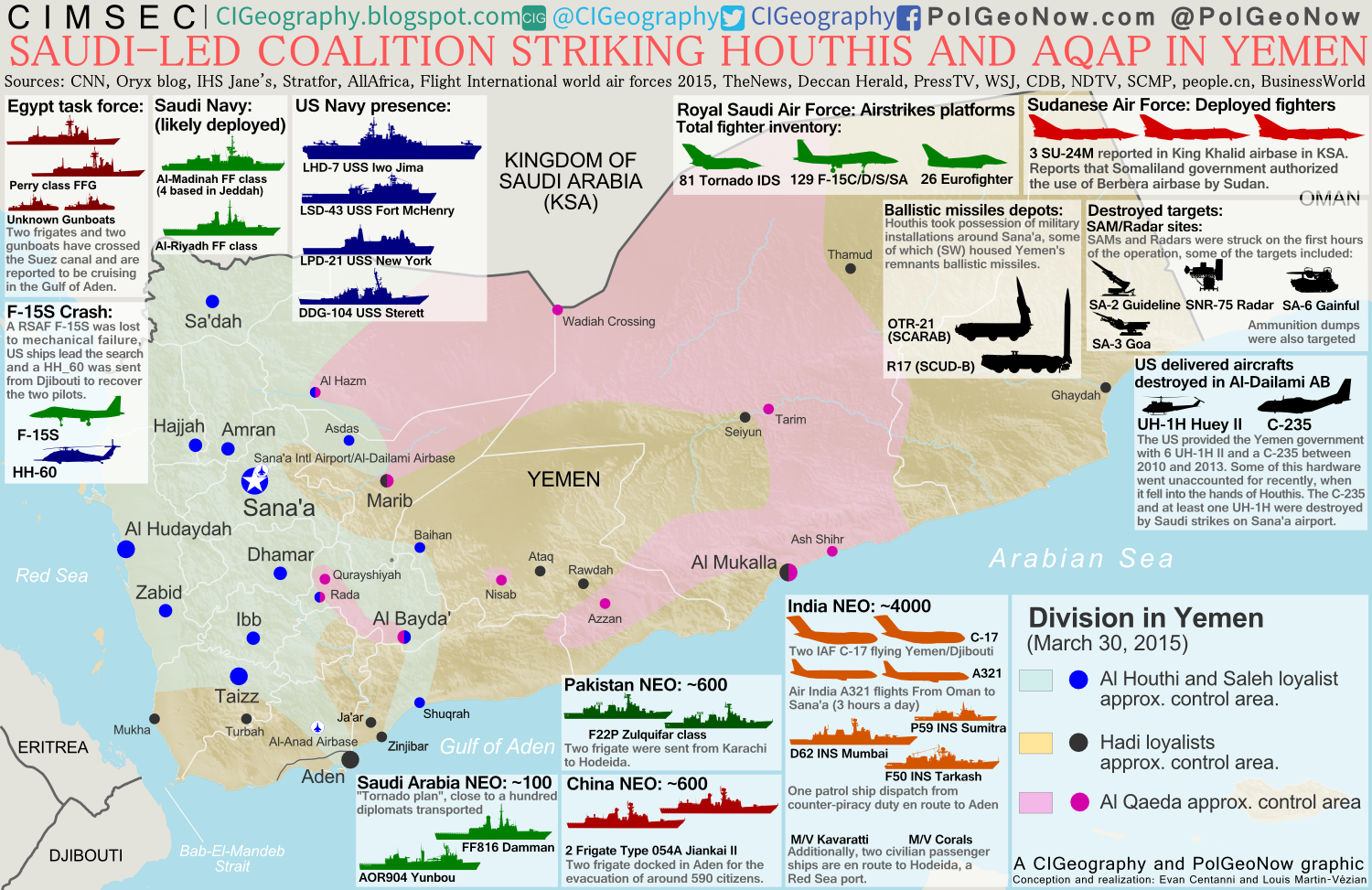
Although the Saudi-led Operation RESOLUTE STORM (alternately translated as DECISIVE STORM) began with air strikes into Yemen on March 26 and continue as of this writing, the heightened level of regional activity also includes maritime operations. These national and multi-national operations highlight the importance of naval platforms and presence. Yemen is strategically located with the heavily-trafficked Red Sea to its west and the Gulf of Aden along its southern coast. Some twenty thousand ships transit the Gulf of Aden annually. Yemen’s ports have been largely closed to commercial traffic.


Evacuation of Citizens

Earlier this year, the US and other nations began pulling out of embassies and recommending their citizens leave Yemen at the earliest opportunity. Once RESOLUTE STORM began, airspace was restricted with limited flights out of the country. Consequently, several countries have been evacuating its citizens via comparatively safer ports such as Aden in the Gulf of Aden and Hodeida situated along the Red Sea. One Pakistan Navy ship got underway from Pakistan on Sunday while a second planned to depart the following day, both for the port of Hodeida where some 600 Pakistani citizenswere converging.

India sent five ships to evacuate approximately four thousand nationals from Hodeida. The passenger ships include the M/V Kavaratti and M/V Corals. The Indian Navy ships include the Delhi-class destroyer Mumbai, the Talwar-class frigate Tarkash, and the Saryu-class patrol vessel Sumitra.

China also interrupted the duties of its 19th anti-piracy flotilla off the Horn of Africa to evacuate citizens from Yemen. The PLA/N frigate Weifang was sent to Yemen and evacuated 449 Chinese citizens and others. Evacuations had taken place at both Aden and Hodeida. Chinese citizens were then taken to Djibouti.


Maritime Security

Several countries have some concern about the Bab el-Mandeb Strait, approximately 18-20 miles wide at its narrowest point“limiting tanker traffic to two 2-mile-wide channels for inbound and outbound shipments.” According to the U.S. Energy Information Administration, approximately 3.8 million barrels of crude oil and petroleum products transited the Bab el-Mandeb every day in 2013. Although the Iranian-backed Houthis leading the insurgency in Yemen have announced that they would not seek to impact transitthrough the strait, the more likely threat would be from Al Qaeda in the Arabian Peninsula (AQAP). In 2013, for example, the Yemeni government reportedly disrupted one AQAP plot to attack ships in the Bab el-Mandeb.

According to Reuters, four ships from the Egyptian Navy transited the Suez Canal to secure the region on the first day of the air strikes.

Search and Rescue

The Flight IIA Arleigh Burke-class destroyer USS Sterrett (DDG 104)rescued two Saudi Arabian airmen from the Gulf of Aden after their two-seater F-15 fighter jet crashed on the first day of the air strikes.

Naval Gunfire Support

According to one source, Egyptian warships began shelling Houthis outside Aden on March 30. The Egyptian flotilla includes the U.S. produced Perry-class frigate Alexandria (F911), whose 76 mm OTO-Melara gun can bombard surface targets out to 16 km away.

Analysts’ Assessment

While the majority of Operation RESOLUTE STORM activities have been air strikes with the possibility of a future ground conflict, the domestic instability in Yemen and on-going military operations underscore the importance of naval platforms, presence, and the varied operations that can be conducted by navies. Naval activity in the region by regional and international actors can be expected to continue for the foreseeable future. Possible future naval missions could include patrols designed to prevent Iran’s resupply of Houthi forces from the sea. Previous attempts by the Iranians to smuggle modern weapons to Houthi forces, such as the Jeehan 1 in January 2013, were foiled by Yemeni government forces. It is doubtful such naval capability still exists in non-Houthi Yemeni elements so multi-national forces will need to take on the maritime interdiction role.

The operations also highlight the PLA/N’s increasing capability. China began sending anti-piracy flotillas off the Horn of Africa in 2008 at the height of Somali pirate activity. To date, the PLA/N has sent nineteen flotillas, each comprised of two warships and one supply ship. These uninterrupted operations have enabled the Chinese to become familiar with long-term operations, logistics, and the importance of presence. Without the PLA/N’s experience in the region, it is unknown how or if it could have extracted its citizens from Yemen in a timely fashion.

A new op-ed in a Chinese newspaper on March 30 points out that“China has evacuated hundreds of its nationals from war-torn Yemen by Monday, in demonstrating responsibility and humanistic care toward its citizens. In the era of globalization, coupled with China’s increasing presence in the world, more Chinese nationals are living and working overseas.” Another online commenter on China’s Sina Weibo stated:“The strength of the motherland is not about the visa-free agreements with other countries, but that it could bring you home from danger.” Put simply: The Navy protects you.

One might ask, given budget priorities, have Americans and Europeans forgotten this?

Claude Berube is a history instructor at the U.S. Naval Academy and author.

Stephanie Chenault is the Chief Operating Officer of Venio Inc. and a Policy & Strategy Consultant for the Department of Defense.

Louis Martin-Vézian is the co-president of the French chapter at CIMSEC.org, and the founder of CIGeography, where he post his maps and infographics on various security and defense topics. He is currently studying Geography and Political Science in Lyon, France.

Chris Rawley is an entrepreneur and reserve naval officer.

* Notícia publicada al CIMSEC. Compartim aquest article doncs resulta aclaridor sobre els moviments al Iemen.

diumenge, 5 d’abril del 2015

PLA has spent 10 years to build a blue-water navy: US expert*

Christopher Sharman, a former US assistant navy attache to Beijing and a student at National Defense University, discussed the five major steps China has taken to establish a global navy since 2004 in his new article written for the Washington-based National Interest magazine.

Between 2004 and 2006, the People's Liberation Army Navy kept itself within the region known as the First Island Chain in the Pacific, extending from Alaska to the Philippines, to avoid direct confrontation with the United States and its security partners. But the PLA Navy enhanced training in disciplines that enabled it to take steps toward conducting operations further from China's coast into the "blue water" of the open ocean, he wrote.

The PLA Navy then took its initial steps into the Western Pacific between 2007 and 2009, when it expanded its area of training operations into the Philippine Sea beyond the First Island Chain. Holding exercises in this region enhanced the PLA Navy's ability to operate in unfamiliar waters. At the same time, it also helped to develop the logistics and command and control systems necessary for operations further from home, Sharman said.

Next, the PLA Navy took steps to normalize its deployments in the Western Pacific between 2010 and 2012. Sharman said it increased the frequency, complexity and its confidence in executing blue-water operations in the region. While the exercises in the Philippine Sea between 2007 and 2009 appeared to be relatively one-dimensional with surface ship against surface ship, the exercises from 2010 through 2012 became multi-dimensional with the participation of aircraft, warships and submarines.

After that, the PLA Navy integrated land-based fixed wing aircraft into Philippine Sea exercises and executed the first Western Pacific exercise that involved all three naval fleets operating simultaneously between 2013 and 2014. Furthermore, PLA surface combat vessels were for the first time deployed to the Indian Ocean for counter-piracy operations around the Gulf of Aden, Sharman noted.

Sharman concluded by saying that the normalization of the PLA Navy's operations in the Western Pacific and the experience of counter-piracy missions has given China the requisite experience, confidence and proficiency to defend China through the operationalization of far seas defense capabilities. This will also allow China to eventually establish a navy with global power projection, he said.

*Notícia publicada a Want China Times. Una perspectiva concisa del procés d'aprenentatge que ha convertit la PLAN en una "Blue Water Navy".

PLA warships take part in the search for Malaysia Airlines flight MH370 in the Indian Ocean on April 3, 2014, another example of how PLA vessels are being deployed in different types of operations further from home. (Photo/CNS)

dissabte, 4 d’abril del 2015

Confirmed: Pakistan Will Buy Eight Chinese Subs*

Details on the type of vessel as well as the new fleet’s price tag remain unknown.


Yesterday, the Pakistani government confirmed the purchase of eight new submarines from China. “The National Security Committee has approved, in principle, the acquisition of eight Chinese submarines,” Additional Secretary of the Ministry of Defense, Rear Admiral Mukhtar Khan, informed the National Assembly’s Standing Committee on Defence in Islamabad.

Details on the type of vessels or their price tag are murky. IHS Jane’s quotes an unnamed Pakistani Foreign Ministry official who said that, “in the recent past, there have been reports of discussions for the Type 041 submarines.”

According to IHS Jane’s Fighting Ships the Type 041 Yuan-class is,“a diesel electric attack submarine (SSK), potentially with Stirling air independent propulsion, that is armed with YJ-2 (YJ-82) anti-ship missiles and a combination of Yu-4 (SAET-50) passive homing and Yu-3 (SET-65E) active/passive homing torpedoes.” The export version of the vessel allegedly displaces about 2,300 tons, according to public sources.

However, as I noted here, the Wuhan-based China State Shipbuilding Industrial Corp (CSIC) supposedly had already signed a contract in April 2011 to deliver six Type 032 Qing-class conventional attack submarines by 2016/2017. Apparently, this deal must be off the table now.

Still other media sources report that Islamabad will build submarines under license based on the Qing-class vessels displacing 3,000 tons: “Pakistan will also build two types of submarines with Chinese assistance: the Project S-26 and Project S-30. The vessels are to be built at the Submarine Rebuild Complex (SRC) facility being developed at Ormara, west of Karachi.”

The procurement of a new fleet of submarines constitutes Islamabad’s most expensive arms deal by far. Estimated total costs range between $4-5 billion. IHS Jane’s quotes a former Pakistani defense official who said that it is “difficult to imagine a price of less than USD 500 million per submarine, if not more.”

He also said that he suspects China to extend a long-term loan, possibly at a low interest rate. Another Pakistani military expert told theFinancial Times that there are still many unknowns: “At this stage, we don’t know the exact financial terms and unless we know the financial terms we can’t be certain about the significance of this order,” he said. “Still, it’s an important contract for Pakistan.”

Ali Sarwar Naqvi, a former senior Pakistani diplomat, said about Beijing’s rationale behind the weapons deal: “China has its own strategic reasons to help Pakistan in this area. As India prepares to head in to the Pacific Ocean, the Chinese are looking to head in to the Indian Ocean.”

* Notícia publicada a The Diplomat. L'ampliació de l'arma submarina pakistanesa sembla consolidar-se. Si l'Índia no millora al mateix ritme les seves capacitats ASW, pot tenir problemes seriosos. Poca gent se'n recorda avui, però l'Índia ja va perdre un vaixell a mans d'un submarí pakistanès.