Classification of surface warships as cruisers, destroyers, frigates,
or corvettes, has become like pornography. There are no generally
accepted definitions, but “I know it when I see it”–except that everyone
sees it a little differently.
Since this is “Corvette Week” what are we really talking about?
(Note: unless otherwise specified, lengths are over all and displacements are full load)
My Combat Fleets of the World, 16th Edition, which I have used here extensively for reference, defines Corvettes as,
“Surface
Combatants of less than 1,500 tons but more than 1,000 full load
displacement–essentially, fourth rate surface combatants.” but goes on to note that
“…the
designation as used here essentially refers to smaller frigates and
does not correspond to the European concept of corvettes as any warship
larger than a patrol craft but smaller than a frigate.” I feel to confine the definition within a 500 ton range is too restrictive. in fact it would have excluded the
Castle class corvettes of WWII as too large, and other corvettes as too small.
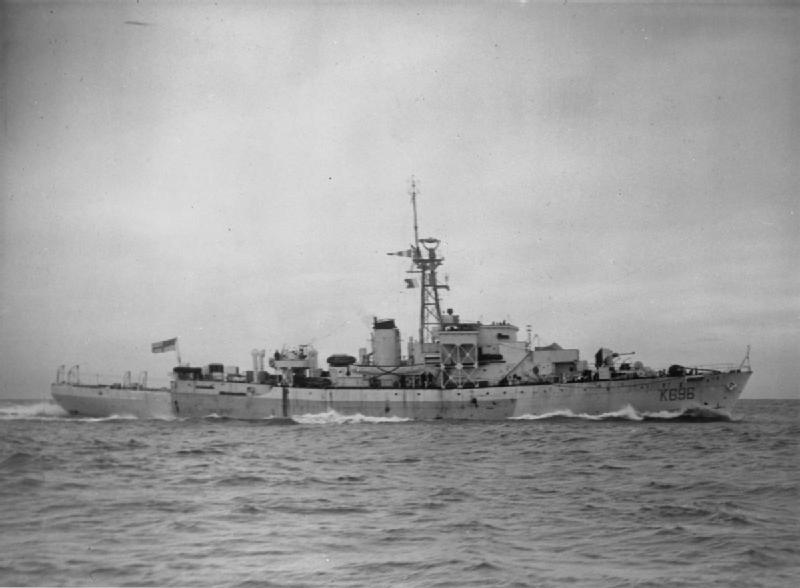
Royal Navy Photograph of Castle class corvette HMS Denbigh Castle (K696)
Pre-WWII
During the age of sail, corvettes were originally warships typically
smaller than a frigate, but larger than a sloop, usually with guns on a
single deck. Some ships continued to be called corvettes as steam was
introduced, but in the Royal Navy, in 1877, corvettes along with sloops
and frigates were subsumed under the new designation “cruisers.”
Corvettes, as a type, essentially disappeared from the English naval
lexicon until 1939. The term was kept alive in some navies (including
the French, German, and Italian) as a rank that translated
corvette-captain, a rank generally equal to Lieutenant Commander.
World War II:
Corvettes as a type reemerged just prior to WWII. As it became clear
that U-boats would be a major threat, Britain saw the need for an escort
vessel that could be built quickly and in large numbers, in yards that
had not been considered capable of building warships. Just before WWII,
they ordered the first of 267
“Flower Class” corvettes that
were built in the UK and Canada. They modified the design for a whale
catcher named Southern Pride, enlarging it to 205 feet overall and a
displacement of 1245 to 1390 tons. They were terrible warships, weakly
armed, cramped, uncomfortable, and slow. Single screw, reciprocating
steam propulsion gave them a maximum speed of only 16.5 knots, a knot
slower than a typical (Type VII) surfaced U-boat. They were originally
intended only for coastal operations, but because of their long range,
they were thrown into the Battle of the Atlantic, where they were by far
the most numerous transatlantic convoy escorts for the critical early
years, taking slow merchant convoys across the mid-Atlantic air gap,
while the Home Fleet’s more capable, but shorter legged, fleet
destroyers were generally held back to escort the battle fleet or met
convoys only as they approached the British Isles.
Flower Class Corvette HMS Polyanthus, Source =www.oldships.org.uk, Author =Leidseplein Date =1943-09-
Reportedly Winston Churchill had a hand it designating this new class
“corvettes,” probably in an attempt to make them appear more glamorous
than the term “patrol vessels” which had been applied to similar vessels
previously. Two years after the re-introduction of the term “corvette,”
the term “frigate” was also resurrected to describe another war
emergency escort program, this one more complex and more capable but
still using reciprocating steam propulsion. Larger commercial yards
converted to making
frigates (301 to 307 ft, 1920 to 2420 ton), but smaller yards continued to make corvettes of the improved
Castle class (252 ft, 1590 to 1630 tons), while naval yards continued to produce small numbers of sloops like the
Black Swan class that were the true premier ASW escorts of the Royal Navy.
Australia also built corvettes, 60 ships of the similar but even smaller, slower
Bathurst Class
(186 ft). Initially they were classified as minesweepers, but found
more employment as escorts, so were more frequently referred to as
corvettes.
Bathurst-class corvette, HMAS Fremantle, State Library of Victoria
Japan, Germany, and Italy all made similar escort ships, but only the numerous Italian
Gabbiano class (193 foot, 728 tons, with combined diesel or electric propulsion no less), were actually referred to as corvettes.
All of the WWII corvettes were primarily ASW escorts, but their were a
number of classes of vessels, many built prior to the war, that share
DNA with today’s missile armed corvettes. These were small, fast,
torpedo armed vessels that resembled destroyers, but most had a standard
displacement of 1000 tons or less. Usually they were referred to as
“torpedo boats.” Japan built twelve, The Germans built 48 (the last 15
were large enough to have been considered destroyers in other navies).
The French Navy completed twelve. The Italians completed 69 (some of
which were closer to frigates or destroyer escorts). The Italian
Spica class (269 ft, 885 to 1,030 ton, 34 knots) may serve as an example.
Italian Spica Class torpedo boat
Generally, the war emergency programs had one thing in common. They
were not the ships these navies would have chosen to build in peacetime.
In wartime priorities change; planning horizons contract. Producibility
may trump quality. They were all compromised in some fashion–in their
speed, survivability, weapons, or economy of operation. Corvettes filled
a need for large numbers of escorts, but after the war, most were
quickly discarded.
The MCM Connection:
The Flower Class Corvettes were originally also equipped to sweep mines. As noted the Australian
Bathurst Class
began life as minesweepers. While the US built no “corvettes” during
the war, the minesweepers of the Raven (220 foot/1040 tons), Auk (221
foot/1,250 tons), and Admirable ((180 foot) classes frequently
functioned in this role. In fact, with minor modification Admirable
class ships were redesignated PCEs (Patrol Craft, Escort). All these
minesweepers were built with sonar. By the end of the war, most were
equipped with hedgehogs, depth charge projectors (K-guns) and dual depth
charge racks, having enjoyed priority for ASW equipment second only to
destroyer escorts.

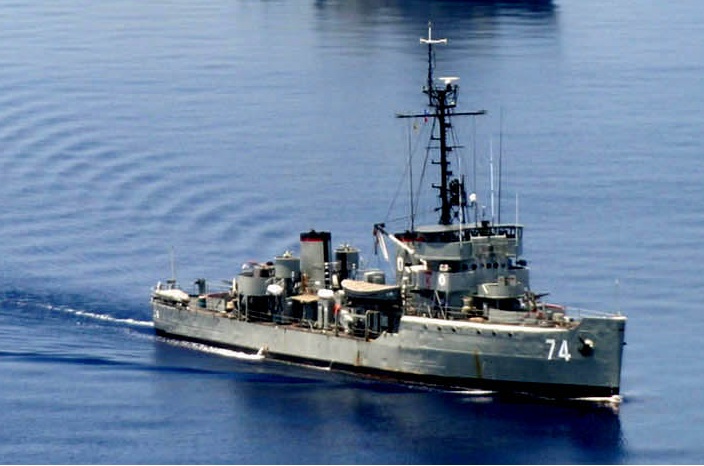
Former Auk class minesweeper still serving in the Philippine Navy as Corvette BRP Rizal (PS-74), US Government photo, 050822-N-6264C-145 Sulu Sea (Aug. 22, 2005)
Post WW II:
Since the end of WWII corvettes have generally fallen into two
categories, with some designs attempting to incorporate elements both
types. They tend to be either:
—Small, fast, missile armed vessels optimized for ASuW, like
Sweden’s Visby Class
(40 knots, 239 ft, 650 tons) usually expected to operate in groups,
either with others of their kind or acting as flagships for even smaller
missile boats, or
—Smaller versions of frigates with moderate speed optimized for patrol
and presence in peacetime and escort during wartime like the Damen
designed
SIGMAs or
India’s Kamorta Class (25 knots, 358 foot oa, 3100 tons).
 Visby class Corvette, HMS Härnösand, Source: Xiziz at en.wikipedia
 SIGMA class corvette
Largest Operators of Corvettes:
SIGMA class corvette
Largest Operators of Corvettes:
The largest operator of corvettes is Russia with approximately 53 (
3 Buyan, 1 Buyan M,
7 Parchim II, 23 Grisha V, 4 Grisha III, 2 Dergach Project 1239, 13
Nanuchka) (80 if you count the 27 Tarantuls that fall slightly below the
500 ton threshold I have assumed).
India, China, South Korea, Indonesia, and Italy also maintain large numbers of corvettes.

Chinese
Type 056 corvette 583 Ganzhou, by
樱井千一
Corvettes in the USN:
While the US Navy has never built corvettes for its own use, the type is not without precedence in the US.
In the early days of WWII, when the US navy was desperately short of
escorts, 18 Flower class corvettes were transferred to the USN. Eight of
those were manned by USCG crews.
 Coast Guard manned Flower Class Corvette USS Intensity (PG-93), mid-1943. Former HMCS Fennel (K194) [http://www.history.navy.mil/photos/images/h97000/h97406.jpg]
In the 50s the Navy was interested in experimenting with types that
might be built hurriedly in an emergency. The result was the four ships
of the
Claude Jones class
(DE-1033-1036) built by Avondale between 1956 and 1959. At 312 feet
long and 2000 tons, they were essentially the same size as the preceding
Dealey Class, but they were simplified, diesel powered, slower, and
more lightly armed. These ships were really a update of the corvette
concept of a cheap simple escorts that lent itself to rapid
construction. (Similarly about the same time the British were building
14
HMS Blackwood Class (Type 14) that were “2nd Rate Frigates” of 1536 tons, powered by a single shaft steam turbine plant with no gun larger then 40mm.)
 USS Claude Jones (DE-1033), US Navy photo, www.navsource.org
In the late 1960s the US built four corvettes, given US hull numbers
PF-103 to PF-106, that were immediately turned over to the Iranian Navy.
They became the
Bayandor Class (275 feet long, 1,135 tons).
In the early ’70s, two additional PF-103 class ships (PF-107 and
108), built to a modified design, were delivered to Thailand’s Navy.
These were the
Tapi Class.
Between 1977 and 1983 Tacoma Boat built a class of four CODOG powered “PCG” for Saudi Arabia, the
Badr class, 245 feet, 1,038 tons, 30 knots.
Between 1983 and 1987 Tacoma Boat built two diesel powered “PFMMs” for the Thai Navy
Ratanakosin class 252 foot, 960 tons, 26 knots.
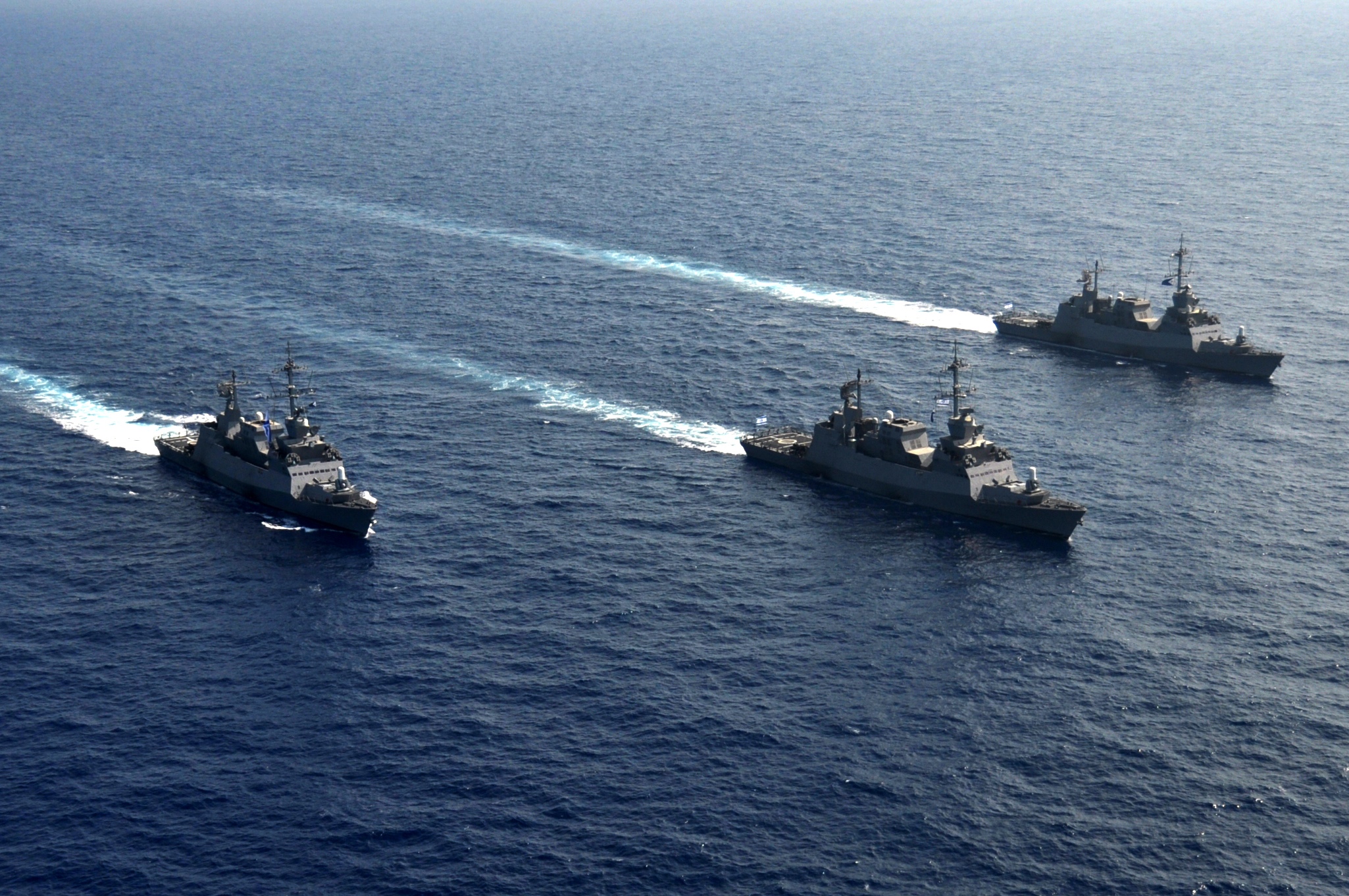
Between 1989 and 1995 Northrop Grumman Litton built three CODOG Corvettes for the Israeli Navy, the
Sa’ar 5 class, (281 foot, 1,275 tons, 33 knots).
 American built Israeli SA’AR5 corvettes, http://www.flickr.com/photos/idfonline/6871983192/in/photostream
Between 2008 and 2013, VT Halter Marine has been building a class of four missile corvettes for the Egyptian Navy, the
Ambassador MkIII class (205 feet, 700 tons, 41 knots). The first has already been delivered.
 An undated photo of the ENS S. Ezzat, an Egyptian Fast Missile Craft. VT Halter Marine Photo
While the Littoral Combat Ships are not normally considered
corvettes, on June 10, 2013, Rear Admiral John F. Kirby, the Chief
of Information for the Navy called them Corvettes. Without a mission
module or aviation detachment, they are really more like OPVs. But when
the Mine Warfare module is mounted they become MCM vessels. When an ASW
or ASuW module is mounted, they start to look like corvettes.
The Claude Jones class ships were transferred to the Indonesian Navy
and continued in service there until 2006. Of the six PF-103 class
ships, two Iranian ships were lost in combat with Iraq, but the
remaining four are still in service with the Iranian and Thai Navies and
have been updated. The Badr class and the Ratanakosin class are still
in service with their respective navies, and the Sa’ar Vs are still the
most advanced surface ships in the Israeli Navy. All but the two Thai
Navy Ratanakosin class (PF-107 and 108) have been equipped to launch
anti-ship cruise missiles.
The Coast Guard Connection:
During WWII Coast Guard Cutters were frequently used as ASW escorts,
some quite successfully,
filling corvette and frigate roles. After the war, new construction
frequently included provision for ASW systems either as built or as
planned upgrades in the case of a major conflict.
The 16 Reliance class Medium Endurance Cutters (210 feet, 1,050 tons,
18 knots) delivered 1964 to 1969, were built with provision for adding
sonar, hedge hogs, and torpedo tubes. They were originally to have been
designated PCs. a designation shared with the sub chasers of WWII.
The 12 Hamilton Class High Endurance cutters (378 feet, 3,050 tons,
29 knots) completed 1967 to 1972, were built with ASW systems installed
and their systems were upgraded and provision for harpoon installed 1989
to 1992. As built, they were not the equal of contemporary Destroyer
Escorts with their AN/SQS-26 sonars, but were comparable to those built
only a few years before. An argument can be made that these ships, as
built and later modified, could be considered, if not frigates, at least
corvettes.
 USCGC Mellon after upgrades including Harpoon, CIWS, and support for LAMPS
The thirteen Bear class cutters (270 feet, 1,780 tons, 19.5 knots)
completed 1983 to 1990, were built without ASW systems, but had
provision for adding a towed array and supporting a LAMPS I helicopter.
If these systems had been provided, then the ships might have also been
considered corvettes.
The Coast Guard’s National Security Cutters, of the Bertholf class
(eight ships planned, 418 ft/4,500 tons) have no installed ASW systems
or ASCMs, but they do have excellent aviation support facilities and the
ship has been marketed as the basis for a frigate program. Aside from
Exocets carried by the French ships, they are in most respects more
capable warships than the
Floreal “light surveillance frigates” (307 ft/2950 tons) and similar to the French Lafayette Class frigates (410 ft/3,600 tons) which also currently have no sonar.

USCGC Waesche, U.S. Coast Guard photo ID: 100228-G-2129M-004
The Coast Guard is in the process of procuring a new class to replace
its Medium Endurance Cutters. The resulting ship is likely to be
similar to the Floreal class (90 to 100 meters in length and 2500 to
3500 tons) but faster and will share sensors and some weapons with the
Bertholf class and the Littoral Combat Ships. Addition of ASW or ASCM
systems would result in ships many would classify as light frigates or
corvettes.
Bottom Line–What is a Corvette?:
Corvettes slot under frigates but above patrol boats or missile boats
as a classification of surface combatants. To me, this means that they
are the smallest or perhaps least capable ocean-going warships. This is a
bit of a stretch for Corvettes like the Visby, but in fact the Swedes
have deployed even smaller warships to the Indian Ocean for counter
piracy operations. That sets the low end of the the displacement range
at about 500 tons, but when we look for an upper limit, it seems a
moving target, with no similar performance based limit.
The US and Britain already build destroyers the size of WWII
cruisers. Germany and in the near future Britain will build frigates
over 6,000 tons full load. Japan’s Coast Guard has OPVs displacing 9,350
tons full load. If we tripled the displacement of WWII corvettes as we
have done with WWII Frigates and Destroyers, Corvettes could displace
almost 5,000 tons, so I don’t think displacement is a reliable
determinant.
Strict naval vessel construction standards don’t necessarily
distinguish a corvette from an OPV either. They were not applied to the
original “Flower” class, and they don’t apply to the Damen designed
Sigma class, built or building for Indonesia, Morocco, and Vietnam, or to the French
Lafayette class (also operated by Taiwan, Singapore, and Saudi Arabia) and
Floreal class (also operated by the Moroccan Navy) which are rated as frigates but which it might be argued are actually corvettes.
The only metric that doesn’t seem to have changed much over the last
70 years is crew size. Corvettes generally have crews of 120 or less,
frigates from 120 to perhaps a bit over 200, while destroyer crews begin
slightly under 200 and go up to about 350, and cruiser crews are larger
still. The DDG1000s will apparently have a frigate sized crew, but
their final crew may be larger than currently planned. OPV crews tend to
be corvette sized or smaller.
Just as the difference between Spruance Class Destroyers and
Ticonderoga Class cruisers was mission and associated equipment, not
displacement, the differentiation between the various types of warships
and between Offshore Patrol Vessels (OPVs) and corvettes may simply
comes down to their missions and equipment. OPVs include a wide range of
ships, but the common thread, generally accepted, is that they have no
ASW weapons, no heavy anti-ship cruise missiles, and only a self-defense
AAW capability. Adding an ASW capability and/or cruise missiles would
convert an OPV into a corvette. Perhaps they would not make very good
warships, but then the original Corvettes weren’t very good warships
either, but they served a vital role. Conversely an old frigate or
corvette, stripped of all its weapons except a medium caliber gun and
heavy machine guns would become an OPV, even if it nominally retained
its frigate or corvette designation as in the case of Portugal’s
Joao Coutinho and
Baptista de Andrade class or some of Italy’s
Minerva class.
If we had no history, and we could start ship designations on “a
clean sheet of paper” we might define ships types based on their
missions and equipment, saying destroyers are vessels designed with
robust capacity to perform well in all three major surface combatant
warfare areas, AAW, ASuW, and ASW. Frigates are designed to perform well
in only two missions areas (with possibly modest self defense
capability in the third). Corvettes would be single mission specialists
with only modest capability in the other two missions (if at all). OPVs
would be vessels equipped for missions that did not require robust
capabilities in any of these three mission areas. All four types might
be called generically “cruisers” which would bring that designation back
to its original meaning, a vessel smaller than a ship of the line that
can operate independently.
The Future of Corvettes:
WWII corvettes were small ships packed with crew and weapons.They
were small because there was an urgent need for many ships that could
not be met by the shipyards that normally built warships. They were a
way of making the small commercial yards serve the war effort. If we are
ever engaged in a prolonged conflict against a near peer adversary we
may again resort to a similar expedience. If so, the resulting corvette
is more likely to be based on a petroleum industry offshore support
vessel rather than a whaling or fishing vessel.
But when ships are built in peace time, for a 20 to 40 year life,
other factors beside construction cost start to dominate. In the West,
crew costs weigh heavily, while increasing hull size appears less
important, provided we do not load up the larger hull with additional
systems which will in turn drive up crew costs. Larger hulls are more
seaworthy, allow greater endurance, and may be made quieter. They may
even be more economical to operate and maintain because of easier
access.
Some European Countries that formally operated a number of Corvettes
seem to have abandoned the type in favor of ships with more range and
better seakeeping including The Netherlands, Denmark, and Norway.
Denmark has instead produced frigates and a novel class of ships, the
Absalon Class “support ships,”
(450 ft/6,600 tons) that include a relatively large hull of modest
speed, with a relatively small crew of about 100, and a large
reconfigurable spaces–an open one topside midships where missile systems
can be placed and a “garage” area under the flight deck that can
accommodate vehicles and containerized loads. These ships are perhaps
too large to be considered corvettes, but they are not nearly so well
armed as the frigates of the similarly sized
Iver Huitfeldt-class.
They do have characteristics I would expect to see on future corvettes,
a relatively commodious hull (because “steel is cheap and air is
free”), a relatively small crew (because that is the most expensive
component over the life-cycle of the ship), and reconfigurable spaces
and weapon systems, that allow the ships to be adapted to different
missions (because that is allow us to hedge our bets regarding what
capabilities will be needed, while allowing that minimal crew over most
of the life of the ship).
Because Corvettes are always compromised, they are likely to be
controversial. Many will not agree with the compromises accepted. That
is certainly true of the new American Corvette, the Littoral Combat
ship.
In some respects the LCSs may be the prototype of the future
corvette, in that it is not particularly small, but they were made cheap
to operate with a minimal crew, and they are single mission ships, but
with the advantage that the mission can be changed over time, although
not as quickly as once advertised. Other aspects of the ship were
perhaps not as well thought out, but they will serve a purpose, and
perhaps the next generation LCS or convertible corvette will better
meet our needs.
* Article
publicat al CIMSEC. Interessant i molt necessària reflexió al voltant de la definició de les corbetes. Lectura obligada per totes aquelles persones interessades en la futura configuració de les forces navals catalanes.


.jpg)