divendres, 18 d’octubre del 2013

Daring Moves on the Niagara*

He had been born in Maryland in July 1782. When he was nine years old his father was killed by an Indian party while working to purchase supplies for the U.S. Army in Ohio, under Major General Anthony Wayne. Elliott’s mother kept him in school in Pennsylvania, where he prepared to study law until he was 18, when he received an appointment as a midshipman and orders to report to the Essex . Like Oliver Hazard Perry, Elliott’s eventual superior on Lake Erie with whom he would have a lifelong rivalry, he saw his first combat during the First Barbary War. Unlike Perry, Elliott was not promoted at the end of the conflict. In 1810 he received the appointment as an acting lieutenant that he had been seeking for years, and he served on board the frigate Enterprise , the corvette John Adams , and the brig Argus before the outbreak of war with the British. 2
Across the Niagara River from Black Rock was a small Canadian garrison at Fort Erie. The fortifications had been under construction since the end of the French and Indian War, though progress had been slow. The British attempted to accelerate construction of the defensive works as soon as hostilities were announced. The British regulars and Canadian militia were spread thin. They struggled to cover the frontier with gun emplacements, attempting to locate one every mile to ward off the invasion they were sure would come. On rising ground that lay across from the Americans at Black Rock they had constructed three small batteries, but they left the rest of the works unfinished due to “want of means.” 3
Elliott’s orders, once his base was selected, were to begin construction of two 300-ton schooners and a half-dozen gunboats. The Navy had purchased several small coasters, and he was in the process of fitting them out as warships as well, but with few supplies and fewer skilled shipwrights the process was laboriously slow. On 6 October Elliott received a report that two British brigs were headed up the lake to anchor under the guns at Fort Erie. By the morning of the 8th, the Detroit , rated at 14 guns, and Caledonia , rated at 3 guns, lay at anchor across from Black Rock. The Detroit had previously been the American vessel Adams , which was captured and reflagged by the British during their successful attack on the American outpost at Detroit in August. The two vessels carried arms and prisoners from the battle that were to be offloaded at Fort Erie. 4

A Bold Plan

As Elliott gazed at the enemy across the Niagara River, he received the first good news that had come his way in weeks. The sailors and officers that Commodore Chauncey had promised him were spotted on the wilderness roads not far from his base. He sent an express rider with orders for the men to hurry their march, since he had “determined to make an attack,” the goal of which would be to capture the pair of British vessels newly arrived off Fort Erie. By noon the men arrived at Black Rock. Elliott realized they were unarmed, only carrying about 20 pistols and no cutlasses or battle-axes, and told them to rest for their intended mission while he put his plan together. 5
Elliott approached Brigadier General Alexander Smyth, the commander of the U.S. Army regulars at Black Rock, and Major General Amos Hall, who commanded the local frontier militia. The two senior officers agreed to loan him the arms that his sailors would need from the Army’s supplies. General Smyth recognized the daring of the plan and detached a group of 50 regulars armed with muskets and placed them under Elliott’s command for the cutting-out. As the men rested the lieutenant had two boats, with a capacity for 50 men each, prepared and hidden in nearby Buffalo Creek.
While the expedition was being prepared, the British sent Captain Harris H. Hickman across the river by boat. Hickman, a U.S. Army officer, was among the prisoners from Detroit who had been transported on board the ships. Paroled by the British, he brought with him an accurate report of the manning of the two ships as well as their arms and cargo. A British account later admitted that Hickman revealed to his countrymen the ships’ “defenceless state.” 6
In the early-morning darkness Elliott loaded his joint force of sailors and Army regulars aboard the two boats. At 0100 they shoved off and headed south against Buffalo Creek’s current before crossing the Niagara’s mouth. It took two hours of hard pulling at the oars but the boats pulled alongside the two ships at 0300 and caught the British completely by surprise. The Americans poured over the gunnels of the ships and quickly subdued their prisoners. Elliott reported that within ten minutes of boarding the sailors had secured the prisoners, slipped the anchors, sheeted the topsails, and had the Detroit under way as the Caledonia followed. 7
The plan had worked smoothly until this point. As the Americans attempted to sail their captured vessels into the lake, the operation started to come apart when they encountered a rapidly moving current and little wind. Elliott gave up his plan to sail the ships clear and was instead forced to head downstream into the river, directly under the guns of Fort Erie. The alarm was raised (the British report was that 300–400 men had overwhelmed the ships’ defenders) and the batteries opened fire. 8

Escape From Fort Erie

The heavy guns mounted in the incomplete works at Fort Erie poured round as well as canister and grapeshot into the two ships as they passed the fort. Elliott struggled to keep control of the Detroit , as the Caledonia was beached under a battery of American guns on the east side of the river. While the British shifted their “flying artillery” to keep the Detroit under fire, Elliott dropped anchor, fearing (from a faulty report) that another British vessel lay farther downriver. He threatened the British gunners, warning that he would bring his prisoners on deck to bear the brunt of the grapeshot. When his threat didn’t silence the guns, he reconsidered and decided “not to commit and act that would subject me to the imputation of barbarity.” 9
With the batteries at Black Rock covering the Caledonia , Elliott ordered all the guns on board the Detroit hauled over to bear on the western shore. The American sailors commenced fire into the British artillery positions. Elliott sent a boat with a heavy line from the ship toward the eastern bank of the river, hoping they would be able to pull the brig to the American side. The current moved too quickly, however, forcing the boat to pay out all the line before it reached the shore. An attempt from the bank, with a line already secured ashore, met with the same fate.
Meanwhile, the gun crews on board the Detroit , firing all the ship’s cannon in a single broadside, rapidly expended all their powder and shot and were left defenseless. Hoping to get out of range of the heavy guns so he could make a final stand against the mobile artillery pieces, Elliott cut the cable of the anchor and the brig drifted downstream. The Detroit drifted stern first, moving with the current for about ten minutes until she ran aground on Squaw Island. 10
Elliott immediately offloaded his prisoners in the boat his force had used to attack the ship, sending them ashore under the guard of most of his crew. With only a few men left, the Americans lowered a skiff that they found. When Elliott abandoned the vessel, “she had received twelve shot of large size in her bends[,] her sails in ribbons, and her rigging all cut to pieces.” 11
Take-Back Attempts
The Detroit was still heavy with weapons, both the ship’s guns and approximately 200 muskets that were being moved from Detroit to Fort Erie, as well as powder and ball for the muskets. 12 The British sent a boat with 40 men across the river to board and attempt to salvage what they could from the brig. Heavy cannon and musketry fire from the American side of the river drove them off.
A second attempt was made, with only a handful of men under the command of Major Cornet Pell of the Niagara Light Dragoons. The boat safely made it abeam the Detroit , with the beached hull providing cover for the British party. However, as they reached the stranded ship, the current continued to push them downstream where they rounded her stern. Now exposed to American musket fire from the shoreline just a hundred yards away, the British began taking casualties. As Major Pell attempted to hoist himself through the cabin windows at the Detroit ’s stern, a musket ball caught him in the forehead, killing him instantly. His body fell back in the boat, and the party struggled back to the British riverbank, every man on board wounded by the withering fire. 13
Throughout the day the cannon and musket fire continued from both sides. Elliott eventually realized that it had “so much injured her [the Detroit ] that it was impossible to float her.” 14 In order to keep the British from being able to salvage anything, he elected to end the standoff. As evening approached he reported to Commodore Chauncey, “I determined at once to set her on fire.” 15
Despite the fact that the Detroit burned, Elliott was still able to pull some advantage from taking the ship. During the night his men salvaged some of her guns to provide the nucleus of the armament needed for the vessels being built and fitted out at Black Rock. On board the Caledonia were $200,000 worth of furs that the vessel’s owners, the Northwest Company, had hoped to ship to England. 16 After the prize money was split and she had been refitted, the Caledonia was officially purchased by the U.S. Navy. Placed under the command of Lieutenant Daniel Turner, the ship proved invaluable at the Battle of Lake Erie when her two long 24-pound guns were the only ones that had the range to hit the heavy British ships as they pounded Perry’s flagship, the Lawrence . The Caledonia also served in the 1814 expeditions on Lakes Huron and Superior before being sold in Erie at the close of the war. 17
The cutting-out of the Detroit and Caledonia caught virtually everyone by surprise. Commodore Chauncey remarked to Secretary Hamilton that “Lieutenant Elliott deserves much praise,” and that he “had no particular orders from me” and was acting out of his own initiative. Chauncey predicted that, because Elliott’s attack deprived the British of two vessels while providing one, as well as arms, to the Americans, control of Lake Erie would be gained before he would be able to establish command of Lake Ontario. 18 He was right; building on the fleet that Elliott founded at Black Rock, Oliver Hazard Perry would take command of Lake Erie first. His suggestion that the lake would be taken in mere months, however, turned out to be optimistic, and it was a year before Perry’s victory near Put-in-Bay.

A Double-Edged Sword

By the summer 1814, American forces had controlled Lake Erie for almost a year since Perry’s victory. He and Elliott had both moved on, with new orders to the Atlantic coast, and Captain Arthur Sinclair had taken the Lake Erie command. That summer he departed on an expedition to Lake Huron, leaving Lieutenant Edmund Kennedy at Presque Isle with responsibility for the naval forces on Lake Erie and orders to cooperate with the Army. In support of operations on the Niagara Peninsula, Kennedy placed three schooners, the Somers , Ohio , and Porcupine , off Fort Erie. It was nearly the same anchorage where the Detroit and Caledonia had lain two years prior.
In July Brigadier General Jacob Brown and his U.S. troops crossed the Niagara River, captured Fort Erie, and defeated the British at the Battle of Chippewa. But the offensive stalled, and British forces under Lieutenant General Sir Gordon Drummond arrived on the Niagara Peninsula. The two armies clashed at the hard-fought Battle of Lundy’s Lane, a tactical draw but a British strategic victory in that the American advance on the Niagara front was curtailed. General Brown was injured and the Americans pulled back to Fort Erie, where the British began establishing siege lines. 19
The British had no naval forces on Lake Erie to contest the waters or to challenge the three schooners overlooking their positions around Fort Erie. Undeterred by the lack of traditional naval force, officers under Commodore James Yeo on Lake Ontario devised a plan to strike at the small American squadron. A force of five bateaux, one gig, and 200 sailors and marines was gathered together near the Niagara River’s outlet on Lake Ontario for an attack. The operation was placed under the command of Commander Alexander Dobbs, the commanding officer of the square-rigged sloop HMS Lord Melville in Yeo’s Ontario squadron, with the assistance of Lieutenant Charles Radcliffe, who commanded the brig-sloop Netley .
Dobbs was 30 years old and a lieutenant when he came to Canada to join Commodore Yeo in 1813, the two having served together on board the ship-sloop Confiance . Born in Dublin in 1784, Dobbs joined the Royal Navy as a midshipman at the age of 13 and received his lieutenant’s commission at the age of 20. In February 1814, after a year on the lake, he was promoted to commander and had command of the Lord Melville , which was renamed the Star. The senior of the commanding officers in a division of sloops and schooners tasked with supplying the British Army on the Niagara Peninsula, he was placed in charge of the four ships that ferried supplies and men between Forts Niagara and George. 20

Midnight Raiders

With the famous Niagara Falls and other obstacles between Dobbs’ raiding force and Lake Erie, the party devised an overland route to close with Fort Erie. The first half of the journey the boats traveled up the Niagara River. Once they reached the farthest point of navigation southbound, they put ashore and the men began clearing a wilderness road south across the peninsula. The boats were hoisted onto wagons and dragged ten miles to the water near Point Ebony. 21
After dark the British raiders put their boats in the water and embarked the force, moving upriver toward the anchorage overlooking Fort Erie. It was an extremely dark night, and they likely used muffled oars to conceal the sound as they moved through the water, making their approach difficult to detect. Near midnight the American schooners came within sight, and the boats closed silently on them. It wasn’t until the British came alongside the American ships’ anchor cables that a lookout on board the Somers called out a challenge.
The British replied that they were “provision boats.” The American land forces had been using the cover provided by the schooners to move provisions and cargo along the river to supply the besieged troops at Fort Erie, so the response sounded reasonable and fooled the Somers ’ officer of the deck. It gave the raiders enough time for their boats to get in position alongside the Somers and Ohio . 22
The Somers was attacked first, as the British cut her anchor cable and poured several volleys of musket fire across the deck. Two men on watch were quickly wounded. Before he could respond to support his sister ship, Lieutenant Augustus Conckling, the officer commanding the Ohio , found bateaux alongside his own schooner and the British swarming aboard. Musket and pistol fire were exchanged as cutlasses were drawn, and a bloody struggle ensued on the deck of the small ship. The 35-man crew of the Ohio was overwhelmed by the much larger British force.
The Americans on deck rallied with their skipper. Holding off the attackers, they shot and killed Lieutenant Radcliffe as he attempted to scale the stern of the ship to come at them from behind. Master’s Mate Alexander McCully was shot through the thigh and was bayoneted in the foot as he defended the ship alongside his skipper. As the British pressed their assault, Lieutenant Conckling’s sword was knocked from his hand when he took a musket ball through the shoulder. Conckling reported that “as their force was an overwhelming one, I thought further resistance vain & gave up the vessel with the satisfaction of having performed my duty and defended my vessel to the last.” 23

The Luck of the Porcupine

Commander Dobbs reported that, of the schooners, “two of them were carried sword in hand in a few minutes.” 24 However, with the cables cut the ships began to drift apart. The Somers and Ohio were pushed to leeward of the Porcupine before the British raiders could reorganize and launch an assault on the third ship. The two captured schooners drifted toward the Niagara River rapids, and the British sailors and marines focused on getting control of the vessels, rather than worrying about the Porcupine . They eventually anchored under the British siege batteries that faced Fort Erie.
The Porcupine lost one of her anchors during the night and dragged down toward the rapids. As the ship passed the British positions she was challenged by a sentry, just as the wind sprang up. The Americans gave no response, instead setting sail and heading for the open lake. The batteries ashore opened up and the Porcupine returned fire as she ran toward the open water. The gun crews kept up a heavy fire, pouring round, grape, and canister shot into the enemy’s positions, hitting and dismounting five of the British cannon. Clearing the Niagara River, the schooner sailed for Presque Isle. After repairs there, she soon sailed again for Fort Erie. 25
The British suffered two killed and four wounded in the operation. The Somers , having been attacked first and taken completely by surprise, had two members of the crew injured before they were overwhelmed and surrendered. The crew of the Ohio suffered the most, having fought a short but pitched battle with the raiders on their deck. One seaman was killed, shot through the body, and seven others were wounded, including Lieutenant Conckling. 26
General Drummond ordered a message read to all the troops in the corps that had held the siege of Fort Erie, congratulating the raiders on their success. He was so inspired by it that he told his men he intended to launch other attacks and called on them to volunteer if they desired, or provide similar ideas for raids. 27 The Americans held out at Fort Erie until November. The British schooners and the threat they posed to the resupply of the fort contributed to the fear that they would be unable to maintain their position during the winter months. The Americans decided to evacuate and destroy the fort. 28

Irregular Warfare, Then and Now

Ship duels and squadron actions created many larger-than-life naval heroes out of captains and commodores during the War of 1812. However, the history of aggressive junior officers, and the use of maritime irregular warfare, illuminates important elements of the war that were no less daring. Today, during the bicentennial of the War of 1812, both the U.S. Navy and Royal Navy find themselves conducting maritime security operations, antipiracy patrols, and irregular warfare worldwide—the kinds of missions that were conducted by junior officers and gunboats throughout the Age of Sail.
The irregular naval operations conducted at the mouth of the Niagara River in 1812 and 1814 provide illustrative examples and an important foundation for discussions of irregular warfare and 21st-century naval operations. Both Elliott and Dobbs became career officers who were promoted to captain in their respective services. In the War of 1812 they demonstrated the ability of maritime irregular warfare

Article publicat la U.S. Naval Institute. Tot i ser un article d'Història, o potser precisament per això, el compartim amb els lectors per totes aquelles lliçons que se'n poden extraure.

dijous, 10 d’octubre del 2013

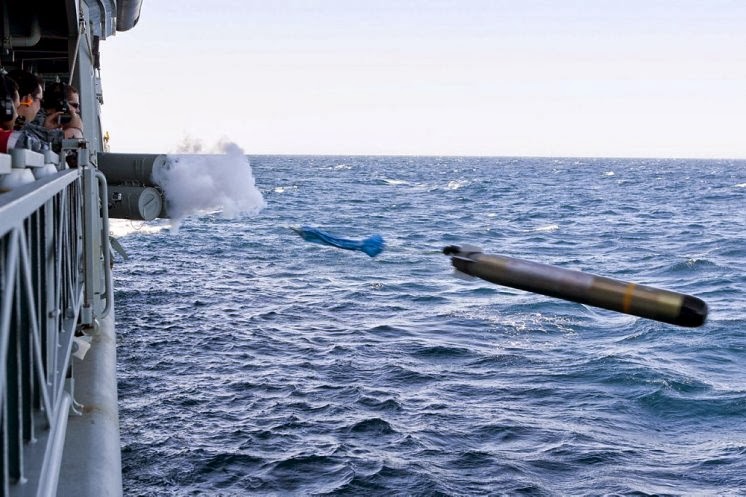
MU90 torpedo enters operational service with Royal Australian Navy *

The Thales-built MU90 lightweight torpedo has entered operational service with the Royal Australian Navy (RAN), following the completion of its final test firing.
During the testing, the MU90 torpedo has been test launched aboard the Australian Navy's Anzac-class ship, HMAS Stuart (FFH 153).
The MU90 lightweight torpedo programme involves the Djimindi Alliance, comprising the Defence Materiel Organisation, Thales Australia and EuroTorp, as well as the Royal Australian Navy and its RAN Test Evaluation Analysis Authority and the Defence Science and Technology Organisation (DSTO).
Thales Australia's CEO Chris Jenkins said MU90 would enhance the Royal Australian Navy's anti-submarine warfare capability.
"We are very pleased that the torpedo has now entered active service, and we look forward to working closely with the DMO and RAN to support the weapon over the coming years," Jenkins said.
"The MU90 is an advanced lightweight anti-submarine torpedo and that can detect and attack deep quiet-running submarines."
Developed by EuroTorp, a consortium between DCNS, Thales and Finmeccanica, Whitehead Alenia Sistemi Subacquei (WASS), the MU90 is an advanced lightweight anti-submarine torpedo and that can detect and attack deep quiet-running submarines.
Commenting on the testing carried out in August, the navy chief vice-admiral Ray Griggs earlier said the MU90 has demonstrated its full capability during the final test and evaluation event and has already completed an extensive test programme using exercise (non-explosive) variants.
Currently, the 3m-long MU90 anti-submarine warfare torpedo is operational with France, Italy, Germany, Denmark and Poland, providing enhanced performance and accuracy in shallow waters and in congested areas.
The DCNS-built MU90 torpedo uses advanced technology to strike any type of nuclear or conventional submarine, including acoustically coated, deep-diving, fast-evasive, deploying anti-torpedo effectors or bottomed in littoral areas.

* Notícia publicada a Naval Technology. La Reial Marina Australiana, amb una reputació d'eficàcia ben guanyada, continua amb el procés de modernització, tot acompassant una excel.lent formació amb bon material.

dimarts, 8 d’octubre del 2013

Blockading China: A Guide*


Earlier this year, a Chinese frigate locked weapon-targeting radar on a Japanese destroyer near the Senkaku Islands.  Both Japan and China lay territorial claims to these uninhabited islands, which are close to both Okinawa and Taiwan.  This is one of many territorial disputes that China has in the South and East China Seas.

Needless to say, there was no escalation in this particular instance: the Japanese destroyer did not respond, and the only volleys fired were of a diplomatic nature.  But what if things shake out differently next time? It is not hard to imagine such a scenario spinning out of control and leading to a shooting war.  What would the U.S. do if this led to a larger regional war?

Under this and many other scenarios, the U.S. would be obligated to defend its allies.  One way in which it might do this would be through a blockade of Chinese maritime traffic by U.S. forces, with the explicit support of nations that control key international straits, including Indonesia and Malaysia.  Though it would be costly and risky, a blockade could prove decisive.  T.X. Hammes and Sean Mirski contend that in the right circumstances, particularly a limited war of long duration, blockade could be a war winning strategy.

At the same time, however, a blockade would not be without its pitfalls. It would take a long time to enact. It would have to balance interdiction of oil imports against economic exports. And a blockading nation would also need to consider how to “hold the line” to prevent China from achieving its goal (in the above example, securing sea control of the Senkaku Island) while a blockade was taking effect.

Given its potential utility and also its possible downsides, decision makers and theater commanders must understand how a blockade of China would actually work and the precise conditions under which it holds promise.

What Should Be Blockaded?

When considering a blockade, the first question is: what commodity is to be targeted?  One obvious option is to target everything.  NWP 1-14, the Commander’s Handbook on the Law of Naval Operations, states that the belligerent right of blockade allows interdiction of all vessels and aircraft, regardless of cargo, crossing an exclusion zone.  Blockades established to starve a civilian populace are illegal, but a reasonable case could be made that China’s agricultural resources and medical capabilities can provide for the civil population even during a blockade.

But just because an option is legal, it is not necessarily wise. Total blockades, such as the Union blockade of the Confederacy or the German U-Boat campaign against Great Britain, are difficult and expensive. It is more efficient to target specific commodities.  For instance, during World War II, the United States used both the strategic air campaign in Europe and the submarine campaign in the Pacific to effectively target Germany’s and Japan’s oil infrastructures.  Such a strategy would prove effective in a long term conflict with China.

Indeed, much as it was for Nazi Germany and Imperial Japan, oil is China’s Achilles’ heel. Chinese domestic oil production supplies only 40% of peacetime consumption and demand continues to increase, even during periods of zero or negative growth in exports (see 2001 and 2009).  Another advantage of targeting oil is the ease of discrimination.  An oil tanker is a unique vessel, easing the blockaders’ burden when identifying and prioritizing targets.  Significant smuggling of oil in other types of ships is impractical.  In addition, China would have a hard time importing enough oil over land due to difficult terrain, underdeveloped pipelines and competition for Russian oil.

However, China recognizes its reliance on foreign oil and has taken steps to reduce its vulnerability to supply disruptions.  Specifically, China has established a robust strategic oil reserve.   China’s 2011 strategic oil reserve was sufficient to supply 100% of domestic consumption (factoring in domestic production) for 25 days without rationing.  Improvements to this reserve are planned to more than double its duration by 2020, even factoring in an increase in Chinese oil demand.
The effect of a war on China’s demand for oil must also be considered.  China uses oil mostly for transportation, so given that a war would reduce Chinese exports (it would not, after all, continue trading with the United States and Japan), the demand for oil to transport goods would go down.  Overland transport mitigates China’s reliance on maritime oil, even though it provides only a small share of China’s total need.  A blockader also must be wary of resale of neutral oil that is allowed past the blockade, requiring a strong coalition to surround China.  Rationing, while it would be unpopular with the Chinese people, would further reduce demand for oil.

China’s export income of $2 trillion would be hard hit simply by declaring such a blockade (in addition to the immediate loss of revenue from U.S. ports closing their doors to China).  This immediate loss to China could provide the catalyst to end hostilities, and if China made a poor transition to a wartime economy, a disgruntled middle class could cost the Chinese  Communist Party dearly, thus reducing the perceived value of a war.

Still, the Chinese economy has proven resilient in times of reduced trade by replacing export income with internal investment and stimulus.  If China determined that the war objectives were worth the loss of exports, effectively managed nationalism could,in the short term buoy popular will during the immediate economic hardship.  As enthusiasm for the war effort faded, governmental control over the economy could then be leveraged to spur domestic development for long term maintenance of the economy (investment in fixed capital contributes 75% more to China’s economy than exports and government stimulus could increase this more).

But because the shift to domestic development would still require oil, the operational emphasis of a blockade should be on stopping oil while interdicting targets of opportunity when practicable.  Periodically interdicting a container ship gives credence to the export blockade and drives away customers, while the main effort still focuses on compromising China’s oil situation.  After all, WWII submariners still sank troop ships; they just sank the tankers first.

How Should a Blockade Be Conducted?
An ideal blockade of China would use multiple layers, with each layer having a different purpose.  These layers should include (1) a distant conventional blockade focused on chokepoints of sea lines of communications to China; (2) a close, unconventional maritime engagement zone, and (3) diplomatic engagement to embargo points of embarkation.

The most critical part of the blockade is the first: control of key chokepoints using conventional forces.  The focal point of this blockade would be the Strait of Malacca and nearby archipelagic straits through Indonesia.  These locations derive the protection of international law and the UN Convention of the Law of the Sea, which states that that belligerents cannot operate in neutral waters.  Consequently, to make the blockade legal, the countries bordering the Strait of Malacca must explicitly support a blockade, becoming belligerents themselves.  While failing to gain Malaysia’s support would be a surmountable challenge – it might simply move the blockade 12 miles outside the straits into international waters –  Indonesia’s support will make or break a blockade.  Its archipelagic sea lanes (at least four basic routes) provide several corridors for blockade runners exploiting innocent passage.  Without Indonesian support, only a United Nations Security Council Resolution allows closure of these sea lanes, and China’s Security Council veto would never allow that.
Even setting legalities aside, a blockade of the Strait of Malacca would be a complicated undertaking. Given the vast quantity of traffic that transits these chokepoints—much of it bound for allied or neutral countries—traditional methods of visit and search are challenging.  Approximately 165 ships of all types transit the Strait of Malacca each day, of which 52 are oil tankers.  A blockader would need to investigate all appropriate ships, evaluate whether they were blockade runners, and seize those that were.  As many as thirteen warships would be required to enforce an oil blockade using traditional methods of visit and search .  This number does not allow for force protection, replacements for material failures or prize crews. Additional ships would have to guard other passages such as the Lombok/Makassar straits.  Increased insurance rates and risk-averse shippers would reduce that number of tankers destined for China; however, China’s large national fleet and other Chinese owned merchants would still sail, and China’s significant cash reserves could supplant traditional insurers.  As such, the operational commander would still need to dedicate a squadron of significant size to blockade, revealing a major opportunity cost.

It is possible to reduce this footprint if some measures are taken during peacetime (there is no time like the present).  Specific examples include development of procedures, relationships and technologies to establish a Navicert system for shipping and stand up land-based Visit, Board, Search and Seizure (VBSS) teams from the Coast Guard and land forces.  A Navicert process is a prescreening of traffic at the port of embarkation previously used by the British during their blockades of Germany, which could make blockade inspections more efficient.  Combining a Navicert process with an electronic system such as the Automatic Identification System (an automated data system installed on all ships 300 tons or larger that reports a wealth of information) increases the potential for success.  A commander can use land based VBSS teams augmented with drones, helicopters and small boats to supplement warships in critical chokepoints, allowing precious destroyers and cruisers to assist in other efforts.  These capabilities would be difficult to develop “on the fly” in wartime, so capabilities and relationships should be fostered now to improve their effectiveness at the onset of hostilities.

The teeth of the endeavor would be a close blockade using assets that can survive and strike in an anti-access, area denial (A2/AD) environment, which means that something like AirSea Battle might still be needed for a blockade to be effective and feasible).  The force commander could focus on Hong Kong, Shanghai and other major shipping hubs to begin with, while preparing to expand as China adapted.  This portion of the blockade would consist of submarines, mine warfare, and long range aircraft that would attack blockade runners that slipped through or around the chokepoints and entered a Maritime Exclusion Zone (MEZ) defined by the coalition.  The MEZ would not need to be 100% impregnable, but a sufficient volume of traffic would need to be sunk to create a deterrent effect on potential blockade runners.  Traditional concepts of establishment, notification, effectiveness, impartiality and limitations would still apply to provide a legal, internationally acceptable basis for this second tier of the blockade.

The third level of blockade would be diplomatic efforts to stop oil transport at the supply side, focusing on convincing nations to support an oil embargo of China.  China gets most of its oil from Iraq, Saudi Arabia, Iran, Russia, Oman, Angola, Sudan, and Kuwait. While many of China’s oil suppliers are antagonistic toward the United States, American allies such as Saudi Arabia who provide significant oil to China could be convinced to support a blockade.  As oil is a commodity, the United States would need to seek diplomatic support to find alternative customers for its allies (even to the extent of adding this Saudi oil to American strategic reserves).  Once some Chinese oil suppliers take their product off the market, nations not supporting an oil embargo of China would then be forced to create new facilities and infrastructure if they wished to supply a risky, temporary demand.

Overland Routes and Chinese Retaliation

While maritime blockade offers a strong possibility of success, Russia could decide to support China with oil over land routes.  However, Russia is limited in its ability to support China by their supply and other markets.  78% of Russia’s exported oil goes to stable, long term European markets.  Robbing these markets or overinvesting in production to support a massive surge in short term Chinese demand is not in the best interest of Russia’s oil oligarchs, even if it meant poking the United States in the eye.  Expanding infrastructure, specifically pipelines and railways, to support Chinese oil needs is also an expensive and time-consuming effort.  As such, Russia would have an uphill climb to validate such investment as part of their national interest.  Other overland routes need to be monitored for expansion, though unforgiving terrain, unfriendly nations and reliance on maritime transport reduce the efficacy of these alternate routes.

China  would have difficulty challenging a blockade through a major naval battle or convoy operations, due to its  limited capability to project sea control away from its home waters.  However, an operational commander must also consider China’s response, particularly the potential for asymmetric action.  Just like other naval operations, a blockade would rely on satellite coverage for communications and reconnaissance as well as digital data exchange to track blockade runners and operate a Navicert process.  This is all vulnerable to Chinese attacks with anti-satellite weapons and in cyberspace.  These actions may not be fatal to a blockade, but they would significantly increase the forces required and reduce capability to stop blockade runners.

While conducting this blockade, coalition forces must also prevent China from seizing disputed territory from allies such as the Senkaku Islands or Taiwan.  As stated earlier, continuing this fight would require operations in an A2/AD environment.  The United States also has to be prepared for a scenario where China achieves its objectives very quickly – say, seizing the Senkakus – and ceases combat operations.  Would  popular opinion and international consensus support excluding China after a quick and possibly bloodless seizure of some small islands?  At this point, a continued blockade would be seen as purely punitive, and international and domestic economic interests would pressure the United States to back down.

Conclusion

There is no way to fight an easy war against China.  China’s geographic advantages, niche military capabilities, economic interdependence and nationalistic populace will make any war costly, regardless of the strategy.  A blockade uniquely negates many of China’s strengths and capitalizes on its weaknesses, but China still retains many options to continue to fight and achieve its objectives. And a blockade would require significant military resources, time, and commitments from allies.
In addition, the United States cannot simply step outside China’s A2/AD’s range and blockade from a safe distance.  If China chose to continue the war despite initial economic repercussions, the United States would be forced to enter the A2/AD environment, both to establish an effective close blockade and to challenge China at decisive points to keep allies in the fight.  AirSea Battle may provide a solution to this, or another construct may need to be developed, but the United States still needs to understand how to operate in almost any environment should the military be called to.

Regardless, the problem of blockade is less of military feasibility and more of political will and economic sacrifice.  The interests of the United States may be best served by economic and diplomatic engagement with China; however, uncertain times and irreconcilable interests could still provoke a war that the United States needs a strategy for.  As such, the United States should not take any strategy off the table, particularly blockade.

Jason Glab has served eleven years as a submarine officer, conducting a Western Pacific deployment, two SSGN missions and two deterrence patrols.  He has also served as a naval analyst at the Defense Intelligence Agency and is currently studying at the Naval War College.

* Article publicat a War on the Rocks. Interessant anàlisi sobre les formes de bloqueig en cas d'un conflicte amb la Xina.

dimecres, 2 d’octubre del 2013

Catalunya marítima. Crònica en blanc i negre, 1880-1980(20/09/2013 - 31/12/2013)*

El Museu Marítim de Barcelona exposa a les Grans Naus dues mostres que pertanyen a la sèrie Catalunya Marítima, crònica en blanc i negre (1880 – 1980), amb imatges que pertanyen al fons del mateix museu així com també al Port de Barcelona. Les exposicions que ara us presentem són Els treballs portuaris i Els barris mariners, que després d’itinerar durant anys per diversos llocs de la costa catalana, han tornat a les Grans Naus de les Drassanes Reials per mostrar-vos vida quotidiana dels barris de pescadors, els edificis, les activitats i els treballs al port. Els treballs portuaris: La història dels ports és paral·lela a la història de la navegació i al desenvolupament del comerç marítim. En un començament, quan la navegació era a vela, les barques buscaven refugi en cales o platges arrecerades dels forts vents i corrents. Les operacions de càrrega i descàrrega es realitzaven, amb freqüència, utilitzant barcasses que transportaven la mercaderia des de la platja al veler fondejat en la badia. En aquests ports naturals era freqüent que les obres realitzades tan sols es limitessin a la construcció d’un moll per atracar les barques i a d’altres petites millores. Amb la incorporació del motor i el desenvolupament del ferrocarril i el transport terrestre, es va accelerar el ritme general dels transports i van evolucionar les infrastructures portuàries. Els vaixells, amb un calat i tonatge cada vegada més grans, tindrien unes bodegues de gran capacitat que permetrien multiplicar el volum de les mercaderies. Per a facilitar les operacions d’estiba es van haver d’ampliar i construir nous molls i es van haver d’adaptar extenses esplanades pel dipòsit i manipulació ràpida de les mercaderies. Aquesta evolució en la fisonomia dels ports va provocar i segueix provocant transformacions en els treballs que s’hi desenvolupen. A començaments del segle XX, a Barcelona es va crear un col·lectiu d’obrers especialitzat en la construcció i ampliació de molls i dics. De les canteres de Garraf extreien l’escullera per la construcció del Dic de l’Est. Un altre col·lectiu rellevant és el dels estibadors el qual, durant segles, s’ha especialitzat en la dura tasca de la càrrega i descàrrega dels vaixells. I un altre ofici a destacar és el de pràctic de port, representat per un professional amb un bon coneixement de l’àrea portuària, doncs la seva missió és la de donar servei en l’entrada, sortida i moviments dels vaixells. De fet, la llista de treballs portuaris seria molt llarga donada la gran quantitat de serveis que, durant segles, han ofert els ports: reparació de vaixells, construcció naval, pesca, empreses dedicades al tràfic comercial, desballestament de vaixells, subministraments, etc. Una llista que es va innovant amb la potenciació d’activitats ja existents, i de llocs de treball de nova creació. Els barris mariners: L’evolució de la fisonomia del litoral sempre ha estat supeditada a l’economia dels seus habitants. Ja a començaments del segle XX, aquests subsistiren gràcies als recursos que tenien al seu abast com la pesca, el conreu de la terra, la construcció naval o el comerç. La fotografia en blanc i negre n’és testimoni i en podem gaudir de les belles imatges del passat. Les dècades dels anys 1950 i 1960 resultaren determinants en la configuració de l’espai costaner: la irrupció del fenomen del turisme de masses i del boom en la construcció afectà de manera profunda les formes de vida d’aquelles poblacions i produí uns greus desajustaments urbanístics i ambientals, sense tenir cap mena de consideració amb els valors naturals i les característiques singulars del paisatge costaner. Aquesta ocupació massiva de la façana marítima implicà, inevitablement, la reconversió del pagès o pescador a comerciant o assalariat de l’activitat generada pel sector terciari. Aquest nou segle, tot just encetat, ens proposa nous reptes. La incipient sensibilitat i germinació de nous valors en la nostra mentalitat aposta per un turisme que hauria de ser un dels elements de pes que impulsi noves polítiques de conservació i difusió del patrimoni natural i cultural. El turisme s’està convertint en una activitat econòmica més sostenible, que ha de buscar noves formes d’explotació del paisatge natural. L’exposició pretén il·lustrar la transformació de les façanes marítimes de les poblacions costaneres catalanes, fent un recorregut des de les costes de llevant fins a les comarques de Tarragona. Imatges característiques de les comunitats litorals, platges amb barques a la sorra, habitatges de pescadors i mariners, omplen aquestes imatges en blanc i negre, que reflecteixen un paisatge litoral avui gairebé desaparegut. Igualment, pretén una modesta reflexió sobre la importància del paisatge com a creació cultural vinculada al patrimoni cultural marítim i, en conseqüència, com un valor a salvaguardar per tal de transmetre’l a les generacions futures.

* Blau Naval recomana la visita d'aquesta interessant exposició.